Woven Wire or Self-Cleaning Mining Screen Mesh: Which Reduces Blinding?
Blinding is one of the fastest ways for a screening circuit to lose effective capacity. Once fine, damp, flaky, or clay-bearing material begins to bridge the apertures, the screen may still be vibrating normally while the usable open area keeps shrinking. Operators then see more carryover, unstable gradation, recirculating load, and frequent cleaning stops.
For most dry, clean, and relatively uniform feed, conventional woven wire remains a practical choice. It is usually the better option when aperture accuracy, wear resistance, and predictable separation are more important than anti-blinding performance. Self-cleaning mesh becomes the stronger choice when the material repeatedly plugs a standard panel and the lost production time costs more than the mesh premium.
The choice is therefore less about which Mining Screen Mesh is universally superior and more about why the apertures are closing in a specific deck position.
Why woven wire blinds in difficult feed
Woven wire uses straight, fixed wires arranged in square, rectangular, or slotted openings. That stable structure is its main advantage: the opening shape stays consistent, the panel supports accurate sizing, and heavy-duty wire can tolerate abrasive aggregate for a reasonable service interval.
Its limitation appears when material is close to the aperture size or carries moisture and fines. A near-size particle can wedge between the wires. Damp crusher dust, weathered fines, clay coatings, and elongated particles can then build around the lodged particle. What began as a few blocked openings can spread across a section of the screen deck.
Woven wire is especially likely to blind when several conditions occur together:
- The feed contains a high proportion of particles close to the target cut size.
- Moisture makes fines adhere to larger particles or to the wire surface.
- Clay, shale, decomposed rock, or sticky manufactured-sand fines are present.
- The screen is operating with insufficient stroke, poor material distribution, or excessive bed depth.
- The selected aperture is too small for the moisture condition and particle shape.
This does not mean the mesh itself is always at fault. A blocked woven wire panel can reveal an upstream issue, such as excessive crusher fines, poor washing, unsuitable feed moisture, or a screen running outside its intended operating range. Replacing the media without checking those conditions may only move the problem to the next panel.
How self-cleaning mesh changes the screening action
Self-cleaning mesh uses crimped wires, independently moving wires, polyurethane strips, or flexible cross-wire arrangements to create motion between individual strands. As the screen vibrates, the wires move relative to one another. That movement helps dislodge particles before they become firmly wedged in an opening.
The benefit is most visible with difficult-to-screen material: damp crushed stone, topsoil-contaminated aggregate, weathered ore, recycled material with variable fines, and feed containing a large near-size fraction. In these applications, keeping more apertures open through the shift can improve effective screening area even when the nominal aperture is similar to a woven wire panel.
Self-cleaning mesh reduces blinding; it does not eliminate the causes of blinding. If material is heavily coated in plastic clay, saturated with water, or delivered to the deck in an excessively deep bed, flexible wire action alone may not maintain a clean cut. Operators may still need to adjust feed rate, deck slope, vibration settings, spray water, or upstream material preparation.
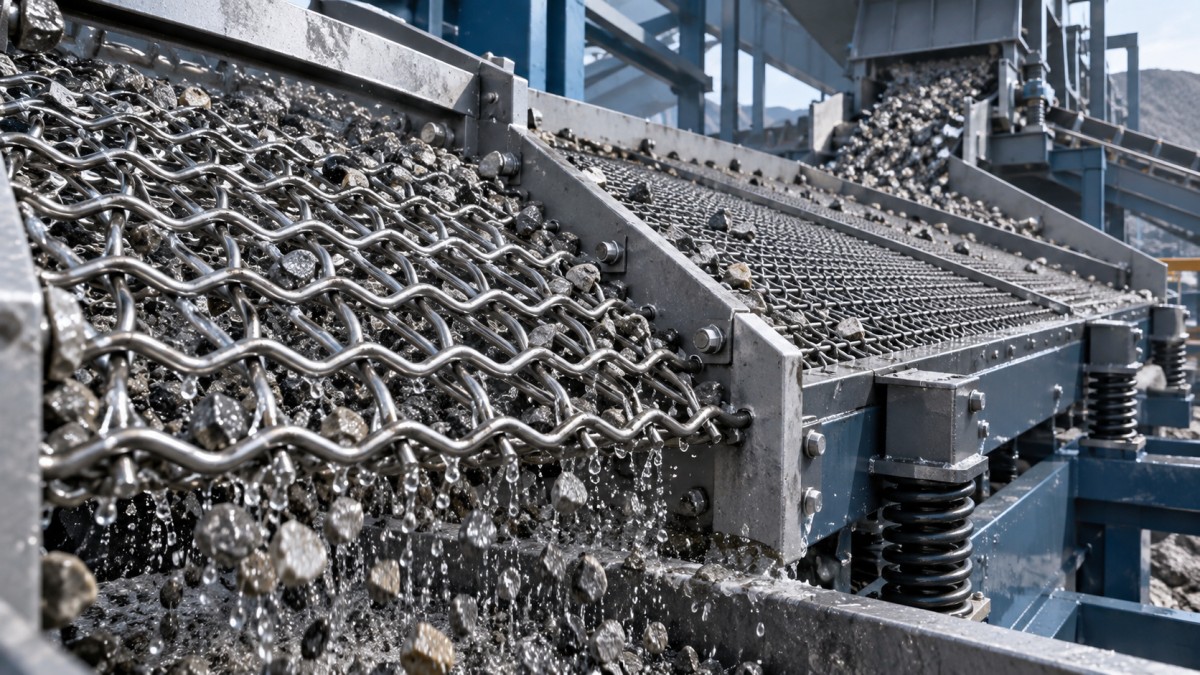
The trade-off is that self-cleaning designs are generally less rigid than conventional woven wire. Their effective opening can vary slightly during operation, and the flexible elements can wear differently from fixed-wire cloth. On applications requiring a very tight, repeatable separation, particularly in dry and clean feed, the anti-blinding advantage may not justify that compromise.
Choose by material behavior, not by the name of the mesh
A useful starting point is to inspect the blocked panel before ordering replacement media. The pattern of blockage says more than a general description such as “wet material.” If individual stones are tightly wedged in the apertures, near-size blinding is the primary issue and self-cleaning wire is a credible option. If the openings are coated with sticky fines, the plant may need a combination of flexible media and better moisture or clay control. If the wire is heavily worn, broken, or distorted, abrasion and impact may be the leading concern instead.
Do not compare panel price alone
A self-cleaning panel can cost more than a standard woven wire panel, and it may not always deliver the same wear life in highly abrasive material. That makes unit price a poor basis for the decision. The more useful comparison is cost per tonne of correctly screened product, including cleaning labor, downtime, lost throughput, off-spec material, and replacement frequency.
For example, a panel with a shorter physical life may still be economical if it avoids repeated shutdowns during wet feed periods. Conversely, fitting self-cleaning mesh to a dry, clean circuit that rarely blinds can add operating cost without improving production. The answer can also differ between decks on the same screen. A top deck may need robust woven wire for impact resistance, while a lower deck handling finer, wetter near-size material may benefit from a self-cleaning design.
Screen media should also be considered alongside crusher settings. A crusher that produces an excessive near-size fraction can make a downstream screen appear undersized or poorly equipped. When evaluating an equipment change such as an OEM Energy Efficient Cone Crusher Reducing Power Consumption For Large Aggregate Processing Plant Machine, assess the resulting particle shape and gradation as well as power demand. A more controlled crusher discharge can reduce the conditions that cause pegging on the final screen deck.
What operators should check before changing mesh
Before moving from woven wire to self-cleaning media, record where and when blinding occurs. Does it begin after rain, during a particular material source, at a specific feed rate, or only on one deck? Check whether the panel is truly blinding, whether material is bypassing due to poor distribution, or whether the screen is overloaded.
- Measure the feed moisture and note whether it changes during the operating day.
- Examine blocked apertures for wedged stones, clay coating, or accumulated fines.
- Check screen stroke, speed, angle, and condition against the machine setup requirements.
- Confirm that feed lands evenly across the deck rather than concentrating in one zone.
- Review bed depth and feed rate before reducing aperture size or changing wire type.
- Specify aperture shape, wire diameter, hook style, panel dimensions, and deck position when requesting mesh.
For a trial, place the self-cleaning mesh on the deck and zone where blinding is most severe rather than converting every panel at once. Compare open-area condition during the same material run, along with throughput, product cleanliness, panel wear, and cleaning time. This gives a clearer decision than judging the media after a change in weather, feed source, or crusher setting.
Woven wire is still the right answer for many aggregate and mining screens. Self-cleaning mesh earns its place where blinding is repeatedly limiting usable deck area. The best selection follows the blockage mechanism: fixed wire for stable, clean sizing; flexible anti-blinding media when near-size or damp material keeps closing the openings; and process adjustments when the feed itself is beyond what any screen panel can correct.
Leave A Message
If you are interested in our products and want to know more details, please leave a message here, we will reply you as soon as we can.