What causes rubber screen mesh to tear around its fasteners?
Rubber screen mesh usually tears around fasteners when movement or load is concentrated at the edge of a mounting hole. Excessive clamping, insufficient support, hole misalignment and repeated screen vibration can each start a crack. Abrasion and rubber degradation can then accelerate its growth.
The position and direction of the tear provide useful clues, but they do not identify the cause on their own. A bolt that appears loose after failure, for example, may have lost clamping force because the rubber compressed or the support underneath moved. Replacing the mesh without checking those conditions can leave the new panel exposed to the same damage.
How fasteners create a tear
A mounting hole interrupts the rubber and concentrates stress around its edge. As the screen moves and material loads the deck, the rubber near that hole is repeatedly stretched, compressed or sheared. Damage begins more readily when the load is carried by a small area rather than distributed through the intended clamping arrangement.
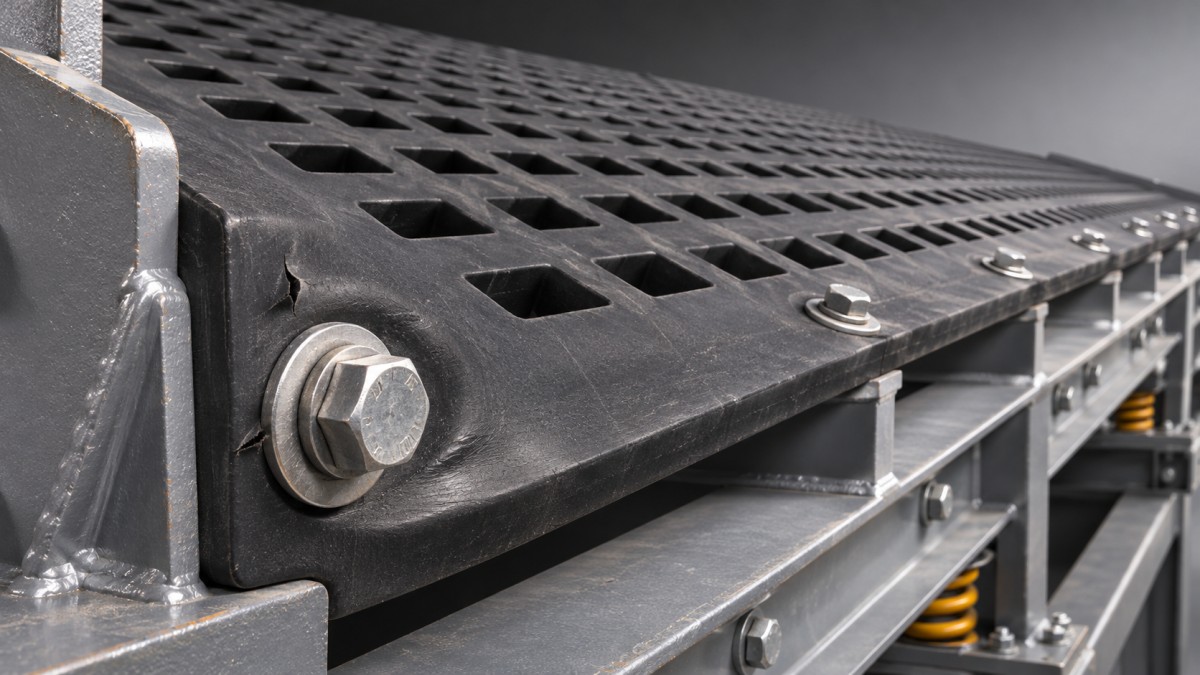
Excessive bolt tightening can crush the rubber beneath a washer or clamp plate. A sharp washer edge, an undersized contact area or a distorted plate increases local pressure further. Cracks may begin at the hole or at the outer edge of the compressed contact area. Tightening beyond the mesh or screen manufacturer’s specification is therefore not a reliable way to stop movement.
Insufficient clamping creates a different mechanism. If the panel slips against its support during each vibration cycle, the bolt can bear repeatedly against one side of the hole. The opening may become elongated in the direction of movement, with polished rubber or fretting marks on the mating metal. Loose hardware can be a cause of this motion, but compression set in the rubber, an uneven support surface or an unsuitable clamping arrangement can also reduce the effective clamping force.
Why installation and support matter
Misaligned mounting holes can put the mesh under tension before the screen starts. Pulling a panel into position or forcing bolts through offset holes leaves a permanent load at one side of each affected hole. Under vibration, that preloaded area sees additional cyclic strain. Hole spacing, panel orientation and frame alignment should therefore be checked with the panel relaxed, not only after the fasteners are installed.
Support beneath the mesh is just as important as the hardware above it. If an edge or mounting rail is uneven, missing, worn or obstructed by trapped material, tightening the bolt can bend the rubber across a gap. A panel that flexes over an unsupported edge will concentrate strain near the nearest attachment points. Witness marks, uneven compression and gaps beneath the panel can help locate this condition.
Check the complete interface rather than assuming that a larger washer alone will solve the problem. A clamp plate may distribute load more effectively in a design that calls for one, but its dimensions, edge finish and compatibility with the deck must follow the screen assembly’s requirements. Substituting hardware without checking clearance and load distribution can introduce another stress point.
Operating conditions that accelerate damage
Vibration is necessary for screening, but the mesh and its attachments must be compatible with the machine’s operating motion. Changes in stroke, speed or vibration direction can alter the forces at the fasteners. Uneven motion caused by a mechanical fault, or an operating condition outside the screen manufacturer’s specified range, can increase panel movement and fatigue loading. The presence of a tear alone does not prove that vibration settings are incorrect; it is a reason to compare measured operation with the machine’s requirements.
Material loading matters too. A concentrated feed stream, a deep bed or large impacts near a panel edge can cause local deflection. Blinding or material buildup may change the load on part of the deck, while abrasive fines trapped between the rubber and its support can wear away the contact surface. A torn hole accompanied by thinning or polished tracks suggests that abrasion or sliding should be investigated alongside fastener tension.
Upstream crushing affects the material presented to a screen, so changes in feed size distribution or impact loading deserve attention when diagnosing a new failure pattern. The FEIFAN Modular Design Hydraulic Cone Crusher Convenient For Disassembly Transport And Installation Work Machine is an example of upstream equipment in an aggregate circuit; its presence does not, by itself, establish the cause of screen damage.
Rubber condition can also change the failure mechanism. Heat, chemicals, sunlight or incompatible process fluids may alter its properties, depending on the compound and exposure. Hardening, cracking away from the bolts or unusual swelling makes degradation worth investigating. Compare damaged and protected areas, and review the material specification against the actual operating environment before attributing failure solely to installation.
Use the damage pattern to narrow the cause
Before removing the panel, isolate and secure the machine in accordance with site procedures. Record the location of damaged fasteners, the orientation of tears and the condition of adjacent supports. Photographs taken before disassembly can preserve evidence of movement or uneven clamping that disappears once bolts are removed.
- Elongated holes and shiny contact surfaces: investigate panel slip, inadequate clamping and movement between the mesh and support.
- Cracks around a deeply compressed washer or clamp edge: check tightening practice, contact area, hardware condition and local support.
- Tears concentrated along one edge or at matching positions on several panels: check hole alignment, rail condition, support height and local loading.
- Broad rubber cracking or a change in hardness or flexibility: assess environmental exposure and compound suitability as well as mechanical loading.
These patterns can overlap. A misaligned panel, for example, may slip after the rubber relaxes, leaving both a directional tear and evidence of fretting. Compare failed and undamaged attachment points on the same deck, then inspect fastener condition, support flatness and panel fit before selecting a corrective action.
After replacing damaged components, install the mesh using the specified hardware, tightening sequence and torque or other clamping instructions supplied for that assembly. Recheck the installation at the interval prescribed by the manufacturer and monitor whether new witness marks or hole distortion appear. A repair is more convincing when the suspected source of movement or stress has been removed, not merely when a new panel has been fitted.
Leave A Message
If you are interested in our products and want to know more details, please leave a message here, we will reply you as soon as we can.