Woven Wire Mesh vs Polyurethane Panels for High-Throughput Quarry Screens
Woven Wire Mesh vs Polyurethane Panels for High-Throughput Quarry Screens
For high-throughput quarry screens, selecting between woven wire mesh and polyurethane panels directly affects production capacity, screening accuracy, maintenance frequency, and total operating cost. The decision is rarely as simple as choosing the media with the longest service life. A screen deck is part of a larger process: feed condition, crusher setting, vibration characteristics, desired gradation, water content, and replacement access all influence the result.
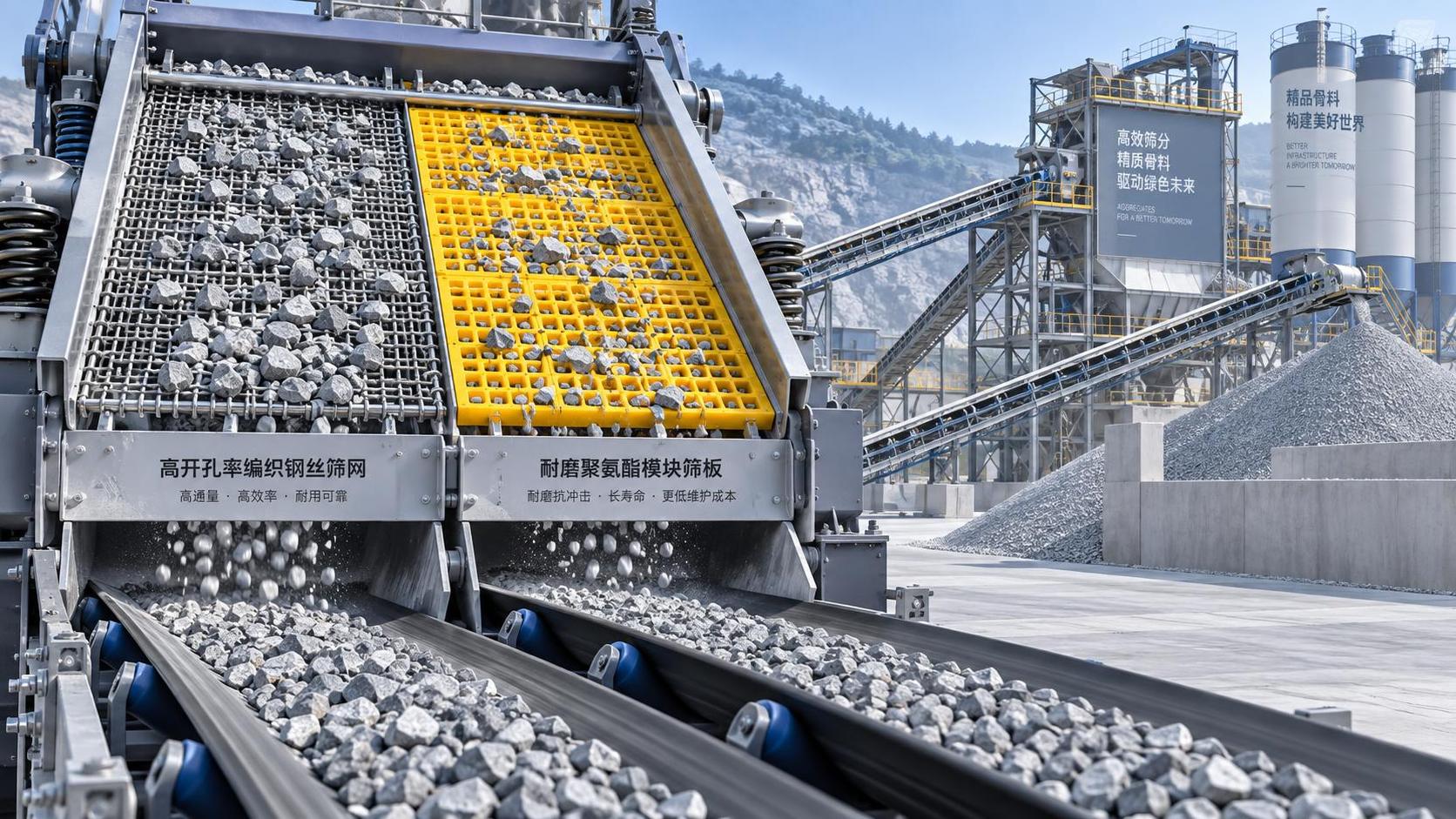
In aggregate operations, woven Wire mesh is often the practical answer where open area and high tonnage are the priority. Polyurethane panels are frequently preferred where abrasive material, damp feed, and repeated maintenance stops are driving cost upward. Both can perform well, but using the wrong media on the wrong deck can create a bottleneck that is easily mistaken for a crusher or screen-machine problem.
The Core Trade-Off: Open Area Against Wear Life
Woven wire mesh generally provides more open area than modular polyurethane screening media with a comparable aperture. More open area gives material more opportunities to pass through the deck during each vibration cycle. On a high-capacity primary or secondary screening deck, this advantage can be decisive, particularly when the feed is relatively dry, free-flowing, and not excessively abrasive.
Polyurethane panels normally have thicker structural sections around each opening. That lowers open area, but the material resists abrasion well and can reduce the frequency of media replacement in difficult applications. For highly abrasive crushed stone, sharp manufactured sand, or wet material that quickly wears conventional steel wire, the reduced downtime may outweigh the loss in theoretical screening area.
This is why purchase price alone is a poor comparison. A low-cost wire screen that requires frequent shutdowns may cost more over a season than a more expensive polyurethane panel. Conversely, specifying polyurethane everywhere can unnecessarily restrict throughput and raise the initial cost of a large screen deck.
Where Woven Wire Mesh Usually Makes Economic Sense
A properly specified wire mesh remains one of the most productive screening surfaces available. It is especially suitable for top decks and intermediate decks where material has sufficient particle size, the goal is to remove oversize efficiently, and the screen must process a large volume without becoming a restriction.
The purchase specification should go beyond aperture size. Wire diameter changes the balance between strength and open area. Crimp style affects stability and aperture retention. The screen’s hook type, panel dimensions, tensioning method, and support-bar spacing also need to match the existing vibrating screen. A mesh that fits nominally but cannot be tensioned correctly may flex excessively, fail at the edges, or produce inconsistent separation.
For quarry managers, a common error is replacing a worn mesh with a thicker wire simply to extend wear life. That may be reasonable, but it also reduces open area. If the machine was already near capacity, the resulting loss in passage can lower output or increase carryover. The better question is whether the operating cost comes from mesh wear alone, or from impact loading, incorrect feed distribution, damaged support bars, and unsuitable screen angle.
When Polyurethane Panels Justify Their Higher Initial Cost
Polyurethane panels are often selected for lower decks, wet screening circuits, and applications with high abrasion. Their resilience can help absorb repeated particle impact, while modular layouts allow maintenance teams to replace worn sections rather than an entire deck. This can be particularly useful where shutdown windows are limited or access around the screen is difficult.
However, polyurethane is not automatically the answer to blinding or pegging. Its performance depends on aperture design, panel profile, material moisture, particle shape, and the amplitude and frequency of the screen. Fine, flat, or near-size particles can still block openings. If blinding is persistent, the solution may involve changing the screening method, using self-cleaning wire media in an appropriate zone, improving feed preparation, or reconsidering the cut point.
Panel fastening should also be reviewed before procurement. Modular polyurethane systems are not universally interchangeable. The supplier needs the deck layout, rail or fastening arrangement, screen dimensions, aperture requirement, and intended installation location. Ordering by aperture alone is a frequent source of avoidable delays.
Think in Deck Zones, Not One Material for the Entire Screen
Many efficient quarry installations use a mixed-media strategy. A high-open-area woven wire mesh can serve the portion of the deck where rapid stratification and throughput matter most. Polyurethane panels can then be installed in high-wear impact zones, around feed areas, or on lower decks where service life has greater financial value than maximum open area.
This approach requires a full process view. Feed material produced by a VSI may have a different particle shape and fines profile from material leaving a jaw or cone crusher. When a plant is processing mixed stone into manufactured sand, changes upstream can alter the screening load downstream. Equipment such as the FEIFAN High Efficiency Dual Crushing Modes VSI-7000 With Wear Resistant Liner And Vibration Monitor For Mixed Stone Sand Making VSI Crusher should therefore be assessed not only for crushing performance, but also for how its output distribution interacts with the screen deck and final product requirements.
What to Request Before Comparing Supplier Quotations
A meaningful quotation comparison needs more than a price per panel or price per square meter. Provide the supplier with the screen make or deck drawing where available, deck length and width, opening size, feed material, estimated feed size range, moisture condition, and the position of each deck. It is also useful to identify whether failure occurs through wire breakage, edge cracking, panel damage, blinding, pegging, or poor screening efficiency.
Ask for the actual media construction: wire diameter and crimp pattern for woven mesh; panel dimensions, aperture profile, fastening design, and intended support arrangement for polyurethane. Confirm replacement lead time, packing method for export, and whether spare media can be supplied in a phased order. For remote projects, the availability of the correct replacement parts can matter more than a small initial price difference.
A Practical Cost Decision for Quarry Projects
The right choice is the one that delivers the required product gradation at the lowest realistic operating cost, not the lowest invoice value. Woven wire mesh is usually compelling when capacity and open area dominate. Polyurethane panels become more compelling when abrasive wear, difficult access, and replacement downtime dominate. Mixed decks are often worth evaluating when different areas of the screen experience different loading conditions.
For projects requiring both screening media and broader plant coordination, an integrated manufacturing perspective can reduce mismatches between equipment and consumables. Founded in 2009 in Binzhou, Shandong, the FEIFAN group combines screen-media production through Binzhou Feifan Wire Mesh Co., Ltd. with crushers, vibrating screens, conveyors, and aggregate-line equipment from Shandong Feifan Mining Machinery Co., Ltd. Its engineering and export operations can support projects that need to align screen media specifications with a complete processing line rather than treat them as separate purchases.
Before placing an order, review the current deck condition, confirm the real source of media wear, and calculate the cost of lost production during changeouts. Those three checks usually make the woven wire mesh versus polyurethane panel decision much clearer.
Leave A Message
If you are interested in our products and want to know more details, please leave a message here, we will reply you as soon as we can.