Where Crushing Plant Bottlenecks Occur and How to Restore Stable Production

A crushing circuit can lose stable output well before any major machine fails. The warning signs are usually familiar: the primary crusher appears to have spare capacity, yet the final tonnage falls; one conveyor runs full while the next one starves; circulating load rises; finished product gradation drifts; or operators spend more time clearing chutes and adjusting settings.
In a Complete Crushing Plant, the bottleneck is rarely identified by looking at the nameplate capacity of one machine. Production is governed by the narrowest point in the material flow, and that restriction can move during a shift as feed size, moisture, wear condition, screen efficiency, and crusher load change. Restoring stability starts with finding where material stops moving smoothly, not simply increasing the setting or speed of the crusher that appears busiest.
Start with the flow pattern, not the equipment list
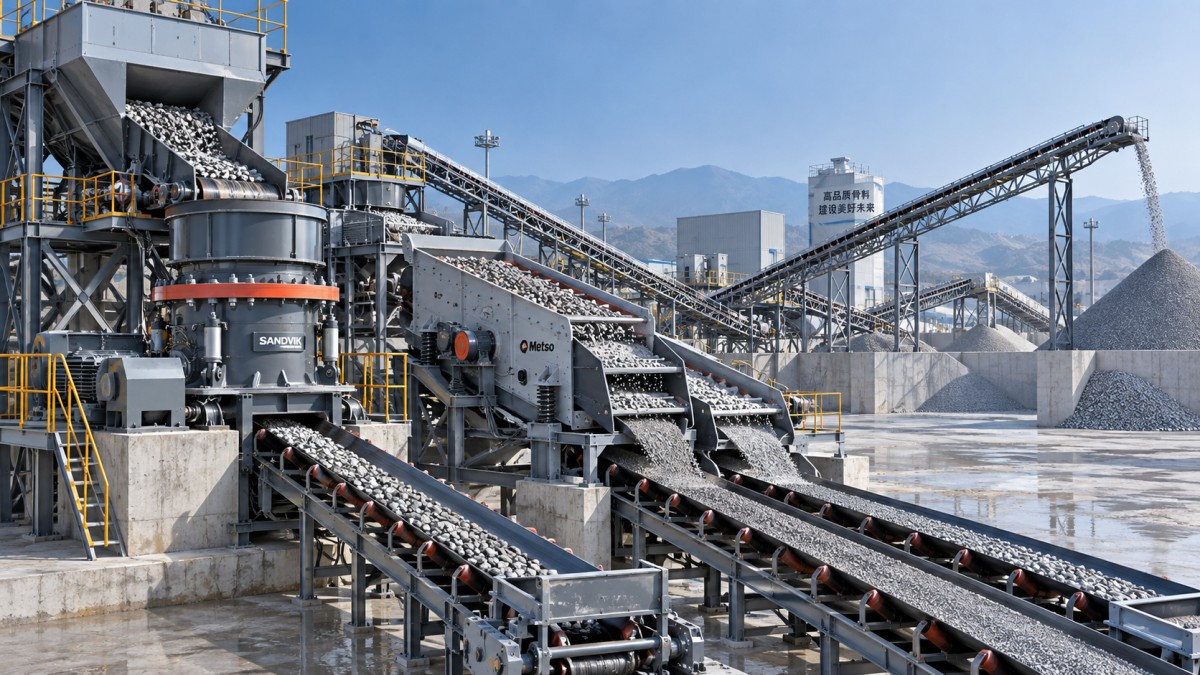
A plant should be assessed as a connected system: feed preparation, primary reduction, transfer, screening, secondary or tertiary crushing, and finished-product handling. A limitation in any upstream stage changes the conditions seen downstream. For example, a vibrating feeder that delivers material in pulses can make a crusher alternately choke and run empty. The crusher may then produce inconsistent particle shape and a variable load on the screen, even though its mechanical condition is acceptable.
The most useful first check is to follow one material stream from the feed hopper to the finished stockpile during normal production. Record where the material accumulates, where belt loading becomes uneven, where recirculating material increases, and where operators intervene repeatedly. A restriction is often visible as one of three conditions:
- Material backs up before a machine or transfer point.
- A downstream machine is consistently underfed despite adequate upstream material.
- One circuit section repeatedly surges between overload and low load.
These patterns matter more than a short-term peak tonnage reading. A plant that reaches a high instantaneous rate but requires repeated stoppages is generally producing less useful output than a line running at a slightly lower, balanced rate.
Uncontrolled feed is often the first bottleneck
Feeders are sometimes treated as simple delivery equipment, but they set the operating condition for the rest of the line. Oversize boulders, excessive fines, wet clay, and uneven hopper drawdown can all make feed flow unstable. When large material bridges in the hopper and then releases suddenly, the primary crusher receives a surge. When fines and wet material build on feeder surfaces, the opposite problem can occur: the crusher is starved even though there is material available above it.
Before changing crusher settings, operators should inspect whether the feed is distributed across the full receiving width and whether the feed rate changes sharply over time. Material should enter the crusher in a controlled, continuous stream appropriate for the chamber. A crusher fed intermittently cannot maintain a consistent reduction ratio or product curve.
Feed preparation also affects screen performance later in the circuit. If excessive fines or sticky material bypass the intended separation process, screen decks can blind and the circulating load can rise quickly. This is why increasing feeder speed is not always a production solution. It may only move the restriction into the crusher, screen, or transfer chute.
Screening losses are easy to misdiagnose
When final output declines, attention often goes directly to the crusher. In many aggregate circuits, however, the screen is the actual constraint. Worn, stretched, blocked, or incorrectly selected screen media changes the cut point and reduces open area. The result may be too much undersize carried into the crushing stage, too much correctly sized material returned for re-crushing, or an off-spec final product.
Screen problems usually show up through changing material distribution rather than a complete stoppage. Operators may see a growing return belt load, more flat or elongated material in a product pile, or material carrying over a deck that previously separated efficiently.
Inspection should cover more than visible damage. Check for:
- Blinding or pegging caused by moisture, clay, or near-size particles.
- Uneven feed across the deck, which leaves part of the screen overloaded and part underused.
- Loose panels, worn support rails, and damaged side tensioning.
- Incorrect stroke, angle, or vibration condition for the material being processed.
- Screen aperture selection that no longer matches the required finished-product specification.
Replacing media without correcting poor feed distribution may provide only a brief improvement. Similarly, adding a finer aperture can reduce carryover but may lower throughput if the screen does not have enough effective area for the feed condition. The practical decision is based on the material’s moisture and gradation, the desired separation point, and the volume that must pass through each deck.
Transfer points and conveyors can quietly cap plant output
Conveyors are often assumed to have ample capacity until a chute blocks or a belt begins carrying an uneven burden. Yet transfer points frequently create restrictions because material trajectory changes after crusher wear, belt speed adjustment, or screen modification. A chute designed for a predictable stream may clog when fines increase, when material becomes wetter, or when a different crusher product enters it.
Look for spillages concentrated on one side of the belt, material striking the chute wall before settling, buildup in dead zones, and a belt that runs heavily loaded in sections but lightly loaded elsewhere. These conditions are not only housekeeping issues. They reduce effective conveying capacity, accelerate belt and liner wear, and create intermittent starvation downstream.
A conveyor should be checked as part of the circuit capacity calculation. Its usable throughput depends on belt width, speed, loading profile, incline, material bulk density, and the condition of the transfer points. Raising belt speed can help only when loading and discharge remain controlled. If the receiving chute is already near its practical limit, higher speed can increase carryback and blockage risk.
Crusher settings must match the circuit, not just the target size
Secondary and tertiary crushers often become unstable when their closed-side setting, chamber selection, feed condition, and recirculating load are no longer aligned. A tighter setting may produce more fines and improve one product fraction, but it can also increase power draw, reduce throughput, and overload the screen. A wider setting may relieve crusher load while sending too much oversize forward, shifting pressure to the next stage.
Stable cone crushing generally depends on even, continuous feed and a chamber kept adequately loaded. Operators should compare the crusher feed size distribution with the chamber’s intended reduction range, then review the return load from the screen. If the return conveyor is carrying too much material, the issue may be poor screening, an unsuitable setting, worn liners, or an upstream change in feed gradation. Treating all return load as a crusher-capacity problem can lead to the wrong adjustment.
For plants that need tighter control of final particle shape, rotational speed can be another operating variable, provided it is adjusted within the equipment’s permitted range and in coordination with feed rate and setting. An OEM Adjustable Rotating Speed Cone Crusher To Control Final Stone Particle Shape Precisely Crusher can be considered where the circuit requires this level of control, but speed adjustment should not be used to compensate for an overloaded screen, poor feed distribution, or unstable return flow.
Restore production in a controlled order
When output drops, changing several variables at once makes diagnosis harder. A more reliable approach is to stabilize the plant section by section. First, establish consistent feed from the hopper and feeder. Then confirm that transfer points are clear and conveyors are running with even loading. Review screen performance before making major crusher changes, because screen inefficiency often creates the recirculating load that makes a crusher appear undersized.
Once flow is stable, adjust crusher settings in small steps and observe the effect on power draw, return material, screen loading, and final gradation. The best operating point is seldom the maximum feed rate at one machine. It is the point where every major stage can process a predictable material stream without chronic accumulation, starvation, or excessive recirculation.
Wear should be included in this routine rather than handled only after output has fallen sharply. Liners, screen media, chute liners, idlers, and belt tracking all affect how material moves through the plant. Production instability is often the first operational signal that one of these conditions has changed enough to alter the balance of the circuit.
A stable crushing line is built through balance: controlled feed, effective separation, clear transfers, matched conveyor capacity, and crusher settings that suit the actual material stream. When operators trace the bottleneck through that sequence, they can restore output with fewer reactive adjustments and avoid moving the problem from one stage of the plant to another.
Leave A Message
If you are interested in our products and want to know more details, please leave a message here, we will reply you as soon as we can.