When does a banana screen suit a high-throughput quarry?
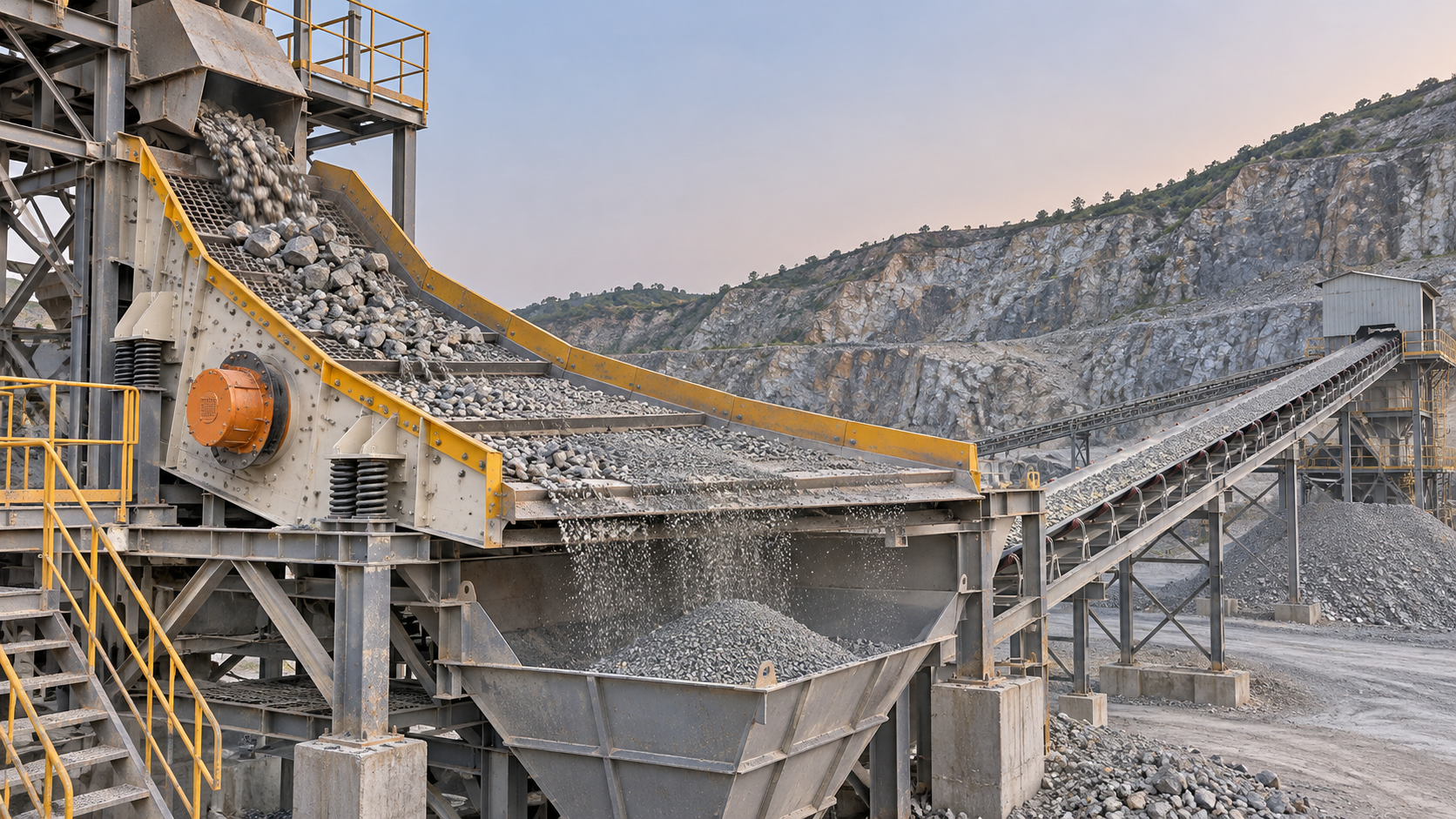
A banana screen is a strong candidate for a high-throughput quarry when the feed contains a substantial proportion of material smaller than the required aperture and the plant needs to process that flow within a limited screening area. Its multi-slope deck moves material quickly over the steep feed section, then slows it on flatter sections so particles have more opportunity to pass through. The choice becomes less attractive when difficult near-size material, wet clay, or a very precise separation dominates the duty.
Match the screen to the feed, not just the tonnage
Start with a representative feed grading for each expected operating condition. The percentage of fines, the amount of material close to the aperture size, and the largest feed particles all influence the required screening area. A headline capacity quoted for free-flowing aggregate cannot establish performance on a quarry feed containing damp, flaky, or sticky material.
Banana screens are particularly suited to removing a large volume of undersize early in the separation process. A relatively deep bed arrives at the steep feed end, where the high material velocity spreads the flow and reduces bed depth. Farther along the deck, the shallower slope gives remaining undersize particles more time to reach the screening surface. The “equal thickness” description refers to the intended control of the material bed; it does not guarantee a perfectly uniform bed under every feed condition.
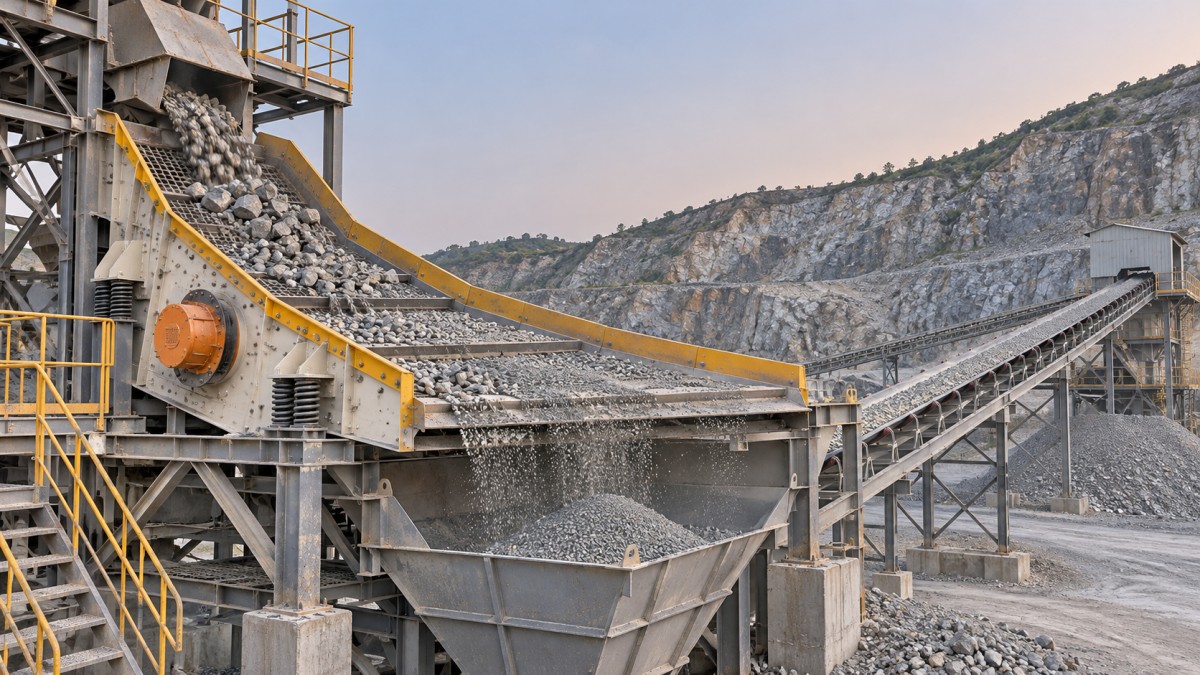
The share of near-size particles deserves separate attention. A feed with plenty of fines well below the aperture can pass readily, while particles only slightly smaller than the opening need more opportunities and the right orientation to pass. If a saleable product has a tight grading requirement, compare the proposed screen’s predicted separation performance with the product specification, not simply its rated throughput.
Where the advantage narrows
High moisture alone does not describe the screening problem. Clean, wet stone may behave very differently from aggregate carrying sticky clay. Clay can coat apertures, bind fines into larger lumps, and prevent particles from reaching the screen surface. Increasing deck area without addressing that condition may leave the same blinding problem on a larger machine. Washing, a different screening medium, or a change in the process ahead of the screen may be needed.
A banana screen also needs a stable feed across its width. A poorly positioned chute can load one side heavily, leaving the other underused and accelerating local wear. Surges from upstream crushers or bins can overwhelm the feed end even when average plant tonnage appears acceptable. Assess peak feed rate and distribution alongside the average rate.
A conventional inclined or horizontal screen deserves comparison when the duty emphasizes a sharp cut, the feed contains a high proportion of near-size particles, or the available headroom and discharge arrangement suit a different geometry. The best arrangement is the one that meets the required product grading at the intended operating rate; a smaller footprint alone does not establish that result.
Deck media and cut size affect the result
Nominal aperture size is only the starting point. Wire diameter, open area, wear resistance, and the shape of the opening influence both capacity and the grading of material passing through. A larger open area offers more opportunity for particles to pass, but a lighter screen surface may wear faster under coarse or abrasive feed. Flaky stone also behaves differently from more cubical aggregate at the same nominal aperture.
For a woven wire option, the aperture and wire specification should be evaluated against the actual cut and wear conditions. The Setting Customizable Aperture Specification To Satisfy Diverse Industrial Mineral Classification Demands Woven Screen Mesh illustrates a customizable aperture approach. Aperture choice still requires confirmation against the deck arrangement and required product grading; a nominal opening is not the same as a guaranteed finished product size.
Different deck sections can experience different duties. The feed end takes the initial impact and a heavier bed, while downstream sections perform more of the final separation. Screen media selection should account for those differences as well as the attachment system, panel support, and access for replacement. On a multi-deck machine, confirm that each deck has sufficient capacity and that oversize and undersize streams can discharge without interfering with one another.
Confirm the installation before selecting a model
Compare the complete machine envelope with the available structure, including the feed chute, discharge trajectories, drive equipment, guards, and clearance for changing media. A compact screening surface does not necessarily translate into a compact installation. The supporting structure must also be assessed for the machine’s operating and starting loads, using the equipment supplier’s load information.
Request a duty-specific assessment based on feed grading, bulk density, moisture, clay content, target cut sizes, deck configuration, and expected peak throughput. Include the permitted amount of misplaced material in each product stream. When feed variability is significant, samples from different quarry faces or seasons provide a more useful basis than a single favorable sample.
Before final selection, trace each discharge to the next conveyor, crusher, or stockpile. A screen sized for increased throughput cannot deliver the intended plant output if a downstream conveyor or transfer point becomes the restriction. Allow enough access to inspect the feed zone and replace worn panels without dismantling surrounding equipment.
Leave A Message
If you are interested in our products and want to know more details, please leave a message here, we will reply you as soon as we can.