What Wire Mesh Grade Works Best for Abrasive Screening Materials?
Select the wire mesh grade by matching wear mechanism, aperture stability, and support conditions to the material being screened. For abrasive feeds such as crushed granite, basalt, quartz-rich sand, iron ore, or slag, a harder grade is usually preferred, but hardness alone does not decide service life. A mesh that is very hard yet too brittle for the vibration amplitude, impact loading, or fastening method may crack at the crown, the hook, or the first few bearing points long before the wires are worn thin.
In screening work, “grade” often refers to the steel composition and heat treatment level of the wire. The most common choices are high-carbon steel, oil-tempered wire, stainless steel for corrosive duty, and polyurethane or hybrid media when blinding and noise are also concerns. For abrasive dry screening, high-carbon and oil-tempered wire mesh are usually the first materials evaluated because they combine tensile strength with relatively good resistance to rubbing wear. Stainless steel can be useful where moisture, chemical attack, or contamination control matters, but it is not automatically the best answer for severe abrasion. In many quarry and mining circuits, stainless wire wears faster than a properly selected high-carbon screen because corrosion resistance and abrasion resistance are separate issues.
Where grade selection usually goes wrong
A common mistake is to choose the hardest available Wire mesh grade without checking the feed condition. If the top deck sees large rock drop height from a transfer chute, the screen surface is exposed to impact and flex fatigue as much as sliding abrasion. In that situation, an ultra-hard wire with limited ductility may break at intersections or near the crimp pattern. Another frequent error is to focus only on nominal opening size. Two meshes with the same aperture can behave very differently if one uses thicker wire diameter, a different weave, or a different crimp depth. Thicker wire tends to last longer in abrasive duty, but it also reduces open area and may lower capacity or increase pegging with flaky stone.
Moisture also changes the decision. Damp abrasive fines can blind a woven panel quickly, especially below medium aperture ranges where near-size particles wedge in the openings. The result may look like a wear problem even when the actual cause is blocked open area. In such cases, the best “grade” may involve changing the screen media type on one deck rather than simply upgrading wire hardness.
High-carbon wire for general abrasive screening
For many dry aggregate and mining applications, high-carbon spring steel wire is the baseline choice. It generally offers a practical balance of wear resistance, elasticity, and cost control. When the feed is angular and abrasive but not excessively corrosive, high-carbon woven wire often performs well on middle and lower decks where impact is lower than on the feed end of the top deck.
Its suitability depends heavily on wire diameter and crimp geometry. A coarse opening with undersized wire may fail by localized thinning, while an oversized wire may preserve life but choke throughput. In practice, selecting high-carbon wire mesh is rarely about material grade alone; it is about the combination of carbon level, heat treatment consistency, wire gauge tolerance, and weave stability under vibration.
When oil-tempered wire becomes the better option
Oil-tempered wire is often considered when abrasion is severe and the screen runs under sustained high vibration. Properly processed oil-tempered wire can provide a useful combination of tensile strength and fatigue resistance. This matters on vibrating screens that operate at high acceleration or on installations where screen panels are tensioned frequently during maintenance. The wire needs to survive repeated dynamic loading, not just contact with hard particles.
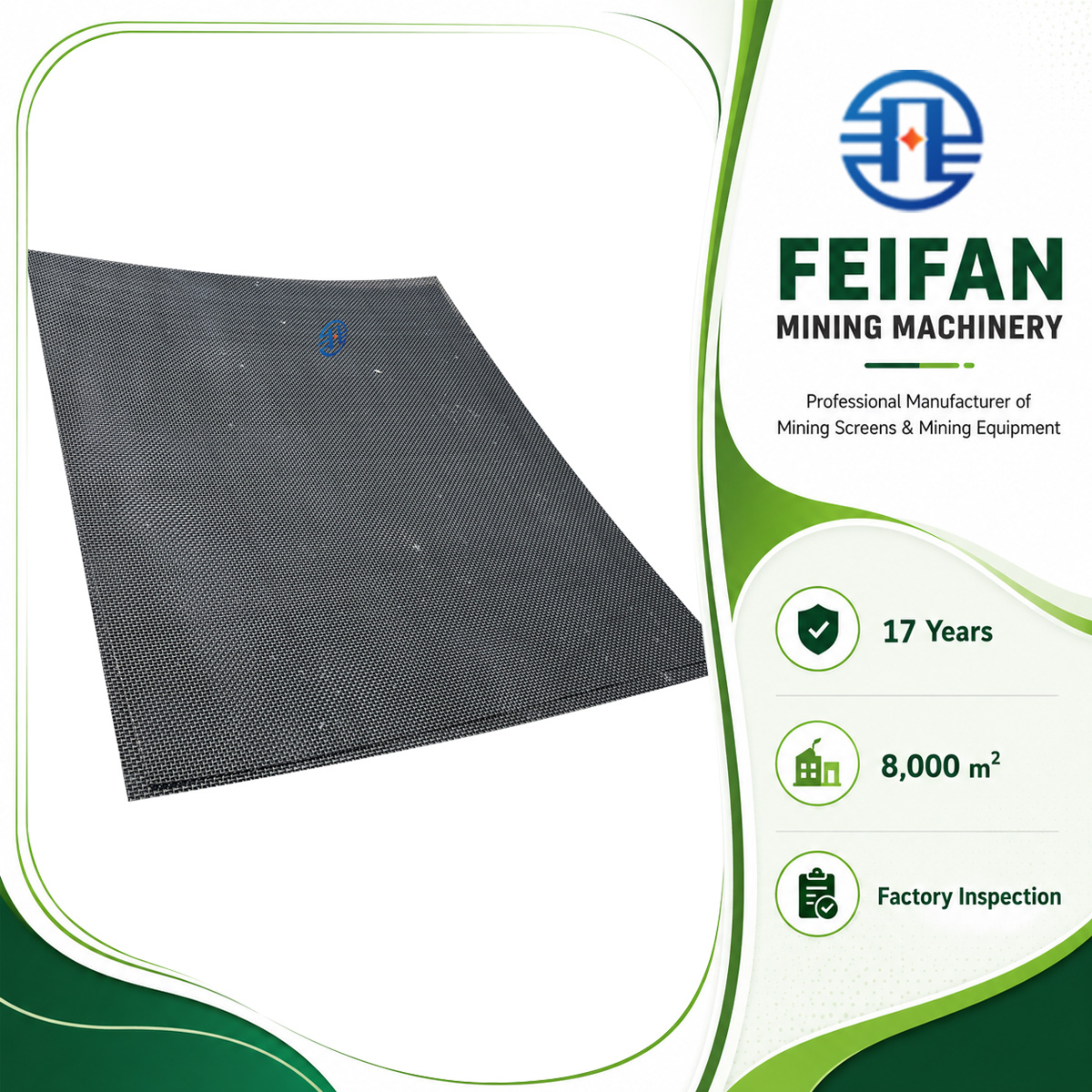
On quarry decks screening crushed stone in nominal sizes such as 5 mm, 7 mm, 8 mm, or 9 mm, a panel like OEM 5mm 7mm 8mm 9mm sieve mesh screen for quarry crusher mining vibrating screen mesh would typically be evaluated by aperture retention, crimp stability, and hook-end durability rather than by opening size alone. Those details decide whether the panel keeps its sizing accuracy after repeated loading cycles.
Oil-tempered grades are not automatically superior in every abrasive application. If the installation has poor support rails, uneven clamping pressure, or frequent oversize tramp impact, panel breakage may still occur. In that case, improving support spacing or changing the feed arrangement may deliver more life than changing wire grade.
Top deck and lower deck should not be judged the same way
The top deck usually sees the harshest impact. Large feed, sharp edges, and chute drop create concentrated stress on the first third of the panel. Here, a slightly more forgiving wire with sufficient toughness may outlast a harder but less fatigue-tolerant option. Some plants use heavier wire diameter on the feed section and a different panel specification further along the same deck.
Lower decks often experience less direct impact but much more sliding abrasion from high volumes of near-size particles. In these zones, aperture accuracy becomes more sensitive because wire wear changes the cut point over time. If gradation control matters, the best mesh grade is the one that holds opening geometry consistently until planned changeout, not simply the one that survives the longest in a worn state.
Weave style affects wear almost as much as material grade
Square woven mesh is common for accurate sizing, but it is not the only pattern worth considering. Double crimp, lock crimp, and flat-top constructions can change how force is distributed across the panel. Flat-top styles may present a smoother screening surface, while lock-crimp structures can help resist movement at wire intersections. For abrasive material, movement between wires can accelerate wear at contact points, so weave stability matters.
If pegging is frequent, the issue may not be an insufficiently hard Wire mesh. It may come from a poor relationship between particle shape and aperture shape. Elongated particles, flaky stone, and variable moisture can all distort performance. Changing from one weave style to another can sometimes solve a problem that repeated grade upgrades do not fix.
Material hardness is only one input
Abrasion severity depends on more than Mohs hardness or rock name. Angularity, fines content, feed velocity, bed depth, and the amount of material carried over the deck all influence wear. Quartz-bearing feed usually cuts wire aggressively because sharp particles slide and roll continuously over the crown of the wire. Slag and recycled mineral material may introduce irregular edges and mixed density that create uneven loading. Fine but dense feed can be especially destructive because it acts like a constant grinding layer rather than intermittent impact.
- If the feed is coarse, dry, and highly angular, higher-strength spring steel or oil-tempered wire is commonly considered first.
- Where water, chemical residue, or corrosion are present, stainless or coated options may become necessary even if pure abrasion resistance is lower.
- When the process handles sticky fines that blind the deck, a mixed-media arrangement may work better than moving to a harder woven wire.
Details that should be checked before finalizing the grade
Panel dimensions and fastening style need close attention. Hook type, hook thickness, and reinforcement at the edges can determine whether the mesh survives tensioning. A strong wire grade installed with a poorly matched hook often fails at the ends first. Support bar spacing is also critical. If the unsupported span is too wide for the selected wire diameter, flexing increases and fatigue cracks appear early.
Transport and handling are sometimes overlooked. Screen panels can be bent, twisted, or stacked improperly before installation. Once the crimp geometry is disturbed, localized overstress develops during operation. That kind of damage may later be mistaken for an incorrect material grade. For replacement ordering, it helps to record deck position, opening size, wire diameter, weave type, hook configuration, and the actual failure mode seen on the removed panel.
Installation practice affects service life immediately. Uneven tension across the width of the panel can shift load concentration to one side. Loose clamping allows movement, which accelerates wear around hooks and support contact points. Over-tensioning can also be harmful by raising residual stress before the machine even starts. After startup, a short inspection period is useful to confirm that the panel is seated properly and not fretting against supports.
Where the required cut sizes fall within common quarry ranges, a specification such as OEM 5mm 7mm 8mm 9mm sieve mesh screen for quarry crusher mining vibrating screen mesh may fit the process window, but the final choice still depends on wire diameter, open area, deck location, and vibration conditions. The opening alone does not identify the best grade.
Reading failure patterns gives better answers than replacing with the same mesh
If wires are polished flat on the crown and gradually reduced in diameter, the mesh is mainly losing to sliding abrasion. A harder or thicker wire may help. If breaks appear near the bends, hook ends, or support points, fatigue or installation stress is more likely. If the panel wears unevenly from one side to the other, distribution across the feed box or screen width may be poor. If openings become distorted before the wires are significantly worn, weave stability or support conditions should be reviewed.
For abrasive screening materials, the best wire mesh grade is usually the one that stays dimensionally stable under the actual vibration and impact pattern of the deck. In many dry quarry and mining duties, that points toward well-made high-carbon or oil-tempered woven wire rather than the hardest material available on paper. The right decision comes from matching grade, wire diameter, weave, and support arrangement to the feed behavior inside the machine.
Leave A Message
If you are interested in our products and want to know more details, please leave a message here, we will reply you as soon as we can.