Water Consumption Differences Between Spiral and Wheel Type Sand Washers
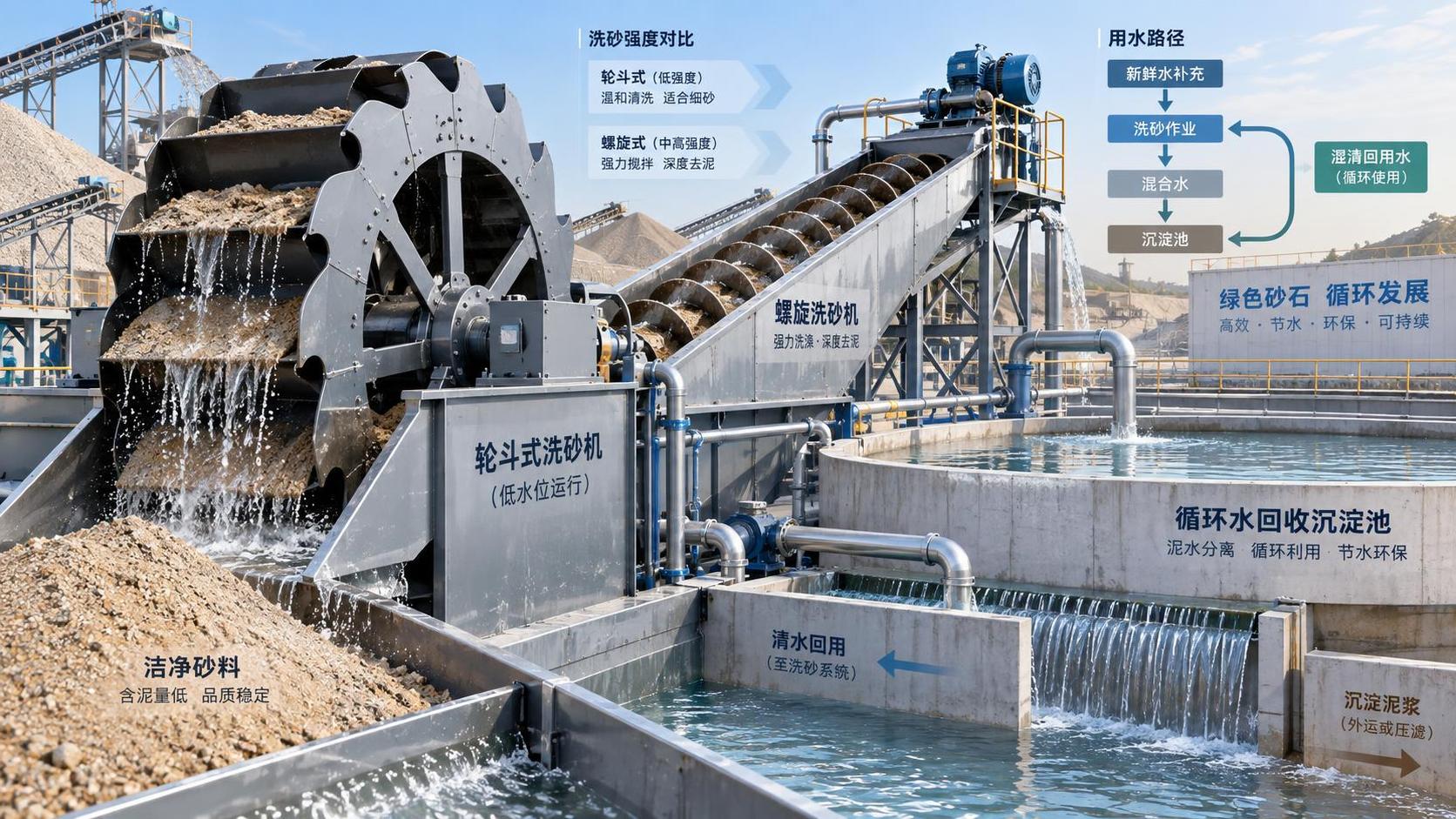
Water use should be evaluated as a plant-system cost, not as a nameplate comparison. In a spiral sand washing machine vs wheel type decision, a wheel washer usually has the lower fresh-water requirement when the feed is reasonably clean and the goal is to wash and dewater coarse manufactured sand or natural sand efficiently. A spiral washer generally needs more process water because it works through a longer slurry washing path, but it can justify that demand when the raw material contains more clay, silt, or stubborn impurities.
The wrong purchase decision is often made by asking which machine “saves more water” in isolation. The better question is: how much water will be consumed, recovered, lost with sludge, and needed again to achieve the required finished-sand quality?
Why the two designs use water differently
A wheel type sand washer uses rotating buckets or wheels to lift sand from a water bath. During lifting, water drains through the buckets and the sand is partially dewatered before discharge. Its washing action is relatively gentle. Because the material stays in the water for a shorter time and the unit is often used with a controlled water level, the machine can operate with a comparatively modest water flow.
A spiral sand washer moves material through a tank with one or two rotating screws. Sand is pushed upward along the inclined trough while water flows against the material. This counter-current action keeps light contaminants and fine particles suspended so they can overflow. It provides a more aggressive washing process, but that process depends on adequate water to carry away fines and prevent the tank from becoming overloaded with slurry.
Lower water use does not automatically mean lower total cost
Wheel type machines often look favorable in a water-cost comparison, particularly where make-up water is expensive, scarce, or subject to restricted supply. Their discharge moisture can also reduce the load on stockpile drainage and downstream dewatering. For a plant producing standard concrete sand from screened, low-clay feed, this can make the wheel washer the more economical choice.
However, selecting a wheel washer for heavily contaminated feed can shift cost elsewhere. If clay lumps remain, if the finished sand has an unstable fines content, or if repeated washing is needed to reach the required cleanliness, the initial water saving may disappear. The problem is not that the machine is inefficient; it is being asked to perform a duty outside its strongest operating range.
A spiral washer can consume more water while still reducing total production risk in a difficult material stream. Its longer washing path may improve the removal of loose clay and surface coatings before the sand reaches the stockpile. This is especially relevant when quarry feed changes across benches, when the plant processes weathered rock, or when natural sand contains variable silt content.
There is also a process-wide connection that procurement teams should not overlook. Abrasive crushing circuits can create a broad range of particle sizes and fine material before washing. When planning both comminution and washing equipment, wear-part selection affects how stable that feed remains. For abrasive ore and rock processing, a component option such as FEIFAN High Hardness Crushing Parts Cone Crusher For Abrasive Ore And Rock Processing Work Machine may be relevant to the upstream equipment review, while the washer should still be chosen based on the actual fines and clay load delivered to it.
The water balance matters more than the machine’s water connection
Fresh-water demand is not equal to total circulating-water flow. Both washer types can be installed in a recycling circuit that includes settling tanks, thickeners, hydrocyclones, filter presses, or other sludge-management equipment. In that arrangement, much of the water is returned to the wash plant. The unavoidable cost comes from water trapped in tailings, moisture carried away with finished sand, evaporation, leakage, and periodic cleaning.
A spiral washer may require a larger recirculating flow to maintain effective washing, but a well-designed recovery circuit can limit fresh-water make-up. Conversely, a wheel washer with a poorly designed settling area may appear water-efficient at the machine yet lose valuable water and fine sand through uncontrolled overflow.
Before accepting a supplier’s water-consumption figure, ask what it represents. It may refer to recommended operating flow, total process flow, or fresh make-up water. These are not interchangeable. The figure also changes with feed gradation, clay content, moisture, target cleanliness, and whether the plant is recovering fine sand from wastewater.
Choose from the feed condition, then price the water system
A practical purchasing sequence starts with material testing rather than machine preference. Review the percentage and type of contaminant: loose dust behaves differently from sticky clay, and both behave differently from very fine manufactured sand. Then define the acceptable finished-sand gradation and cleanliness target. A washer that removes more fines is not necessarily better if those fines are needed to meet the final grading requirement.
- Choose a wheel type washer when feed is already well screened, clay content is low, water availability is constrained, and lower discharge moisture is valuable to the operation.
- Choose a spiral washer when feed has more mud, clay coatings, or difficult-to-remove impurities and the plant can support a stronger washing and water-recovery circuit.
- Consider a combined process when the material is highly variable. Upstream screening, controlled washing, fine-sand recovery, and sludge treatment may deliver a better result than relying on one washer to solve every problem.
For a new or upgraded line, the equipment supplier should assess the crusher discharge, screen cuts, wash-water source, available footprint, and tailings route together. Manufacturers that provide crushers, screens, conveyors, sand washers, and complete aggregate line design can evaluate these interfaces as one process rather than supplying a washer as an isolated machine.
A cost-focused decision rule
Use wheel type equipment when water reduction is the priority and the material is clean enough for gentle washing. Use spiral equipment when wash quality on dirtier feed protects product value better than the additional water and recovery cost. In either case, budget for water recovery early. The lowest-cost sand washing solution is rarely the unit with the lowest apparent water flow; it is the system that consistently meets product requirements with controlled water loss, acceptable fine-sand recovery, and minimal rehandling.
Leave A Message
If you are interested in our products and want to know more details, please leave a message here, we will reply you as soon as we can.