Spiral Sand Washer vs Wheel Type: Which Handles Muddy Feed More Effectively?
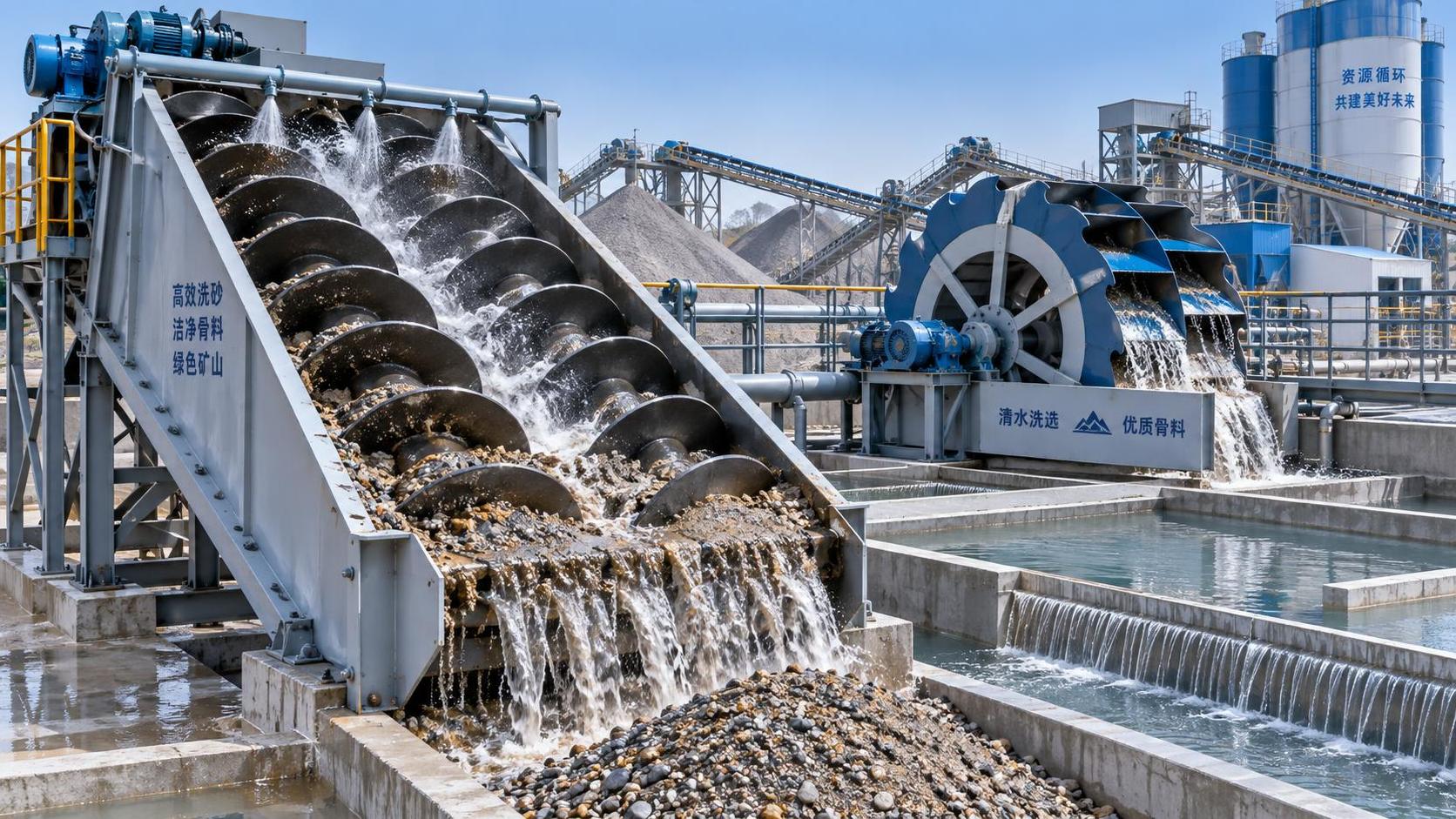
For feed containing substantial clay, silt, and slurry-bound fines, a spiral sand washer generally handles the material more effectively than a wheel type unit. Its inclined screw conveyor continuously agitates, lifts, and drains the sand, giving sticky fines more opportunity to separate before discharge. That advantage matters when poor washing performance would otherwise lead to high methylene blue values, unstable grading, excessive mud content, or rejected aggregate.
That conclusion is not a blanket rule. A wheel washer can be the more economical choice where the feed is already well screened, clay contamination is low, water supply is limited, and recovery of very fine sand is not the main production objective. The practical decision in a spiral sand washing machine vs wheel type comparison depends less on nominal capacity than on the condition of the incoming material and the cost of managing the resulting slurry.
Muddy feed exposes the difference in washing action
A wheel type sand washer uses rotating buckets or paddles to scoop settled sand from a water bath. During lifting, water drains through the perforated bucket surfaces and the sand is discharged. The machine is mechanically straightforward, compact, and often suitable for manufactured sand or natural sand with limited attached mud.
Its limitation appears when clay is plastic, cohesive, or attached as a coating to the sand particles. A short residence time in the wash tank may remove loose silt, but it may not break down clay lumps effectively. If the feed enters with a high proportion of slurry, the bath can become overloaded. Once the water in the tank is heavily contaminated, the wheel may lift material that has been only partially cleaned. Fine sand can also escape with the overflow unless a separate recovery stage is installed.
A spiral washer moves material along an inclined trough with one or two rotating screws. This transport mechanism performs several tasks at once: it stirs the material in water, rubs particles against one another, conveys cleaned coarser sand upward, and allows much of the dirty water and suspended fines to flow back toward the lower end. The longer transport path and more forceful agitation are why spiral units are generally better suited to muddy sand and gravel feed.
The same mechanism, however, should not be confused with a complete clay-treatment solution. Dense clay balls, weathered shale, organic contaminants, and excessive minus-75-micron material can require a scrubber, hydrocyclone, dewatering screen, or settling system ahead of or after the washer. Installing a larger spiral machine without addressing these upstream conditions can simply transfer the bottleneck to water treatment and tailings handling.
Where the spiral washer has a clear operational advantage
A spiral washer is usually the stronger option when the project must process pit-run sand, river material with seasonal silt variation, crusher feed contaminated by wet fines, or stockpiled aggregate exposed to rainfall and soil carryover. It is particularly relevant where the coarse fraction contains mud-coated particles that must be scrubbed before meeting downstream concrete, asphalt, or drainage aggregate requirements.
The key advantage is stability under variable feed. Wheel washers often perform best with relatively controlled feed conditions. A sudden rise in clay content can change the water bath characteristics quickly, increasing carryover and reducing cleaning efficiency. A spiral washer has more tolerance for this variation because the material remains under agitation and travels through a longer washing zone.
For coarse sand and small gravel, the screw also offers a useful dewatering effect at discharge. This can reduce the free-water burden transferred to stockpiles and downstream screens. It does not eliminate the need to assess moisture specifications, but it can improve the consistency of material handling where wet product creates loading, transport, or stockpile management problems.
There is a trade-off: the abrasion and transport action that improves cleaning also increases wear exposure. Screw flights, trough liners, bearings, seals, and gear drives should be treated as operating-cost items rather than ignored until failure. Feed containing sharp crushed particles or hard contaminants can accelerate wear substantially. A purchase comparison based only on equipment price will miss this cost.
Wheel washers remain viable in controlled applications
Wheel type machines are not inferior by definition; they are better matched to a narrower set of conditions. They can be effective where raw sand is relatively clean, the main objective is rinsing and light desliming, and the plant needs a compact washer with modest power demand. Their lower agitation can also be an advantage when excessive particle attrition is undesirable.
They may fit a line processing screened manufactured sand after the crushing circuit has already removed most clay-bearing fines. In this setting, the machine is not being asked to scrub heavily contaminated material. It is performing a finishing wash, and its simpler configuration may support lower initial cost and easier day-to-day operation.
The risk is specifying a wheel washer from a clean sample while the actual production feed changes after excavation advances, rainy-season stockpiles are introduced, or recycled water becomes more turbid. A wheel washer that appears sufficient at commissioning can become the weak point when feed quality deteriorates. The equipment decision should therefore be based on credible worst-case feed conditions, not only average material descriptions.
Water consumption is a system question, not a machine label
It is often assumed that a wheel washer is always the lower-water option and a spiral washer is always water-intensive. The more meaningful question is how much clean or reclaimed water the whole plant needs to meet product quality targets.
A wheel washer may use a smaller wash bath, but poor separation of mud can force recirculation adjustments, repeat washing, reduced throughput, or downstream correction. A spiral washer may require more active washing water, yet it can remove more contamination in one pass when the feed is difficult. Neither result can be evaluated properly without considering thickening, sedimentation, hydrocyclone recovery, filter press capacity, and the quality of recycled water returned to the plant.
Fine sand recovery deserves particular attention. Both washer types can lose valuable fine material in overflow if the process is not designed around the particle-size distribution. Where recoverable fines have commercial value or disposal cost, a hydrocyclone and dewatering screen may change the economic case more than the selection between wheel and spiral alone. Conversely, if the specification requires removal of a large fine fraction, recovery equipment should not be sized merely to maximize yield; it must preserve the target gradation.
Cost comparison: purchase price is only the beginning
For muddy feed, the lower capital cost of a wheel washer can be misleading if it leads to off-spec product, lost saleable sand, or frequent production reductions. The relevant cost comparison includes the washer, supporting steelwork, civil works, water pumps, pipeline layout, electrical load, wear parts, labor for cleaning, sludge management, and downtime caused by feed changes.
Spiral systems commonly require more robust installation because of their length, incline, drive arrangement, and slurry discharge layout. They can also demand more space. This should be checked early against site constraints, especially in retrofit projects where conveyor elevations, drainage channels, and stockpile access are already fixed.
Wheel units may be simpler to integrate physically, but their apparent simplicity should not lead to undersized settling capacity. If muddy water returns to the washer without adequate clarification, washing efficiency falls regardless of machine type. In remote sites, the availability of replacement bearings, gear components, liners, and screw-flight repair capability can be as important as the original equipment specification.
Screening performance also affects washer economics. Removing oversized debris and controlling the feed envelope before washing reduces unnecessary wear and improves cleaning consistency. For abrasive quarry applications, screen media selection should be aligned with the washing circuit; a 1 adopting manganese steel wear resistant raw for quarry aggregate grading screening Woven Screen Mesh may be relevant where the pre-wash screening stage handles coarse, abrasive aggregate and requires durable aperture control.
Questions that should be answered before specifying either design
The most useful procurement documents define the feed rather than simply requesting a stated tonnes-per-hour rating. They should identify the particle-size distribution, maximum feed size, expected clay and silt condition, percentage of minus-size material, moisture variation, target product grading, and required cleanliness indicators. If source material changes across the quarry or borrow area, the specification should state both normal and difficult-feed conditions.
It is also important to establish whether the washer will receive raw feed, screened sand, crusher dust, or a blend. A spiral washer sized for a coarse, relatively uniform sand fraction may not operate as intended when it receives an uncontrolled mixture of gravel, clay lumps, and excess fines. Similarly, a wheel washer should not be expected to replace attrition scrubbing where the specification demands removal of strongly adhered clay.
Ask suppliers to state the basis of their capacity figure: feed gradation, solids concentration, clay level, water rate, and final product requirement. Capacity claims without these conditions are difficult to compare. The same applies to water demand and fine-sand loss estimates, which depend heavily on the complete process arrangement.
For consistently muddy feed, the decision normally favors a spiral washer, often as part of a broader washing and fines-recovery circuit. For relatively clean, controlled sand where compactness and lower initial expenditure matter more than aggressive scrubbing, a wheel type washer can be justified. The correct choice is the one that maintains product quality at the site’s realistic worst feed condition without creating a larger water, wear, or slurry-disposal problem elsewhere in the plant.
Leave A Message
If you are interested in our products and want to know more details, please leave a message here, we will reply you as soon as we can.