Rubber Screen Mesh Explained: Uses, Materials, and Screening Advantages
Rubber Screen Mesh Explained: Uses, Materials, and Screening Advantages
Rubber Screen Mesh is a practical screening solution for operators handling abrasive sand, gravel, ore, and recycled aggregates. Designed to reduce noise, absorb impact, and resist wear, it helps improve screening efficiency while protecting vibrating screen equipment. This article explains its common uses, material options, and key screening advantages to help you select the right mesh for reliable, long-term operation.
In a crushing and screening plant, the screen media is often treated as a replaceable detail. In reality, it has a direct effect on product grading, downtime, machine load, and the daily working environment around the screen. A poorly matched panel can blind over, wear unevenly, crack around fixing points, or allow too much oversize material into the next process. Rubber media is not the answer to every screening problem, but in the right duty it can solve several operational issues at once.
What Rubber Screen Mesh Actually Does
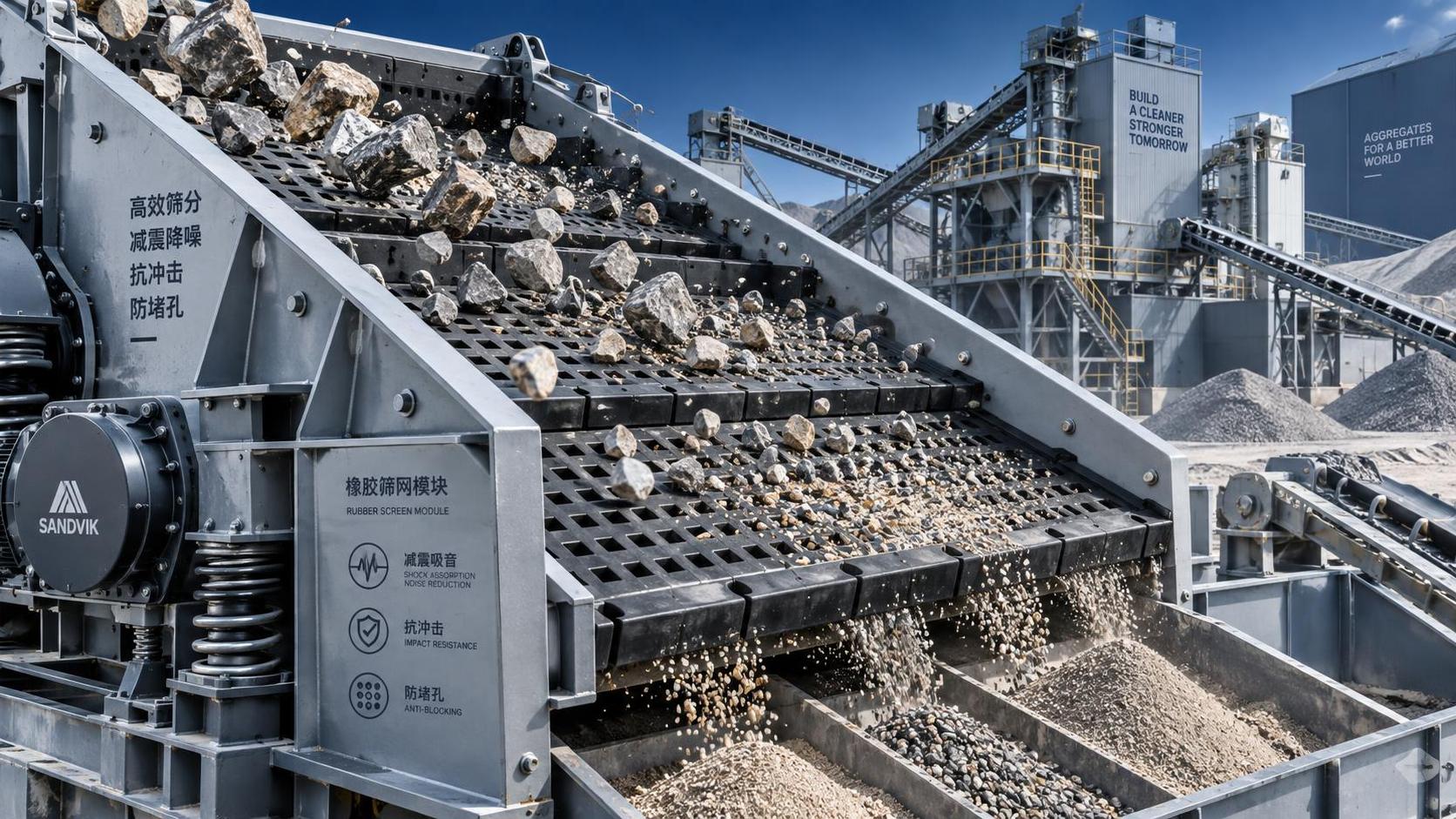
Despite the name, Rubber Screen Mesh does not necessarily resemble woven wire mesh. It is usually a molded or fabricated screening panel with accurately formed openings. Depending on the screen deck and fastening arrangement, it may be supplied as modular panels, tensioned mats, side-tensioned sheets, or custom-cut sections. The elastic rubber body cushions the impact of incoming material while separating particles according to aperture size and shape.
This resilience matters when the feed contains sharp rock, high drop heights, or irregular recycled material. Instead of transmitting every impact directly into a rigid screen surface, rubber absorbs part of the energy. The result is often lower noise and less aggressive impact loading on the screen deck. For operators working near vibrating equipment for long shifts, the reduction in metallic clatter can be noticeable, even though overall site noise still depends on the feed system, enclosure, chute design, and machine condition.
Its flexibility can also help material move across the deck. As the screen vibrates, the rubber surface flexes slightly, which may reduce pegging when particles lodge in an opening. This is especially useful with angular aggregate, damp material, and feed containing a mix of flat, elongated, or flaky particles. It should not be confused with a cure for severe clay contamination; sticky fines and excessive moisture may require washing, spray bars, or a different screening arrangement.
Where It Is Commonly Used
Rubber screening panels are commonly installed on medium and heavy-duty vibrating screens in quarrying, mining, aggregate processing, construction waste recycling, and some water-conservancy or infrastructure material projects. They are particularly relevant where feed is abrasive and impact is high, such as a scalping deck receiving crushed stone or a sizing deck handling coarse gravel.
A typical plant may use different media on different decks. A steel screen can be suitable where a rigid open area and sharp separation are required. Polyurethane panels are often considered for fine screening and high-abrasion duties where aperture precision is important. Rubber panels are frequently selected where impact absorption, noise control, and resistance to coarse material are higher priorities. The correct choice is therefore less about declaring one material “better” and more about matching the deck to its feed and purpose.
In wet aggregate production, screening must also be viewed as part of the full material flow. If excessive fine sand is carried into a washing stage, or if washing is expected to compensate for poor sizing upstream, operators may face unstable product quality. Equipment such as the FEIFAN 2FG15 Double Spiral High Capacity Equipment for Building Aggregate Washing with Fine Sand Recovery Spiral Sand Washer belongs downstream in this wider process discussion: screen opening selection, water content, and fines recovery should be reviewed together rather than as isolated equipment decisions.
Material Construction and Why It Matters
The term “rubber” covers more than one compound. Manufacturers can adjust the formulation for abrasion resistance, elasticity, tear resistance, temperature conditions, oil exposure, or wet-service requirements. A panel used for clean, dry granite may not need the same compound as one screening mixed demolition waste or handling slurry-bearing material. The supporting frame, embedded reinforcement, aperture profile, and fastening design also influence actual service life.
For this reason, buyers should avoid selecting a panel only by its outside dimensions and opening size. A panel that fits physically may still be wrong if its thickness cannot handle the feed impact, its aperture shape promotes blinding, or its fixing system does not match the screen deck. Square, rectangular, slotted, and specially shaped openings each affect particle passage differently. Slotted holes, for example, may be useful where throughput is important, but the direction of the slot must be chosen with the required product shape in mind.
Key checks before specifying a panel
- Feed material type, particle shape, abrasiveness, and moisture level.
- Top feed size and whether large stones strike the screen directly.
- Required cut size, allowable near-size content, and target throughput.
- Screen motion, vibration amplitude, deck angle, and available screening area.
- Panel dimensions, support-bar spacing, fastening method, and replacement access.
- Whether blinding, pegging, noise, premature wear, or poor grading is the real problem to solve.
These details are more useful than simply asking for a “heavy-duty rubber mesh.” A reliable supplier should use them to confirm whether rubber is appropriate at all, and whether a combination of rubber, polyurethane, and steel media would make better sense across the plant.
The Main Screening Advantages
The first advantage is impact resistance. Coarse aggregate can hit a top deck with considerable force, particularly when the feeder discharge is poorly controlled. Rubber panels help cushion that impact and can reduce the tendency for brittle failure associated with some rigid media. Good feed distribution is still essential; no panel will wear evenly if most of the material lands on one small area of the deck.
The second is wear behavior. Abrasive material gradually removes material from every screen surface, but a properly selected rubber compound can provide useful durability under harsh aggregate conditions. Wear should be monitored around apertures, panel edges, and locking points. As holes enlarge or tear, product sizing becomes less controlled, and continuing to run the panel may create quality problems that are more expensive than a planned replacement.
A third benefit is lower noise. Steel-on-stone impact creates a sharp sound that can make a screening station unpleasant to work around. Rubber dampens much of this direct contact. It is a meaningful operational benefit, but it should be assessed realistically: overall noise management requires attention to chutes, transfer points, guards, screen bearings, and the entire process layout.
Finally, flexible media may improve uptime when it is designed for fast replacement. Modular systems allow operators to replace damaged sections instead of removing an entire deck surface. That benefit depends on keeping the correct spare panels on site and checking that worn supports or loose rails are not damaging otherwise sound media.
Common Mistakes During Operation
One common mistake is blaming the mesh when the issue begins upstream. If the crusher is producing excessive flat particles, if the feeder is surging, or if the screen is overloaded, a different panel alone may not restore clean separation. Another is using a finer opening to chase a tighter product grade without checking the actual material moisture and the available deck area. The immediate result can be reduced capacity and more blinding.
Operators should also inspect tension and fastening during routine maintenance. Loose panels can move against their supports, accelerating wear at contact points. Damaged cross members, blocked apertures, and uneven feed distribution deserve attention before a panel is judged defective. Recording the location and type of wear over several changeouts can reveal whether the problem is material-related, machine-related, or caused by the installation method.
Selecting Media in the Context of the Whole Plant
Screening performance is closely connected to crushing, conveying, washing, and stockpiling. A source that understands only screen panels may overlook the process conditions that determine their performance. Feifan’s group structure brings wire-mesh manufacturing together with mining machinery production and export support: Binzhou Feifan Wire Mesh focuses on polyurethane and steel screen meshes, while Shandong Feifan Mining Machinery produces crushers, vibrating screens, feeders, conveyors, and related aggregate equipment.
Based in Binzhou, Shandong’s mining-equipment industrial base, the group has worked in sand and gravel equipment manufacturing and EPC-oriented aggregate projects since 2009. Its 66,000-square-meter factory, production workforce, and technical team provide a practical basis for reviewing screen media alongside the machine, deck structure, and material flow rather than treating each part as separate. For overseas projects, delivery requirements, spare-parts planning, local power conditions, and service access should also be confirmed before finalizing a specification.
The best Rubber Screen Mesh choice starts with a clear operating picture: what material enters the deck, what grade must leave it, where wear occurs, and how the screen behaves under load. With those facts in hand, operators can make a more defensible choice between rubber, polyurethane, steel, or a mixed-media arrangement—and avoid solving a process problem with the wrong replacement panel.
Leave A Message
If you are interested in our products and want to know more details, please leave a message here, we will reply you as soon as we can.