Maintenance Demands of Spiral Sand Washers Compared with Wheel Type Units
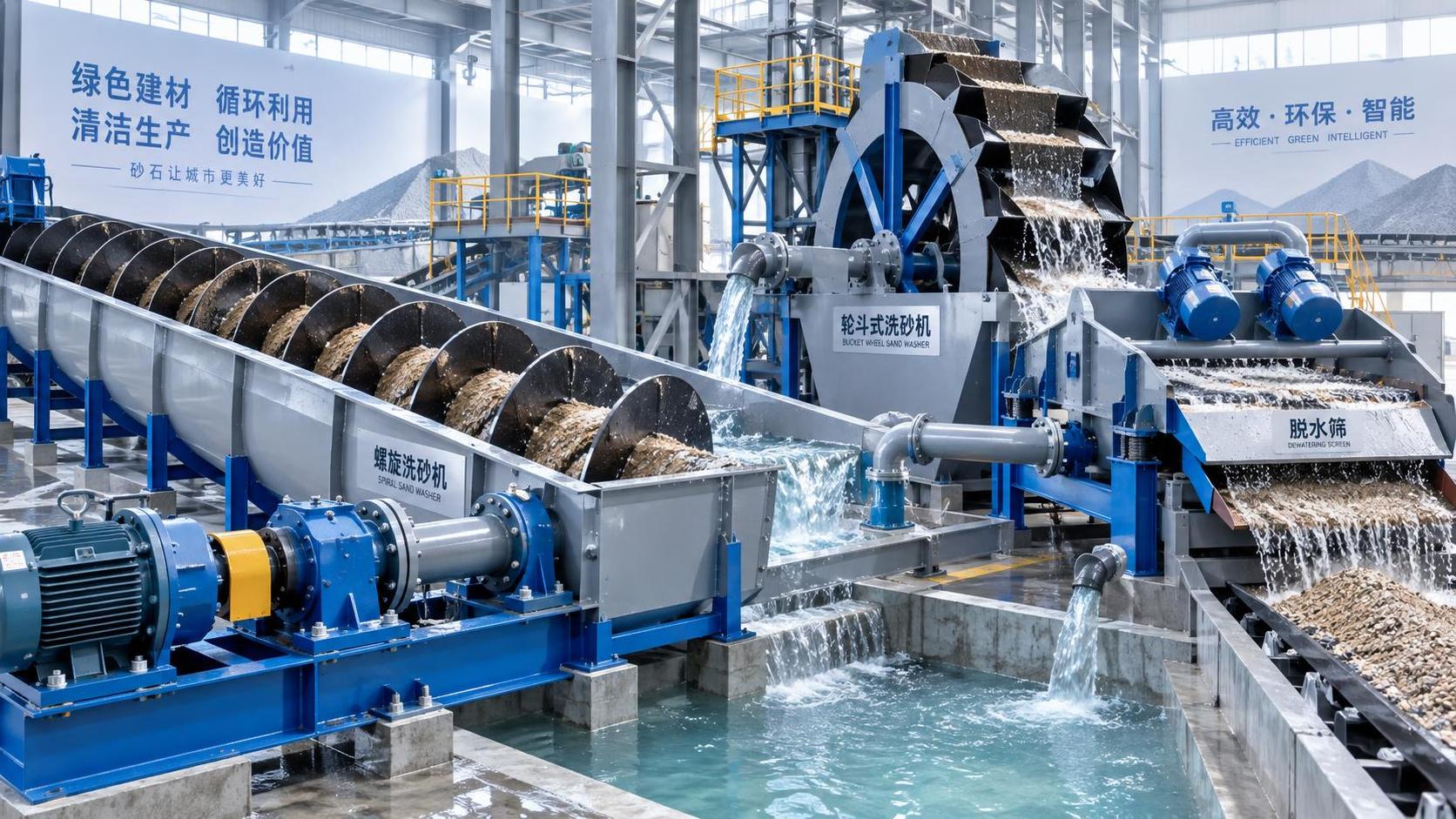
Maintenance is one of the clearest operational differences in a spiral sand washing machine vs wheel type comparison. A spiral washer generally demands more attention to its drive train, lower bearing protection, and accumulated sediment, while a wheel type unit is usually easier to inspect and clean but can lose washing efficiency if its buckets, screen sections, or water circulation are poorly maintained. Neither design is inherently “low maintenance” under all conditions; the better choice depends on feed contamination, clay content, required throughput, drainage arrangement, and the discipline of the operating routine.
The key point is that maintenance burden is driven less by the machine’s appearance than by where abrasive slurry travels, where solids settle, and how easily operators can identify a developing fault before it becomes a shutdown.
Why spiral washers need closer mechanical attention
A spiral sand washer moves material along the tank by rotating helical blades. This continuous conveying action makes it effective for handling larger volumes and more heavily contaminated feed, but it also places the spiral shaft, blade assemblies, gearbox, and support bearings under sustained load. Abrasive sand is not only being washed; it is being pushed, lifted, and discharged along the trough.
The most maintenance-sensitive area is commonly the lower end of the spiral shaft, particularly where the shaft support is exposed to wet fines and slurry splash. Seal failure, insufficient lubrication, or worn bearing housings can allow abrasive material to enter the bearing zone. Once contamination begins, bearing temperature, vibration, and rotational resistance may increase quickly. A washer can continue running for some time with a damaged seal, but the eventual repair may involve more than a simple seal replacement if the bearing and shaft journal are scored.
Spiral blades also deserve routine measurement rather than visual inspection alone. Blade wear changes the clearance between the helix and the tank bottom. Excessive clearance reduces the machine’s ability to convey settled material efficiently and may leave a compacted layer of sand in the trough. This buildup increases torque demand and can make restarting difficult after an unplanned stop. In severe cases, packed sediment can distort wear liners, overload the drive, or create uneven resistance along the spiral.
A practical daily routine for a spiral unit should therefore include checking for abnormal gearbox sound, shaft vibration, oil leakage, bearing temperature change, loose blade fasteners, and unusual accumulation near the discharge end. The machine should not be judged only by whether sand is leaving the outlet. Stable discharge can conceal rising mechanical resistance until the drive system is already under stress.
Sediment removal is a major operating issue, not a cleaning detail
Both washer types accumulate fines, but the location and consequence of sediment differ.
In a spiral washer, fine particles tend to settle in the tank beneath or around the spiral. If the feed contains sticky clay, crusher dust, or poorly dispersed silt, the settled layer may become compacted. Operators should monitor whether the water flow is carrying fines out as intended or whether the trough is gradually filling with dense sediment. Adding more water does not always solve the problem. If the material enters as clay-bound lumps, the washer may need better upstream disintegration, screening, or controlled feed distribution before its cleaning performance can improve.
A wheel type washer typically uses rotating buckets to lift sand from a water bath and drain it over screens. Its basin can also collect sediment, especially when fine material loads are high. However, the basin is usually more accessible than the lower area of a spiral tank. This can make manual cleaning and inspection easier during scheduled stops. The trade-off is that a neglected basin reduces available water volume and changes the washing environment. Fine solids can recirculate with process water, reducing the effectiveness of washing and increasing wear on pumps where a recovery system is installed.
Cleaning intervals should be set according to actual feed condition, not a calendar assumption. A clean, well-screened manufactured sand feed and a clay-rich natural sand feed can require entirely different basin or trough cleaning frequencies, even when processed through machines of similar capacity.
Lubrication: fewer points do not eliminate the risk
Wheel type washers often have a simpler lubrication routine because their main drive components are generally positioned above the water line. Bearings, reducers, chains, belts, or gears remain easier to access, and routine visual checks can be completed without entering a sediment-filled tank. This is a meaningful advantage where maintenance staffing is limited or where shutdown windows are short.
That simplicity should not be confused with immunity to failure. Wheel drives may suffer from misalignment, insufficient chain tension, damaged gear teeth, worn bucket wheel bearings, or water ingress through deteriorated seals. Splashing water and wet sand can still reach exposed components, especially if guards are missing or drainage is poor. Where a wheel washer uses a gearbox, oil level and oil condition should be checked according to the gearbox supplier’s instructions, with particular attention to milky oil, metallic particles, or leaks around shafts and inspection covers.
Spiral washers normally require a more disciplined lubrication record because the consequences of missed service are often greater at the shaft support and reducer. Grease type, lubrication interval, and quantity should follow the equipment documentation. Over-greasing is not a harmless precaution: it can damage seals, increase heat, and force grease out where it attracts abrasive dust. Under-greasing creates the opposite risk—metal-to-metal contact and accelerated bearing failure. The correct practice is controlled lubrication with inspection of the discharged old grease or oil condition where the design permits.
Wear parts: accessibility matters as much as service life
Spiral blades, tank liners, shaft-end supports, and discharge components are the principal wear areas on a spiral washer. Their service life depends heavily on sand hardness, particle shape, feed size, and operating water level. A dry or under-watered spiral condition can increase direct abrasion and torque. Oversized stones entering the washer can bend or crack blade sections, damage liners, and create sudden load spikes. Upstream screening is therefore part of washer maintenance control, not merely product grading.
Wheel type units concentrate wear on buckets, bucket lips, screen panels, side plates, wheel rims, and drainage sections. Since these components are normally more visible, early wear is easier to identify during ordinary walk-around inspections. A worn bucket may still carry sand, but reduced drainage performance can increase moisture in the finished product. Damaged or blocked dewatering screens have a similar effect, creating a quality problem that may be mistaken for insufficient drainage time or excessive wash water.
Maintenance planning should consider replacement access. A wear part that is inexpensive but requires extensive dismantling, lifting equipment, or prolonged stoppage can cost more in lost production than a higher-priced component designed for faster replacement. This is particularly relevant for sites operating a single washing line without standby capacity.
Water management determines whether maintenance stays routine
Many apparent washer faults originate in the water system. Insufficient water can leave fines attached to particles, increase friction in a spiral trough, and cause uneven loading. Excessive water can overflow containment areas, carry usable sand away, or overload downstream settling and recovery equipment. Unstable water pressure can also make product moisture and cleanliness inconsistent.
For wheel washers, the water level in the basin affects how effectively sand is agitated before being lifted by the buckets. A low water level may reduce washing action; an excessively high level can alter material flow and increase the amount of fine solids retained in circulation. For spiral units, water should be distributed so that fines are released and carried toward the overflow without creating dead zones where sediment settles.
Water clarity is a useful operating indicator but not a complete quality measure. Clear-looking water does not prove that clay coatings have been removed, while visibly turbid water may simply reflect a feed with high fine content. The more important question is whether the washer is consistently separating unwanted fines without losing an unacceptable amount of saleable sand.
Inspection signs that should trigger action
Some conditions warrant immediate investigation rather than waiting for the next planned maintenance stop:
- Increasing drive current or repeated overload trips, especially on spiral units;
- New vibration, knocking, grinding, or irregular gearbox noise;
- Sand buildup that remains after normal flushing;
- Hot bearing housings, leaking seals, or contaminated lubricant;
- Reduced discharge rate despite unchanged feed conditions;
- Higher finished-sand moisture caused by blocked wheel screens or damaged buckets;
- Unexpected loss of coarse sand through overflow or abnormal amounts of fines in the product.
These signs should be recorded together with feed condition and water changes. A washer’s behavior cannot be interpreted properly without knowing whether the incoming material has changed. A sudden rise in clay, crusher dust, or oversize particles may create symptoms that resemble mechanical failure.
Choosing based on the maintenance environment
A wheel type washer is often easier to keep serviceable where material is relatively clean, throughput is moderate, and operators need quick access to drive and screening components. Its accessible layout supports routine inspection, but it requires regular basin cleaning and close attention to bucket and dewatering-screen condition.
A spiral washer is more suitable where continuous conveying and stronger scrubbing action are needed, particularly when feed carries more adherent fines or contamination. Its maintenance plan must be more rigorous because submerged or slurry-exposed components are less forgiving of poor sealing, delayed lubrication, and sediment accumulation.
Washer reliability also begins upstream. Poorly controlled crusher discharge, excessive fines generation, and inadequate scalping can transfer avoidable maintenance work to the washing section. In a medium-scale quarry arrangement, stable feed sizing from equipment such as an OEM PXE Jaw Crusher 1 Year Warranty, Reinforced Flywheel, High Inertia, For Continuous Operation In Medium Scale Quarry Machine can help limit oversize material entering downstream screens and washers, provided the entire circuit is correctly screened and balanced.
The practical distinction is straightforward: wheel units generally reduce inspection and access difficulty, while spiral units require stronger control of lubrication, sediment, and wear in exchange for more intensive material handling. The right maintenance decision is not to select the machine with the fewest visible components, but the machine whose servicing requirements can be performed consistently under the site’s actual water, feed, labor, and shutdown conditions.
Leave A Message
If you are interested in our products and want to know more details, please leave a message here, we will reply you as soon as we can.