Key Safety Checks for Apron Feeder Operation in High-Tonnage Plants
Meta Title: Key Safety Checks for Apron Feeder Operation in High-Tonnage Plants
When an Apron Feeder fails in a high-tonnage plant, the problem is rarely limited to lost throughput. It can expose workers to moving parts, create unstable loading conditions, and trigger a chain of shutdowns upstream and downstream. In practice, the safest Apron Feeder operation comes from disciplined checks before startup, close attention during loading, and clear action limits for wear, misalignment, and guarding defects. If you are responsible for equipment quality or site compliance, the priority is simple: catch small mechanical warnings before they become safety incidents.
A lot of people focus first on production rate. That makes sense, but it also hides one common mistake: assuming a feeder that is still running is a feeder that is still safe. In heavy aggregate and mining duty, that assumption does not hold for long. A worn pan, loose chain, damaged return roller, or ineffective emergency stop may not stop the machine today, but it can push risk to the next shift.
What should be checked first on an Apron Feeder?
If a quick answer is needed, start with the parts that can hurt people fast or cause a sudden mechanical event: guards, emergency stops, chain tension, pan condition, drive area, and material loading alignment. After that, verify lubrication points, bolts, and any sign of abnormal noise, vibration, or side pull. These checks are basic, but they are also where most preventable failures begin.
The first walkaround matters more than many teams admit. Before startup, look at whether the discharge path is clear, whether any rock is trapped under pans or around the return track, and whether access platforms are clean and usable. A feeder in a dirty, blocked area is harder to inspect properly, and poor visibility is often the reason early damage is missed.
Guarding and emergency devices are not paperwork items
On paper, guarding and emergency stops are simple compliance points. On site, they are usually the difference between a manageable near-miss and a serious event. Side guards, nip-point protection, rotating shaft covers, and pull-cord or mushroom-stop devices must be physically checked, not just ticked on a form.
Pay attention to damaged or modified guards around the head shaft, sprockets, and drive assembly. In high-tonnage service, maintenance teams sometimes remove guarding for access and fail to reinstall it correctly during a rushed restart. That is a bigger risk than many plants realize because apron feeders do not look fast, and slow-moving equipment can invite unsafe behavior around exposed pinch points.
Emergency stops should be tested according to site procedure and manufacturer guidance. A stop device that has not been function-tested recently is an assumption, not a control measure.
Chain, sprocket, and track condition tell you a lot about actual risk
Most serious apron feeder issues give early mechanical clues. Elongated chain, uneven tension, worn sprocket teeth, and poor tracking usually show up before a complete failure. The problem is that these signs are easy to dismiss as “normal wear” until the feeder begins surging, jerking, or pulling to one side.
Look for these conditions during routine inspection:
- Uneven chain sag from one side to the other
- Abnormal wear on sprocket teeth or chain pins
- Metal fines or unusual debris under the return section
- Pans rubbing the frame or skirt structure
- Rollers or track components that no longer rotate freely
One field reality is worth stating clearly: chain tension that is too tight is not “safer.” Over-tension can accelerate wear on chains, shafts, bearings, and sprockets. Under-tension can promote jump, impact loading, and tracking problems. The correct setting should follow the equipment maker’s limits and be checked consistently, especially after replacing wear parts.
Pan condition and loading pattern deserve closer attention than they usually get
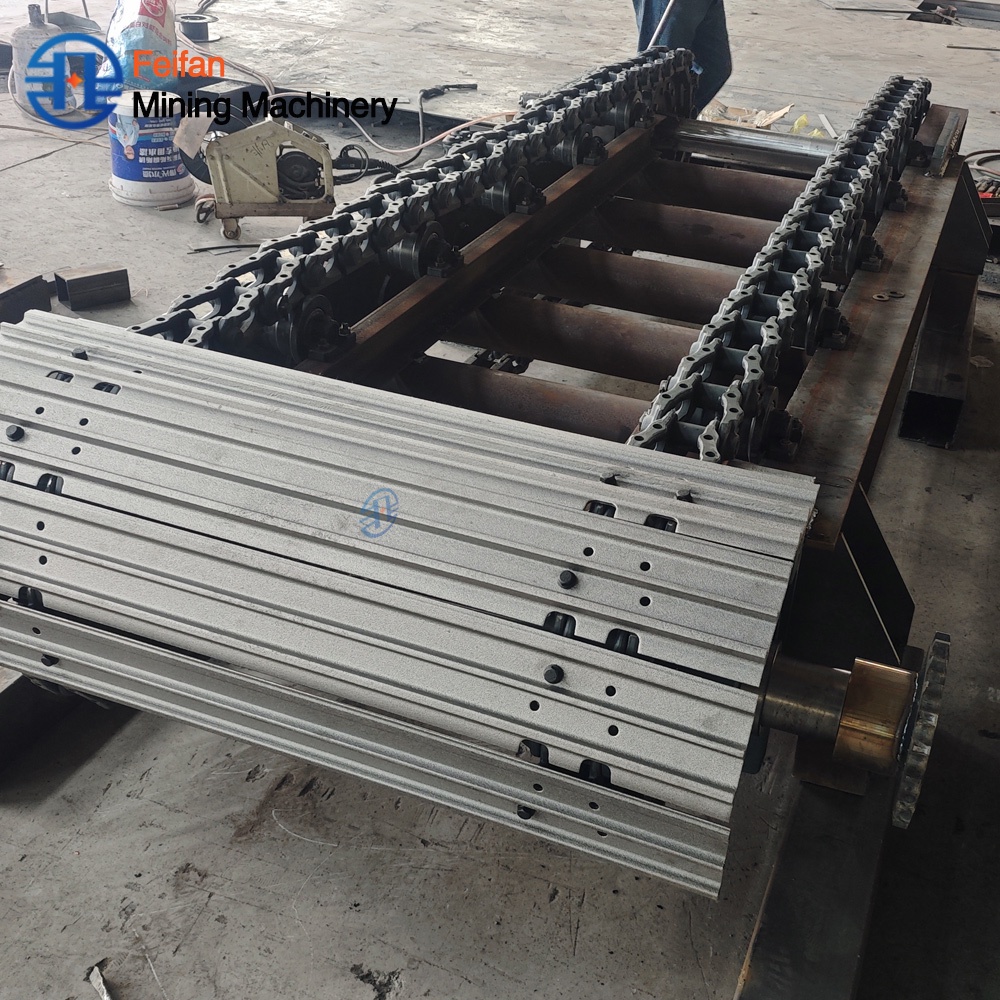
Pans take direct impact, abrasion, and uneven burden loading. In high-tonnage plants, that means cracks, deformation, loose fasteners, and edge wear are not cosmetic issues. A damaged pan can affect material sealing, alter load distribution, and in some cases create a snagging or spillage hazard that pulls operators into repeated cleanup exposure.
Loading should also be centered and controlled. When the chute drops material off-center, the feeder may continue running for months while suffering one-sided wear. That is one reason repeated chain adjustment does not always solve the real problem. The root cause may be poor chute design, inconsistent feed presentation, or oversized lump impact.
In full-line crushing systems, these checks should be linked with the condition of upstream and downstream equipment. For example, if a primary or secondary crushing stage is delivering unstable product shape or excessive coarse material, the apron feeder below storage may see harsher loading than intended. In those cases, reviewing adjacent equipment selection, including machines such as OEM Custom Cavity Design Spring Cone Crusher For Coarse And Medium Stone Crushing Production Machine, can be part of the broader reliability discussion, even though it does not replace feeder-specific inspection.
Lubrication is basic, but poor lubrication still causes advanced failures
There is nothing glamorous about lubrication checks, yet neglected lubrication remains one of the easiest ways to shorten feeder life. Bearings, chain systems, and drive components need the right lubricant, at the right interval, in the right quantity. Too little creates heat and wear. Too much can contaminate adjacent areas or hide seal problems.
What matters here is not just whether lubrication was done, but whether it was done against a defined standard. Many plants have intervals on paper but weak confirmation in the field. If you are auditing a site, ask to see actual condition trends: bearing temperature, grease condition, leakage evidence, and maintenance records tied to runtime or tonnage where possible.
This is also where manufacturer support makes a difference. Groups with long experience in aggregate and mining equipment manufacturing usually build better process discipline around wear parts, fabrication accuracy, and service response. A company established in 2009 in Binzhou’s mining equipment base, with feeder, crusher, screen mesh, conveyor, and EPC capability under the same group structure, often has an advantage in diagnosing line-level interactions rather than treating the feeder as an isolated machine.
Electrical and control checks should match mechanical reality
A feeder can be electrically healthy and mechanically unsafe. That sounds obvious, but many inspections lean too heavily on motor current, interlocks, and panel status. Those are useful indicators, not proof of safe condition.
Verify start-up alarms, interlock logic, local isolation points, cable protection, and stop response time. Then compare those findings with what the machine is physically doing. If current draw is rising, ask whether buildup, overloading, chain drag, or misalignment is increasing resistance. If operators report frequent nuisance trips, do not rush to widen control limits before checking the mechanical cause.
Repeated resets are a warning sign. They usually mean the feeder is being pushed to operate through a condition that should have triggered inspection.
Common mistakes during inspections
One mistake is checking the feeder only when it is stopped. Another is checking it only when it is running. You need both views. Shutdown inspection reveals cracks, bolt loosening, trapped material, and wear surfaces. Running inspection reveals noise, oscillation, surging, off-center motion, and spill behavior.
Another mistake is relying only on visual checks from one side. Many apron feeders hide developing problems on the return side, near the head section, or under skirts where material carryback builds slowly.
And one more: treating recurring cleanup as a housekeeping issue. If a feeder area constantly needs cleanup, that usually points to skirt wear, pan damage, poor sealing, or bad loading control. It is a mechanical signal first and a cleaning burden second.
What good practice looks like in a high-tonnage plant
A strong inspection routine is short enough to be repeated and specific enough to be useful. That usually means a pre-start check, an in-operation observation window, and a planned shutdown inspection with documented wear criteria. Not every site needs the same interval. Tonnes handled, material abrasiveness, lump size, moisture, and plant layout all affect the right frequency, so local operating conditions should be verified against OEM recommendations and site standards.
The better sites also define clear trigger points. For example: when chain stretch exceeds the allowable limit, when a guard is missing, when a pan crack reaches a set threshold, or when emergency stop testing is overdue, the feeder does not return to service until the issue is closed. That is what makes a safety check meaningful. Without action limits, inspection becomes observation without control.
Near the end of any review, come back to the same question: is the Apron Feeder still operating inside the condition it was designed for, or is the plant quietly asking it to absorb problems created somewhere else in the line? That single question often reveals more risk than a stack of generic checklists.
FAQ
How often should an Apron Feeder be inspected?
It depends on tonnage, material abrasiveness, and duty cycle. In heavy service, brief pre-start checks and regular operating observations are standard practice, with deeper inspections during planned shutdowns.
Is abnormal noise always a sign of immediate shutdown?
Not always, but it should never be ignored. Noise can come from chain wear, roller seizure, trapped material, or misalignment. The response should follow site risk rules and the severity of the condition.
What is the most overlooked safety issue on apron feeders?
Improper or incomplete guarding after maintenance is high on the list. Off-center loading and chronic spillage are also overlooked because they often develop gradually.
Can control system alarms replace physical inspection?
No. Alarms show symptoms. Physical inspection confirms the mechanical condition behind those symptoms.
Internal Link Anchor Text Suggestions
- Apron feeder maintenance checklist: link to maintenance guide page
- Common causes of feeder chain wear: link to troubleshooting article
- How to improve material flow in aggregate plants: link to process optimization page
- Crusher and feeder matching in stone production lines: link to equipment selection page
- Mining screen mesh selection for abrasive materials: link to screen media page
External Authority Source Directions
- Equipment manufacturer official maintenance and operation manuals
- Government or regulator pages covering machinery guarding and workplace safety compliance
- Industry association guidance on bulk material handling and mining plant safety
Leave A Message
If you are interested in our products and want to know more details, please leave a message here, we will reply you as soon as we can.