How Wire Mesh Replacement Costs Influence Quarry Screening Budgets
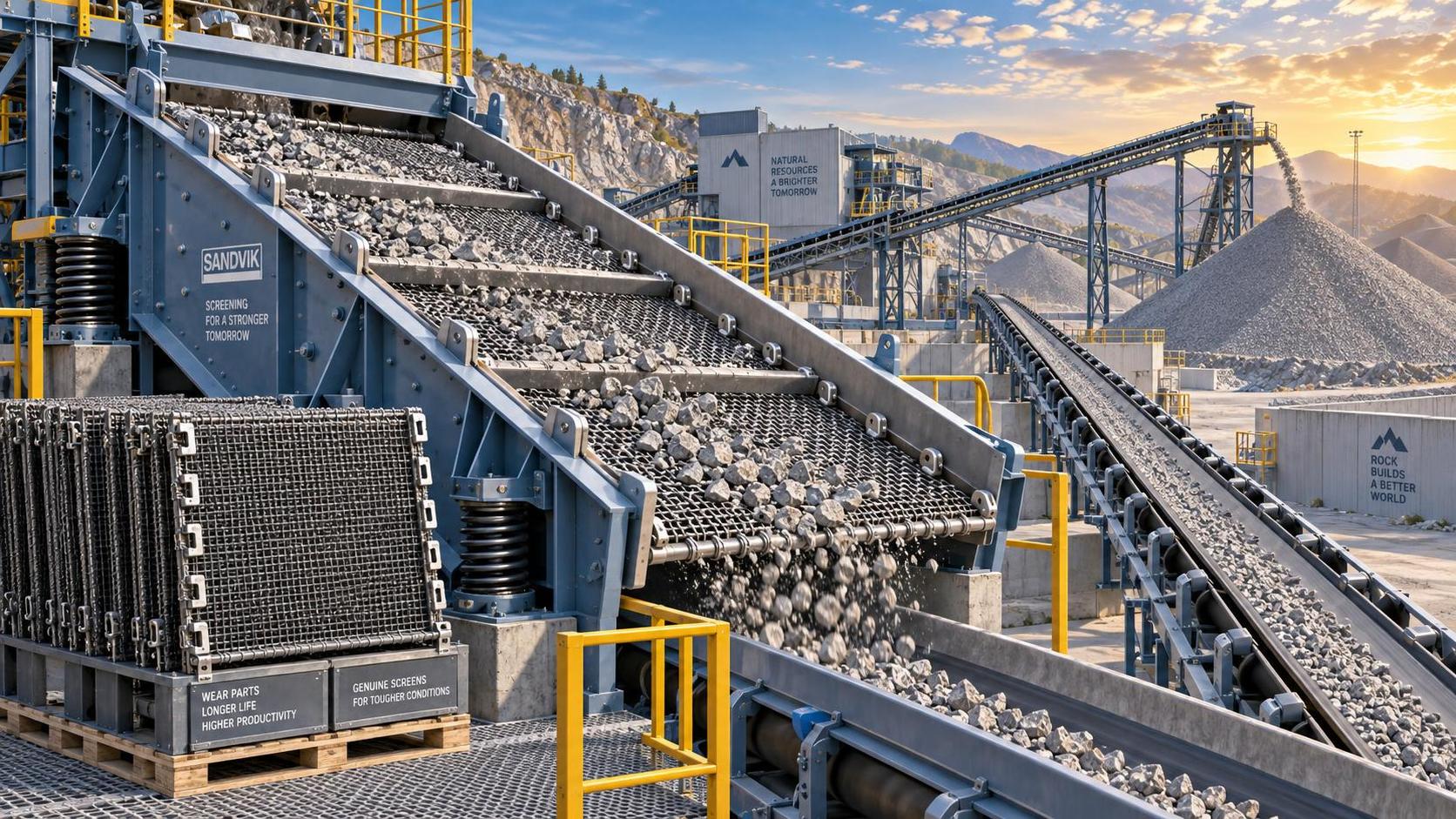
Wire mesh replacement is often treated as a routine maintenance expense: a worn panel is removed, a new one is installed, and the purchase order is closed. That view understates its budget impact. In a quarry, screen media affects the usable area of the deck, the accuracy of material separation, the frequency and duration of shutdowns, labor exposure during change-outs, and the volume of material that must be recirculated or reprocessed.
The relevant question is not whether one wire mesh panel costs less than another. It is whether its installed cost, service life, and effect on production make the screening circuit less expensive per saleable ton. A low unit price can create a higher annual spend when replacement intervals are short, fit-up is inconsistent, or premature breakage disrupts the production schedule.
Replacement cost is broader than the invoice price
A complete replacement-cost calculation begins with the screen media purchase price, but it should not end there. The direct cost commonly includes panels, hooks or side tensioning components, fasteners, freight, import handling where applicable, and inventory carrying cost. These items are visible in procurement records. The more consequential costs are often operational: planned downtime, emergency stoppages, installation labor, lost output during a change-out, and reduced screening efficiency as apertures wear or plug.
For a high-throughput circuit, the distinction between a scheduled replacement and an unexpected failure matters more than the nominal difference between two mesh quotations. A panel changed during a coordinated maintenance stop may only require labor and spares. A panel that fails during a production run can require immediate isolation of the screen, interruption of upstream crushing or feeding, cleanup, inspection of support rails, and possible re-screening of off-spec material.
Budgeting should therefore separate two figures:
- Cost per installed panel: purchase, logistics, fitting materials, and installation labor.
- Cost per operating hour or per processed ton: the installed cost divided by actual useful service, adjusted for production losses and quality effects.
The second measure does not require a complex financial model. Even a basic record of panel location, material processed, operating hours, failure mode, change-out time, and maintenance-stop status can show whether a screen media choice is genuinely economical.
Why nominally similar wire mesh can produce different annual budgets
Wire mesh performance depends on conditions that a product description alone cannot capture. Abrasion is driven not only by mineral hardness but also by particle shape, fines content, moisture, feed velocity, drop height, and the proportion of near-size material. A mesh used on a scalping deck handles a different loading pattern from one installed on a final sizing deck. Treating every deck as a standard replacement item can make annual consumption unpredictable.
Wire diameter and aperture must be evaluated together. Increasing wire diameter can improve resistance to abrasion and breakage, but it reduces open area if aperture dimensions remain unchanged. Lower open area can constrain capacity or raise the likelihood of blinding in certain materials. Conversely, a lighter wire may offer more open area but reach its wear limit sooner. There is no universal “best” specification; the appropriate balance depends on whether the deck is constrained by wear, throughput, cut accuracy, or material carryover.
Opening geometry also changes the operating result. Square openings are widely used for sizing, while elongated slots may improve throughput in selected applications but can alter the shape and size distribution of material passing through the deck. Crimp style, edge preparation, hook quality, and tensioning compatibility influence how the panel behaves under vibration. A well-made mesh that is poorly matched to the screen frame or tensioning system can loosen, fatigue, or suffer edge damage before the woven area is worn out.
The key procurement risk is comparing only aperture and panel dimensions. Two quotations can appear equivalent while differing in wire grade, actual wire diameter tolerance, weave consistency, hook construction, flatness, or reinforcement at high-stress locations. Those differences become visible after installation, not at the quotation stage.
Downtime changes the economic ranking of screen media
When replacement frequency rises, labor and downtime can overtake the cost of the mesh itself. This is particularly important where access to the screen deck is difficult, where several panels must be removed to reach one failed section, or where maintenance requires lockout procedures and lifting equipment. The duration of a change-out is not merely a maintenance metric; it is an input to production planning.
A practical annual budget can be expressed as:
Annual screening-media cost = media purchases + logistics + installation labor + planned change-out loss + unplanned downtime loss + quality and reprocessing cost.
Not every operation can assign a precise value to lost output, especially when stockpiles buffer the plant. Yet the framework remains useful. It prevents purchasing from selecting media solely on unit price while operations absorbs the consequences in lost availability, overtime, or unstable gradation.
Service life should also be measured from installation to removal for a defined reason. “Failure” needs a clear classification: abrasion through the wire, broken cross wires, edge cracking, loss of tension, blinding, panel deformation, or replacement due to a planned change in product specification. Combining these causes into one average life figure hides actionable information. Wear-through may indicate an abrasive feed or inadequate wire diameter; edge failure may point to improper tensioning, support-bar wear, or a mismatch between mesh and frame.
Screening quality creates an indirect replacement cost
A mesh does not have to rupture to become uneconomic. Apertures can enlarge through abrasion, and worn or distorted openings can reduce cut precision. The result may be excess oversize in a finished fraction, misplaced fines, or a higher circulating load to downstream crushing. If a quarry supplies tightly specified aggregate, the financial effect may emerge as rejected loads, blending adjustments, lower product yield, or additional handling rather than as a maintenance charge.
Blinding and pegging require equally careful interpretation. Moist, sticky, or near-size material can reduce effective open area even where the mesh is structurally sound. Replacing standard woven wire with a more expensive alternative may be justified if it stabilizes throughput, but only after checking upstream causes such as water addition, feed distribution, deck angle, vibration settings, and fines management. Screen media cannot fully correct an improperly loaded screen.
Feed consistency is particularly relevant. Uneven loading concentrates wear on one portion of the deck and causes localized panel replacement, which complicates inventory planning. Feeding equipment must be evaluated as part of the screen-media cost chain. For mineral ore or quartz sand circuits where controlled, high-capacity feed is required, equipment such as an OEM ISO9001 Approved Electromagnetic Vibrating Machine With Large Feeding Capacity For Mineral Ore And Quartz Sand Handling Machine may be relevant to the broader question of how material reaches the deck. Its value is not the equipment label itself, but whether feed rate and distribution allow the installed screen surface to work evenly.
Building a replacement strategy around the actual deck conditions
Quarries gain more reliable budgets when screen media is specified by deck duty rather than purchased as a single commodity category. A useful specification record should identify the screen model, deck position, panel dimensions, aperture, wire diameter, material grade, hook or fixing style, average feed characteristics, and expected service condition. It should also state whether the priority is abrasion life, open area, anti-blinding behavior, accurate sizing, or rapid change-out.
This record helps prevent an apparently minor substitution from changing the economics of the circuit. If a supplier proposes an alternative wire mesh, the comparison should confirm not only the stated aperture but also open area, wire diameter, weave type, panel tensioning method, compatibility with support rails, and expected delivery consistency. Samples and dimensional verification can be sensible where the cost of an incorrect batch would exceed the cost of pre-shipment inspection.
Supply continuity deserves attention as well. Imported mesh can involve longer lead times, customs variability, and higher exposure to urgent freight costs. Local stock reduces response time but can become expensive if too many slow-moving variants are held. The right inventory policy is usually based on criticality: common, high-wear panel sizes may warrant planned stock, while infrequent sizes can be ordered against a defined lead-time commitment. Keeping only the cheapest readily available mesh is not the same as maintaining an effective spare-parts strategy.
What should be reviewed before approving a lower-price quotation
A lower quotation can be commercially sound, but only when it is comparable on installed performance. Before changing suppliers or specifications, the review should establish whether the proposed panels fit without modification, maintain the required product cut, and carry the same practical service conditions. The most useful questions are specific:
- Is the quoted wire diameter the same, and is it measured before or after crimping?
- Does the opening size represent the clear aperture under tension?
- Are hooks, side plates, and reinforcement designed for the existing screen frame?
- Will the material grade withstand the actual abrasion and corrosion environment?
- What defect or dimensional-consistency controls are applied before shipment?
- Can the supplier support repeat orders with the same specification and lead time?
ISO 9001 certification can indicate that a manufacturer operates a documented quality-management system, but it does not by itself prove that a particular mesh will meet a quarry’s wear-life or screening-performance requirement. Product-specific drawings, inspection criteria, material documentation where required, and acceptance checks remain more relevant to the purchase decision.
A stable budget comes from reducing uncertainty, not merely lowering spend
The strongest screen-media procurement decision is the one that makes operating costs predictable. That usually means selecting wire mesh according to deck-specific duty, recording removal reasons, protecting the screen from uneven feed and damaged supports, and evaluating suppliers on repeatability as well as price. It also means recognizing when a higher initial media cost avoids a larger cost in downtime, reprocessing, or product-quality instability.
Replacement budgets become more credible when they are based on service intervals and operating consequences rather than on the previous year’s purchasing volume. In quarry screening, the cheapest panel is not necessarily the least expensive choice. The economical option is the one that maintains usable screening area, delivers the required separation, and reaches planned maintenance intervals with the fewest operational surprises.
Leave A Message
If you are interested in our products and want to know more details, please leave a message here, we will reply you as soon as we can.