How to Size a Complete Crushing Plant for Required Throughput and Feed Size
How to Size a Complete Crushing Plant for Required Throughput and Feed Size
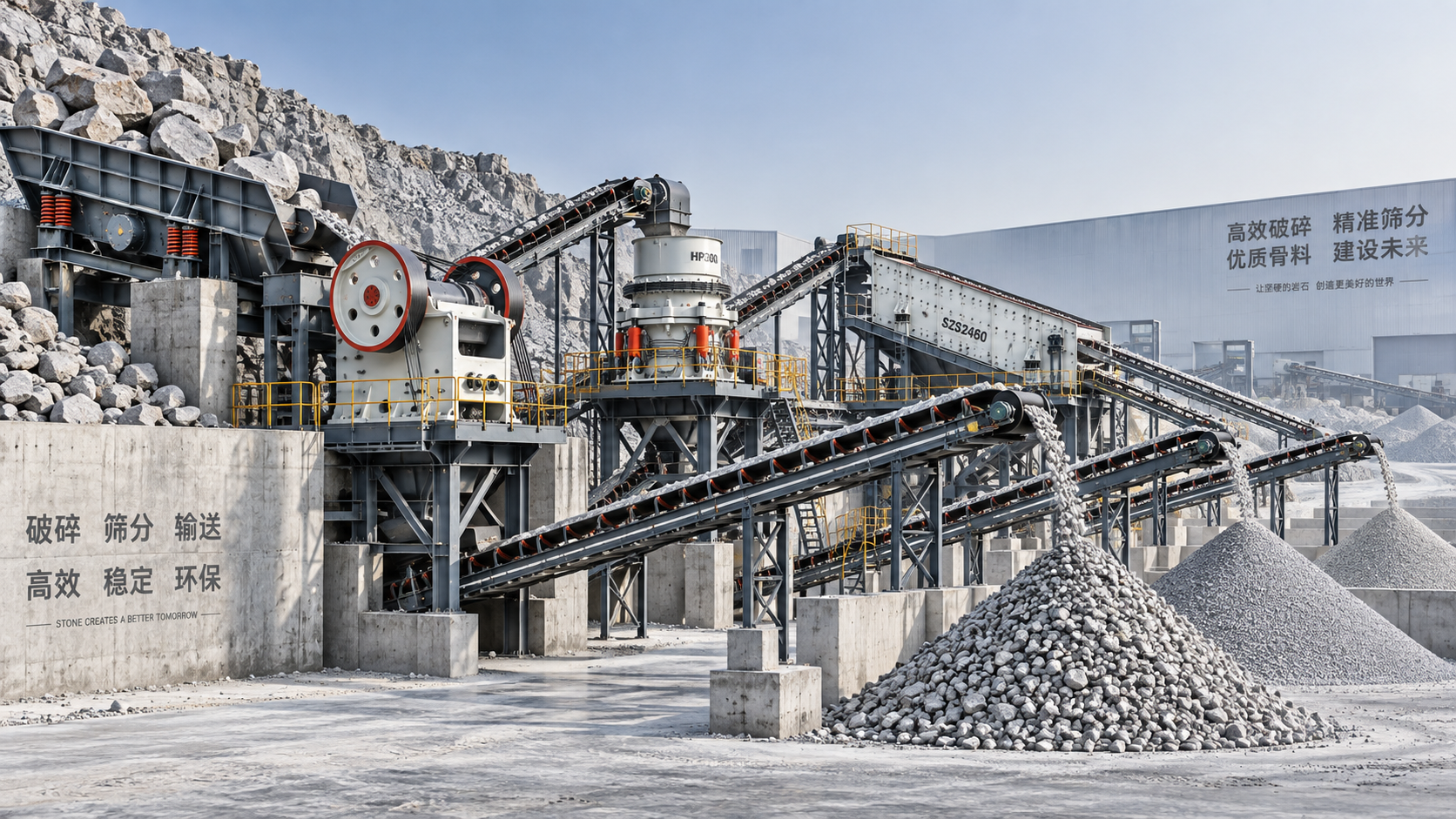
Sizing a Complete Crushing Plant is not a matter of selecting one crusher with a nameplate capacity above the requested tonnage. A plant may appear adequate on paper yet lose output because the feeder cannot regulate surges, the primary crusher receives oversized rock, the screen is overloaded with fines, or a transfer conveyor becomes the restriction point. For technical evaluators, the real task is to create a balanced process in which every machine can handle the material, flow rate, and product requirement under expected operating conditions.
The starting point is a reliable design basis: required hourly throughput, annual operating hours, maximum feed size, material hardness and abrasiveness, moisture and clay content, bulk density, and the required final gradations. If any of these inputs are uncertain, capacity calculations should be treated as preliminary. In aggregate production, the size distribution of the actual run-of-mine feed often matters as much as the stated maximum rock size.
Define Throughput Beyond the Headline Tonnage
A request for “200 tonnes per hour” needs clarification. Is that the average finished-product output, the peak incoming feed rate, or the capacity expected during the best operating period? Is production required for one shift, two shifts, or seasonal campaigns? The answer changes the margin needed in the plant design.
A practical design normally considers more than the target average. Feed consistency varies with blasting practice, loader operation, stockpile segregation, and weather. Planned maintenance also removes equipment from service. Rather than simply oversizing every machine, evaluators should identify the expected duty cycle and allow sensible capacity margin at the stages most exposed to variation. This is especially relevant upstream, where a short interruption at the primary section can leave the entire downstream circuit idle.
Capacity must also be measured at a clearly defined point. A plant may process a given tonnage at the primary crusher while producing less saleable aggregate after screening, recirculation, washing, and removal of unsuitable fines. When comparing proposals, request a mass-flow description showing feed rate, crushed product flow, screen oversize return, and each final product stream. It makes hidden bottlenecks easier to identify.
Feed Size Sets the Primary Stage
The primary crusher must accept the largest credible particle, not only the average rock fragment. Its feed opening, chamber geometry, allowable reduction ratio, and feed arrangement should be reviewed together. A jaw crusher is often considered where the feed is coarse and irregular, while gyratory-type solutions may be evaluated for substantially larger continuous-duty applications. The correct choice depends on the duty, material behavior, and project scale rather than a single rule.
Do not assume that a larger opening automatically solves feed problems. A poorly controlled feed can reduce crushing efficiency, accelerate liner wear, and create uneven discharge. A heavy-duty grizzly feeder may be needed to absorb loader or truck surges and remove bypass fines before primary crushing. Where sticky material is present, the feeder and grizzly arrangement deserve as much attention as the crusher itself; otherwise, bridging and carryback can dominate plant availability.
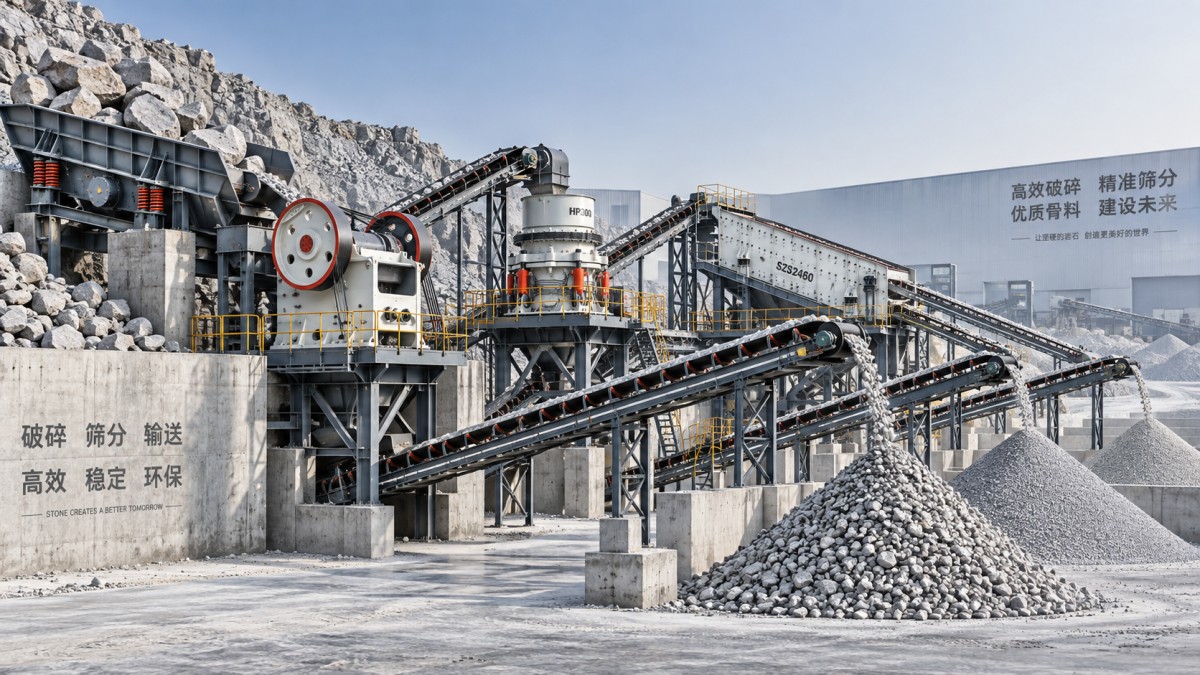
The discharge from the first stage then determines whether a secondary crusher can work efficiently. If the primary crusher produces too much oversize, the secondary chamber may choke or require a wider closed-side setting than the final specification allows. If it produces excessive fines, screening load and recirculating loads can rise without adding useful product. A balanced reduction ratio across stages is generally more stable than forcing one machine to do too much work.
Match Crushing Stages to Product Specification
For many hard-rock aggregate plants, the circuit follows a primary crushing stage, secondary reduction, screening, and—where required—tertiary crushing or sand making. However, the required products should decide the layout. A simple base-course product may need a different circuit from a plant producing several tightly controlled aggregate fractions and manufactured sand.
Cone crushers are commonly assessed for secondary or tertiary duties where controlled reduction and cubical particle shape are important. Hydraulic adjustment can help operators respond to liner wear and changing product demand, but it does not eliminate the need to verify feed size, feed distribution, and recirculating load. In space-constrained or smaller processing layouts, a compact cone crusher configuration may be worth assessing alongside the screen and conveyor geometry, such as the FEIFAN Compact Structure Hydraulic Cone Crusher Saving Space For Small Scale Processing Plant Crusher .
Screening is the control point that makes a multi-product plant work. The selected screen must have sufficient effective area for the required cut sizes, material moisture, and expected percentage of near-size particles. Fine, damp, or clay-contaminated feed can reduce screening efficiency substantially in real operation. A screen sized only from dry laboratory assumptions may become the limiting machine after commissioning. Screen media selection also matters: wire mesh, polyurethane panels, and other options involve a trade-off among open area, wear life, blinding resistance, and product accuracy.
Treat Conveyors and Stockpiles as Process Equipment
Conveyors are often underestimated because they do not crush material, yet they determine whether the circuit can sustain flow. Belt width, speed, incline, transfer chute design, impact loading, and installed drive power must match the actual stream being carried. A return conveyor carrying screen oversize may see a higher instantaneous load than the nominal plant throughput. Each conveyor should therefore be checked against its own duty, not copied from the headline capacity.
Stockpile design is equally important. Small buffers between key stages can keep downstream equipment running during short upstream interruptions. At the same time, excessive rehandling, uncontrolled pile segregation, and limited access for loaders can undermine the value of that buffer. The best layout is usually the one that gives operators room to maintain equipment, inspect transfer points, and isolate machines safely without creating unnecessary material handling.
Questions That Expose Weak Plant Proposals
- What feed gradation, moisture level, and material properties were used for the capacity calculation?
- Is the stated capacity based on fresh feed, crusher throughput, or finished saleable products?
- What is the expected circulating load in closed-circuit crushing stages?
- Which component limits output if the feed contains more fines or the desired product split changes?
- How will liners, screen media, wear parts, and critical drives be serviced without disrupting the whole line?
These questions move the evaluation beyond a list of equipment models. They also clarify whether the supplier has considered the plant as an operating system rather than a collection of machines.
Bring Manufacturing and EPC Thinking into the Review
For a complete line, process design, fabrication, screen media, installation coordination, and after-sales access are closely connected. FEIFAN’s group structure covers mining machinery, wire screen production, and import-export support: Shandong Feifan Mining Machinery manufactures crushers, screens, and belt conveyors, while Binzhou Feifan Wire Mesh produces polyurethane and steel screen meshes. This combination can be useful during evaluation because screening performance and wear-part selection should be considered with the crushing circuit, not after equipment has already been specified.
Established in Binzhou, Shandong Province in 2009, the group operates a 66,000-square-metre manufacturing site with 156 workshop employees and a technical R&D team that includes 13 senior engineers. Its experience with EPC-oriented aggregate projects and export supply to regions including Africa, Central Asia, and the Americas supports a practical focus on line integration, transport considerations, and service planning. Even so, every project still requires its own site data, local electrical requirements, civil constraints, and product specification review.
Before approving a Complete Crushing Plant, ask for a process flow diagram, equipment duty list, material balance, layout drawing, power schedule, and wear-part assumptions. Then test the proposal against the difficult conditions—not merely the ideal feed. A plant that remains balanced when feed size shifts, fines increase, or one product fraction becomes more important is usually a more defensible investment than one sized only for an attractive capacity figure.
Leave A Message
If you are interested in our products and want to know more details, please leave a message here, we will reply you as soon as we can.