How to Select Mining Equipment Based on Ore Hardness, Capacity, and Site Access
Selecting the right Mining Equipment is critical to keeping a project on schedule, within budget, and productive from day one for project managers.
Ore hardness, required capacity, and site access determine far more than a crusher model. They affect plant layout, wear costs, commissioning risk, energy demand, and maintenance planning.
The best equipment selection starts with operating data rather than supplier catalogues. A practical design balances throughput, product specification, mobility, maintainability, and long-term operating cost.
Project leaders should evaluate the complete material flow, from feed delivery through crushing, screening, conveying, washing, stockpiling, and final loading, before approving individual machines.
A system that appears inexpensive at purchase can become costly when it produces excessive fines, requires frequent liner changes, or cannot be transported efficiently to site.
Start With Ore Hardness and Material Characteristics
Ore hardness is the first technical factor because it directly affects crushing method, machine structure, wear-part consumption, installed power, and expected maintenance intervals.
Do not assess hardness alone. Request representative samples and test compressive strength, abrasiveness, moisture, clay content, particle shape, and maximum feed size before finalizing equipment.
Hard rock with high compressive strength often requires a robust primary jaw crusher followed by cone crushing stages for reliable reduction and controlled product gradation.
For highly abrasive materials, prioritize thick wear liners, durable rotor components, reinforced feed areas, and easily replaceable screening surfaces to reduce unplanned shutdowns.
Soft or moderately hard material may allow impact crushing, which can provide better shaping and lower capital expenditure when abrasion levels remain manageable.
However, impact crushers are not automatically the lowest-cost option. In abrasive granite, basalt, or quartz-rich feed, wear consumption can outweigh initial savings quickly.
Material moisture also changes the decision. Wet, sticky feed can bridge in hoppers, blind screens, and reduce crusher efficiency unless the plant includes appropriate scalping and washing stages.
Project managers should ask suppliers for wear-life estimates based on comparable material. Generic performance claims are less useful than documented operating experience with similar ore.
Size Capacity Around Real Production Conditions
Required capacity should be defined as a sustained hourly target, not simply the maximum nameplate output shown in a Mining Equipment specification sheet.
Start with annual production goals, expected operating days, daily working hours, and realistic availability. Then add a practical allowance for maintenance, weather, and feed variation.
For example, a plant targeting 500,000 tonnes annually should not be sized only by dividing production by calendar hours. Effective operating time is always lower.
Capacity calculations must consider the bottleneck. A large crusher cannot improve plant output if the feeder, screen, conveyor, stockpile capacity, or truck loading station is undersized.
Use a material balance for every stage. Record feed size, reduction ratio, circulating load, fines generation, product split, and required stockpile volume across the process.
Screening capacity deserves particular attention because screen efficiency controls both final product quality and crusher recirculation. Poor separation can overload downstream crushing equipment.
For demanding applications, specify replaceable, wear-resistant media matched to material characteristics. Options such as FEIFAN OEM Vibrating Screen Replacement Parts Polyurethane Rubber Metal Wear Resistant Accessories Manufacturer can support longer service life where abrasion and screening loads are high.
Allowing moderate design margin is sensible, but excessive oversizing wastes capital and energy. The target is stable output during normal variation, not oversized equipment running inefficiently.
Assess Site Access Before Selecting Plant Configuration
Site access determines whether equipment should be fixed, semi-mobile, modular, skid-mounted, or fully mobile. This decision should happen before civil construction and procurement begin.
Narrow roads, weak bridges, steep grades, remote border crossings, and limited crane access can make standard plant modules difficult or expensive to deliver.
Map the transport route from port or factory to the installation area. Include legal haulage limits, turning radii, bridge clearances, local permits, and seasonal road conditions.
When access is restricted, modular Mining Equipment can reduce delivery risk. Smaller components may be transported separately and assembled on site using planned lifting procedures.
Mobile crushing and screening units can shorten startup schedules where reserves move frequently or where permanent foundations are impractical. They also reduce relocation costs between pits.
Fixed plants are often preferable for long-life operations with high, consistent tonnage. Their layouts can support larger stockpiles, better automation, and lower unit operating costs.
Assess available utilities early. Electrical supply, diesel logistics, water availability, drainage, and communications infrastructure can materially affect both configuration and total project investment.
Site topography is equally important. A layout that uses natural elevation for gravity flow may reduce conveyor length, energy consumption, earthworks, and transfer-point maintenance.
Choose Equipment as an Integrated Production Line
Individual machines should be selected only after the process route is established. Primary crushing, secondary reduction, screening, sand making, washing, and conveying must work as one system.
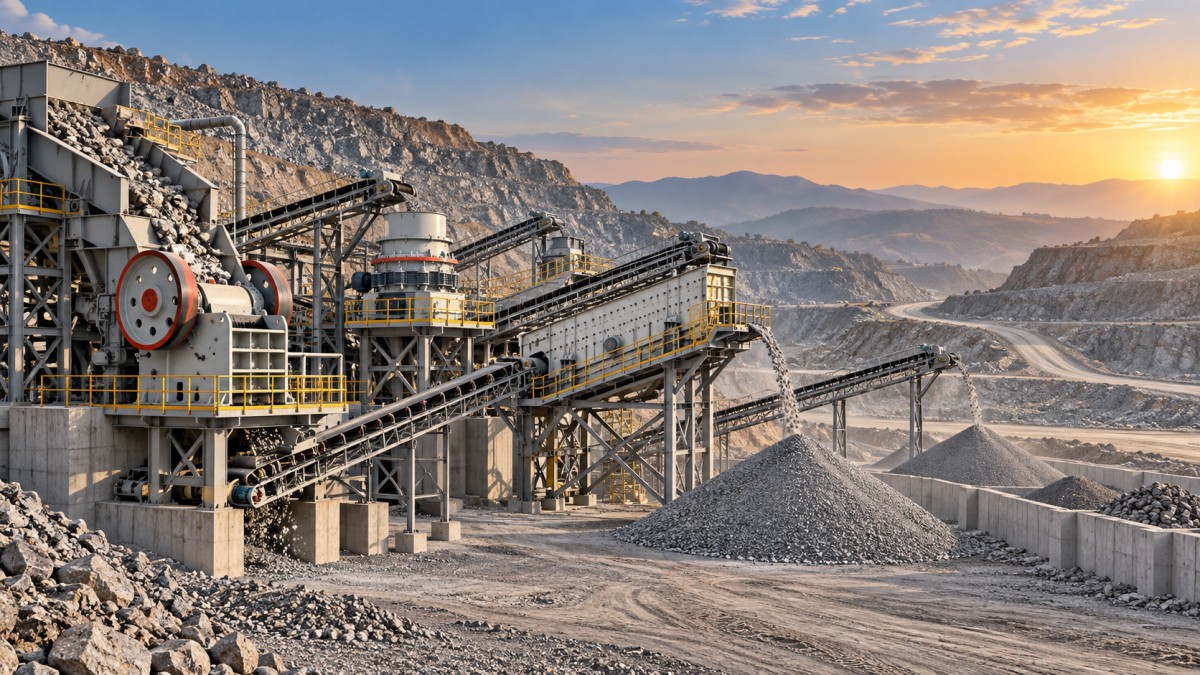
A typical hard-rock aggregate line may include a vibrating feeder, jaw crusher, cone crusher, vibrating screens, belt conveyors, sand maker, and dust-control equipment.
The exact arrangement depends on feed size and final products. Road base material, railway ballast, concrete aggregate, and manufactured sand each require different gradation and shape control.
Ask whether the proposed system can produce all planned products simultaneously. A plant that meets one specification but compromises another may create inventory and sales problems.
Consider transfer points carefully. Poor chute design causes blockages, belt damage, dust leakage, and segregation. These issues are often more disruptive than the main crusher itself.
Automation should match project complexity. Basic interlocks protect equipment, while advanced controls can stabilize feed rates, track production, monitor vibration, and reduce operator dependence.
For overseas or remote projects, standardizing motors, bearings, belts, and electrical components can simplify spares management and reduce repair delays during critical production periods.
Evaluate Cost Beyond the Purchase Price
Capital cost is visible during procurement, but operating cost determines project profitability over time. Energy, wear parts, labor, downtime, transport, and maintenance should be evaluated together.
Compare suppliers using total cost of ownership over several years. Include liner replacement frequency, screen media life, power draw, service response, and recommended critical spare inventories.
Higher-quality equipment may cost more initially but reduce lost production. For project managers, availability is often the most valuable performance indicator because downtime affects every downstream activity.
Request a clear scope of supply. Confirm whether foundations, steel structures, electrical cabinets, cables, lubrication systems, dust control, installation guidance, and commissioning are included.
EPC-capable suppliers can reduce interface risk by coordinating process design, equipment manufacture, installation support, and after-sales service under a unified technical responsibility.
Before signing, review warranty conditions and local support capability. Fast access to engineers, wear parts, and practical troubleshooting is essential when production targets are tight.
Use a Decision Framework Before Issuing the Purchase Order
A disciplined selection process prevents costly assumptions. Build a comparison table that evaluates technical suitability, operating cost, delivery schedule, site compatibility, and supplier service capacity.
First, validate material data through sampling or laboratory testing. Second, confirm the required product sizes and annual output. Third, develop the process flow and equipment list.
Next, verify transport feasibility and site infrastructure. Then compare suppliers based on complete proposals, including layouts, power demand, wear parts, commissioning support, and exclusions.
Finally, conduct a risk review with operations, maintenance, logistics, finance, and construction stakeholders. Their input often identifies practical constraints missing from early process calculations.
The right Mining Equipment choice is not the machine with the highest advertised capacity. It is the system that reliably delivers required products under actual site conditions.
Conclusion
Ore hardness determines crushing and wear requirements, capacity defines the production balance, and site access shapes plant configuration, transport planning, and installation strategy.
Project managers should select equipment through material testing, realistic throughput analysis, site assessment, and total-cost comparison. This approach produces more reliable plants and stronger investment outcomes.
Leave A Message
If you are interested in our products and want to know more details, please leave a message here, we will reply you as soon as we can.