How to measure replacement screen mesh before ordering
How to Measure Replacement Screen Mesh Before Ordering
Ordering the wrong Screen Mesh can delay an aggregate project, increase costs, and disrupt production. Accurate measurements help project managers select a replacement that fits the vibrating screen and meets screening requirements. Before placing an order, check the mesh dimensions, aperture size, wire diameter or panel thickness, and fixing method. This guide explains what to measure and what information to share with your supplier, helping you avoid fitting issues and keep your operation on schedule.
Start with the screen deck, not just the old mesh
A worn screen is a useful reference, but it may no longer represent its original dimensions. Edges can deform, hooks can bend, and openings can enlarge through abrasion. If the previous panel was an imperfect fit, copying it may reproduce the problem.
Before measuring, isolate and lock out the machine according to site procedures. Clean away buildup and identify the deck position, material flow direction, and tensioning arrangement. Check the equipment drawing or previous approved specification if available, then compare it with the actual deck and an intact section of the old screen.
Record dimensions in millimetres and label each measurement on a sketch. “Length” and “width” can be interpreted differently, so mark which direction runs along material flow and which runs across it. Note the number of panels on the deck and whether each position uses the same size.
Measure the panel and its attachment points
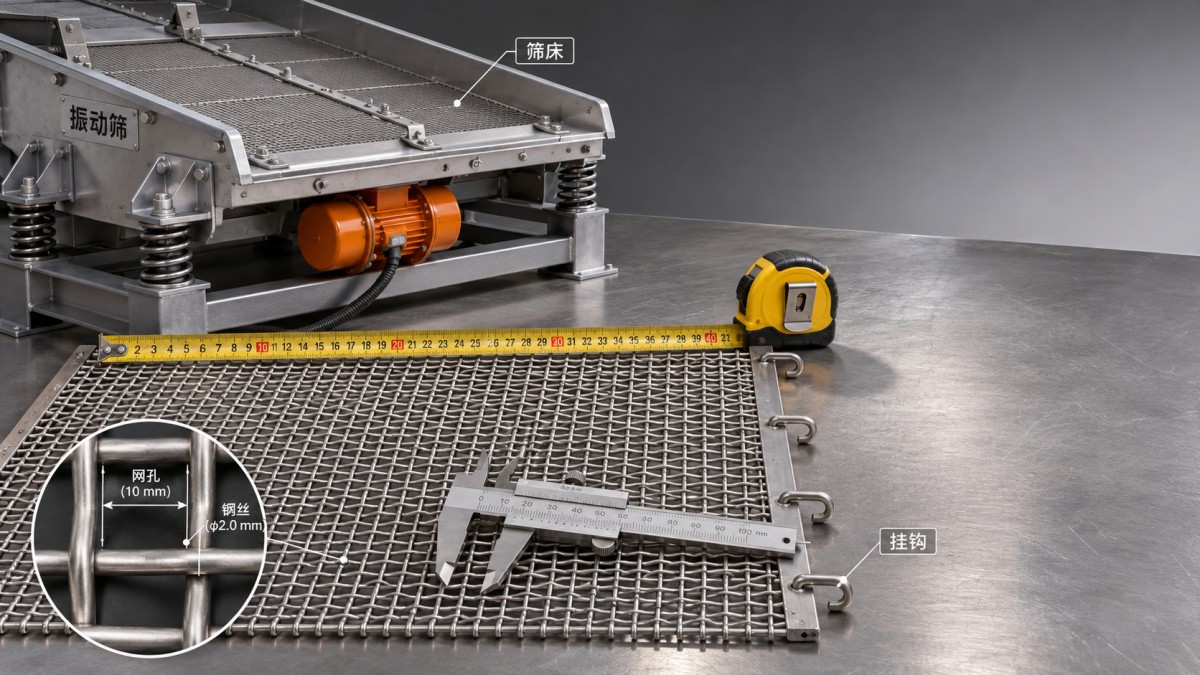
For a tensioned woven-wire screen, measure the usable screen surface and the overall dimensions separately. Take measurements at more than one point; a difference may indicate wear, distortion, or an uneven deck. Tell the supplier whether a dimension includes the hooks rather than assuming their standard measuring convention matches yours.
Examine both hooked edges. Record the hook profile, direction, approximate angle, and any reinforcing strips or rubber protection. Photograph an end view beside a ruler. Also identify whether the screen is tensioned across the machine or along it: the hook orientation and panel construction must suit the installation.
For modular polyurethane panels, measure overall length, width and thickness, then document the underside and fixing details. Depending on the system, the critical dimensions may include pin positions, slot spacing, rail profiles or bolt-hole centres. Check edge and corner modules separately; they may differ from panels in the middle of the deck.
Do not use deck size alone to calculate panel dimensions. Allowances, support arrangements and fixing geometry depend on the equipment design. Ask the supplier to confirm the dimensions and tolerances on a drawing before manufacture.
Check the opening and material specification
The aperture is the clear opening between adjacent wires or panel edges, not the distance from wire centre to wire centre. Measure several openings in an unworn area with calipers and record both directions, particularly for rectangular slots. If the old surface is badly worn, use the original specification or the required product grading as the starting point instead of relying on a single field measurement.
For woven wire, measure wire diameter as well as aperture, and describe the weave or provide a close-up photograph. Mesh count—the number of openings per linear inch—is not the same as aperture size: wire diameter also affects the clear opening. For polyurethane, provide panel thickness, aperture shape and slot orientation relative to material flow.
A heavier wire or thicker panel may improve resistance to wear in some duties, but it can also reduce open area or change screening performance. Equally, changing material without checking the support and fixing system can create installation problems. Treat a proposed redesign as a separate decision from a like-for-like replacement.
Include operating conditions in the cost decision
The lowest quoted panel price is not necessarily the lowest project cost. Compare expected service life, changeout labour, freight, spare stock and the production time at risk during replacement. A screen that fits but blinds frequently may cost more to operate than its purchase price suggests.
Give the supplier the material being screened, approximate feed size, required separation, moisture conditions and the problem with the current screen. Wet or sticky material calls for a different discussion from dry, free-flowing aggregate. If washing is part of the wider process, equipment selection should be considered alongside the screening duty; the FEIFAN Multi Functional Wheel Sand Washer Device For Dry Sand Wet Sand Processing Anti Blocking Machine is one example of equipment in the group’s sand-processing range, rather than a substitute for specifying the screen correctly.
What to send before approving the order
A useful enquiry combines the marked-up sketch with photographs of the complete deck, panel surface, fixing detail and any damaged areas. Add the machine manufacturer and model if known, quantities by deck position, required delivery date and whether replacement fasteners are needed. Flag any measurements taken from damaged parts as uncertain.
Binzhou Feifan Wire Mesh manufactures polyurethane and steel screens, while the wider FEIFAN group also produces screening equipment. That combination can be useful when a replacement needs to be checked against the machine arrangement rather than quoted from a panel size alone. For a custom order, agree on the drawing, material, aperture, tolerances, packing and delivery terms before release; where the geometry remains uncertain, discuss a sample or site verification before committing to a full set.
Leave A Message
If you are interested in our products and want to know more details, please leave a message here, we will reply you as soon as we can.