How to compare screen mesh prices by service life

A lower Screen Mesh price only saves money if the mesh processes enough material before replacement. Compare the delivered cost of each option against the tonnes of acceptable product screened during its useful life, then add the labor, lost production and other costs associated with changing it. A more expensive panel can be cheaper per tonne when it lasts longer or reduces unplanned stoppages; the reverse is true if it restricts throughput or requires costly modifications.
Turn the quoted price into a cost per tonne
Start with a consistent cost boundary. For each option, include the mesh and freight, any required fastening parts, installation labor, disposal and the cost of production lost during replacement. Divide that total by the tonnes of acceptable product screened over the same service period. Use actual contribution lost during downtime where it can be estimated; if production can be recovered later, count only the loss that remains.
Cost per acceptable tonne = total mesh-related cost during the period ÷ acceptable tonnes produced during the period.
Suppose one screen costs twice as much as another and lasts twice as long. Its purchase cost per operating hour is equal to the cheaper option’s, provided both run under comparable conditions. If the longer-lasting screen also needs fewer changeouts, its total cost can be lower. But if it reduces screening capacity or produces more off-spec material, those losses must be included before reaching a conclusion.
Compare the same screening area and scope of supply. A quote for individual panels is not directly comparable with one for a complete deck unless panel count, edge preparation, supports and fasteners are accounted for. Freight can also change the result when panels differ substantially in weight or shipment frequency.
Service life needs a clear endpoint
Record life in operating hours and in tonnes processed. Hours show maintenance exposure, while tonnes reflect the amount of work completed. Either measure alone can mislead: a mesh may remain installed for a long calendar period because the plant ran infrequently, or accumulate many operating hours at a reduced feed rate.
Define replacement by the condition that actually ends useful service. A hole, broken wire or detached panel is an obvious endpoint, but oversize contamination, loss of separation efficiency or unacceptable blinding can require earlier action. A screen that remains physically intact while allowing off-spec material through is no longer delivering the intended result.
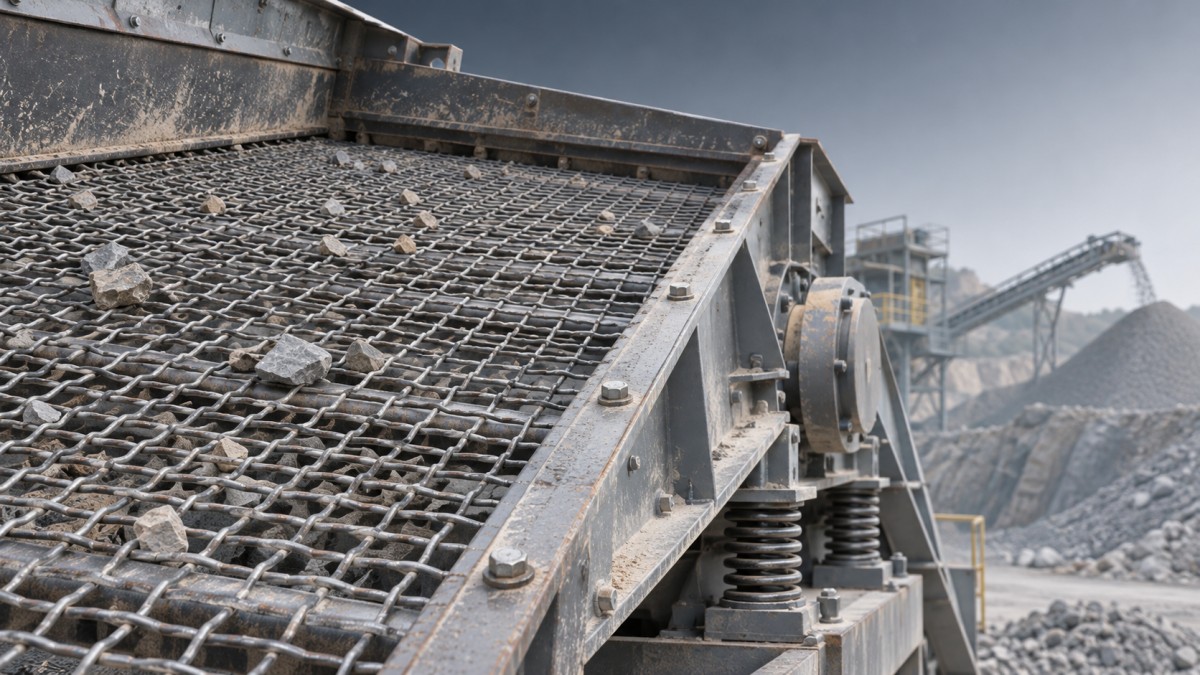
Inspect wear patterns at removal. Localized damage near the feed end points to a different problem from uniform abrasion across the deck. Incorrect tension, damaged supports or material striking the screen too hard can shorten the life of either steel or polyurethane. Replacing the mesh without correcting the cause makes a price comparison unreliable.
Compare materials at the required separation
Steel wire screens offer a familiar option where open area and screening capacity are important. Wire diameter affects both strength and available opening area: thicker wire can resist wear for longer, but leaves less space for material to pass through at the same nominal aperture. Steel also needs correct tension and sound support to limit wire movement and premature breakage.
Polyurethane panels can offer good abrasion resistance in suitable applications and are available in modular configurations. Their thicker screening surfaces and different opening geometry can alter effective open area and near-size particle passage. A panel that lasts longer but requires the deck to run below the required throughput may have a higher cost per acceptable tonne.
Compare aperture shape, actual opening dimensions and open area alongside the material. Wet, sticky feed can blind or peg openings differently from dry, free-flowing aggregate. Feed size distribution, impact height, moisture and deck position all affect the result, so a service-life claim from another application is a starting point rather than a guaranteed outcome.
Upstream washing changes the material presented to a screen, so comparisons are most useful when the washing arrangement remains consistent. Where a circuit includes FEIFAN Environment Friendly Dust Free Sand Washing Gear For Green Mining Project Adjustable Speed Machine , record water use and feed condition during each trial; a change in fines or moisture can alter both screening performance and wear.
Account for the changeout, not just the panel
Replacement cost varies with installation method. A modular panel may allow a worn section to be changed without removing the entire deck, provided compatible spares and fastening parts are available. A tensioned screen may have a lower initial cost but require a longer stoppage to release, remove and retension. Compare the work actually required on the existing machine, including access, lifting equipment and any support repairs.
Separate scheduled downtime from unexpected failure. If replacement fits into an existing maintenance shutdown, the incremental production loss may be small. An unexpected tear during a production run can have a much greater cost, especially when the screen is a bottleneck and there is no spare capacity. Avoid charging the full value of a scheduled shutdown to the mesh if other maintenance would have stopped the plant anyway.
Build a comparison from operating records
Run alternatives on equivalent decks or in successive periods with similar feed and operating settings. Record the installed quantity, delivered cost, start and removal dates, operating hours, tonnes processed, changeout time and reason for replacement. Note any changes to feed source, screen speed, spray water or support condition; these can explain a difference that would otherwise be attributed entirely to the mesh.
Where operating conditions cannot be held constant, use a range of expected service lives rather than a single estimate. Calculate the break-even life by dividing the proposed option’s total cost per changeout by the current option’s cost per changeout, then multiplying by the current service life. This gives a useful threshold when throughput and product quality remain comparable. Revisit the calculation if either screen changes the quantity of acceptable product.
Keep a record of the failure location and a sample or photograph of the removed mesh with the operating data. That evidence makes it easier to distinguish normal wear from a support, tensioning or feed-distribution problem before committing to the next order.
Leave A Message
If you are interested in our products and want to know more details, please leave a message here, we will reply you as soon as we can.