How does feed distribution affect banana screen performance?

Feed distribution can determine whether a banana screen delivers its intended capacity and separation efficiency. A well-spread feed allows more of the deck width to do useful work. A concentrated stream can overload one area while adjacent screen media remains lightly loaded, allowing undersize material to leave with the oversize and accelerating localized wear.
The effect depends on more than where the feed lands. Feed rate, particle size, moisture, impact velocity and the shape of the incoming stream all influence how the bed develops across the deck. For an Equal Thickness Screen operating below its rated capacity, uneven distribution may still cause poor separation; conversely, a uniform feed cannot compensate for a screen that is undersized for the duty.
Why distribution matters on a multi-slope deck
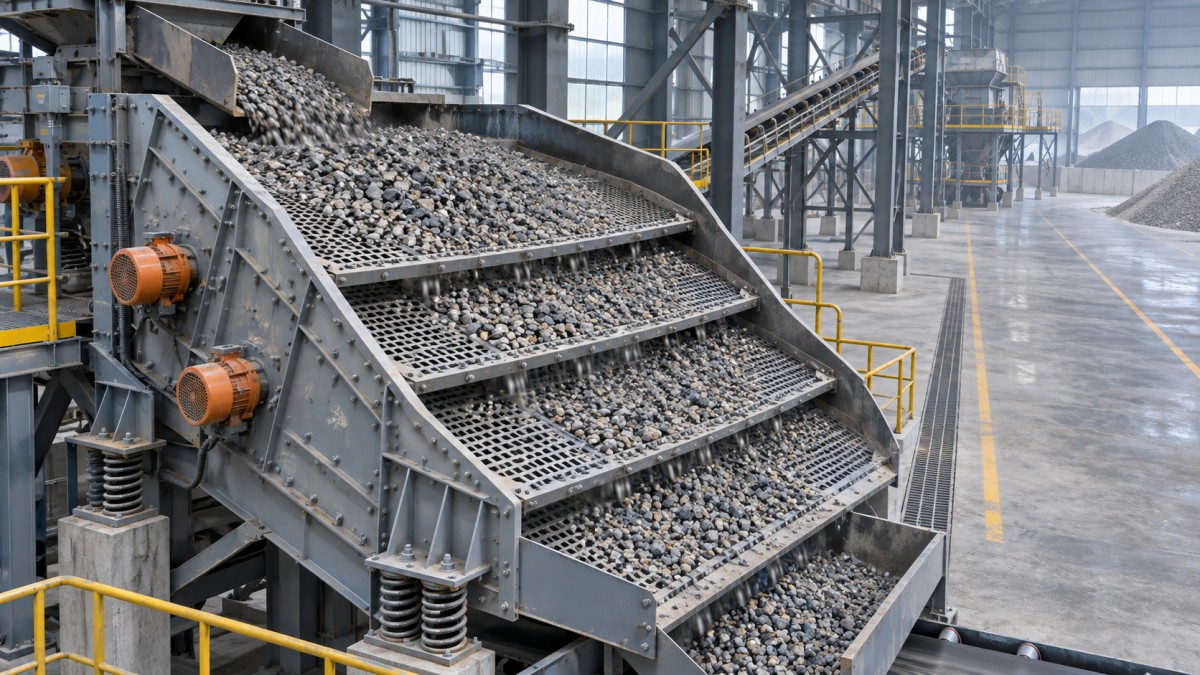
A banana screen uses deck sections with different inclinations. The steeper feed-end section moves material rapidly, encouraging a large proportion of undersize particles to pass through early. As material travels towards flatter sections, its velocity falls and the remaining particles have more opportunity to approach the openings.
This arrangement depends on the bed presented to the screen. If most of the feed enters along the centreline, the loaded strip can remain deeper than the material at the sides. Fine particles must travel farther through that bed before reaching the screen surface, and openings beneath the concentrated stream must handle more material. Some fines may therefore carry over with the oversize even though unused screening area is visible nearby.
Uneven feed can also change the wear pattern. A narrow stream may strike the same panels repeatedly, while a high-speed or off-centre impact can increase abrasion at the feed end. The resulting wear pattern is useful evidence, although it should be interpreted alongside material abrasiveness, media selection and the condition of the feed chute.
Start at the transfer point
Observe the incoming stream before adjusting the screen. A conveyor may deliver material centrally when empty or lightly loaded but develop a biased stream as the belt load, particle size or moisture changes. Chute geometry can also concentrate material, direct it toward one side or cause large particles to separate from fines before they reach the deck.
Check where material lands across the full operating range, including normal production and higher-load periods. Look for a continuous band of material across the usable width, rather than judging distribution only by the chute outlet. Material can spread after impact, but a deep central ridge or a persistent bare strip suggests that the deck is not being used evenly.
The feed arrangement should also manage impact. Excessive drop height or a poorly directed stream can damage media and disturb the bed. A feed box, impact section or spreading arrangement may help, provided it is designed for the material and does not create a blockage point. Sticky or wet feed, for example, may build up inside a chute that works well with dry aggregate.
Separate distribution problems from other causes
Poor screening performance does not automatically mean the feed is uneven. Before changing the chute, compare the following observations:
- Across-deck loading: Does one side or the centre consistently carry a deeper bed? Check the feed trajectory and chute for build-up or misalignment.
- Screen media condition: Are openings blinded or pegged across the deck, or mainly in one area? Moisture, particle shape and aperture selection can restrict passage even with a well-distributed feed.
- Feed rate and composition: Has the proportion of near-size material, fines or moisture changed? A screen that handled an earlier feed may struggle when the material becomes harder to separate.
- Machine condition: Is the screen operating at the specified motion and inclination? Mechanical faults, damaged media or incorrect settings can produce symptoms that resemble a feed problem.
Inspect the oversize and undersize streams as well as the deck. Fines in the oversize can indicate insufficient opportunity to pass through, while oversize in the undersize may point to damaged panels, gaps or an unsuitable aperture. Sampling under representative operating conditions gives a stronger basis for diagnosis than a brief visual check alone. Follow site isolation and access procedures when inspecting the machine or collecting samples.
What to specify when assessing a feed arrangement
Give the equipment supplier the expected range of feed rates, particle sizes, bulk characteristics and moisture conditions, together with the required separation and available transfer geometry. A single average throughput figure can conceal short periods of concentrated loading that determine how the chute and feed end perform.
Ask how the proposed arrangement spreads material across the usable deck width and how it accommodates changes in feed composition. Also review access for clearing build-up, replacing wear liners and inspecting the first screen panels. A distribution device that improves dry-feed coverage may need a different layout when clay or wet fines are present.
Where screening is part of a washing circuit, assess the upstream and downstream equipment together. For example, the location and operation of a wheel washer such as the OEM ISO Certified Full Automatic Wheel Sand Washing Gear For Modern Intelligent Sand Plant Machine affect the circuit layout, but its suitability does not establish that the screen feed is evenly distributed. The screen still needs to be assessed against the actual material stream at its own feed point.
After a chute or feed-box change, compare distribution, product separation and media wear under similar operating conditions. If the bed becomes more even but separation remains poor, investigate screen capacity, aperture condition and material characteristics before making further changes to the feed arrangement.
Leave A Message
If you are interested in our products and want to know more details, please leave a message here, we will reply you as soon as we can.