How Aperture Size and Panel Thickness Affect Rubber Screen Mesh Capacity
How Aperture Size and Panel Thickness Affect Rubber Screen Mesh Capacity
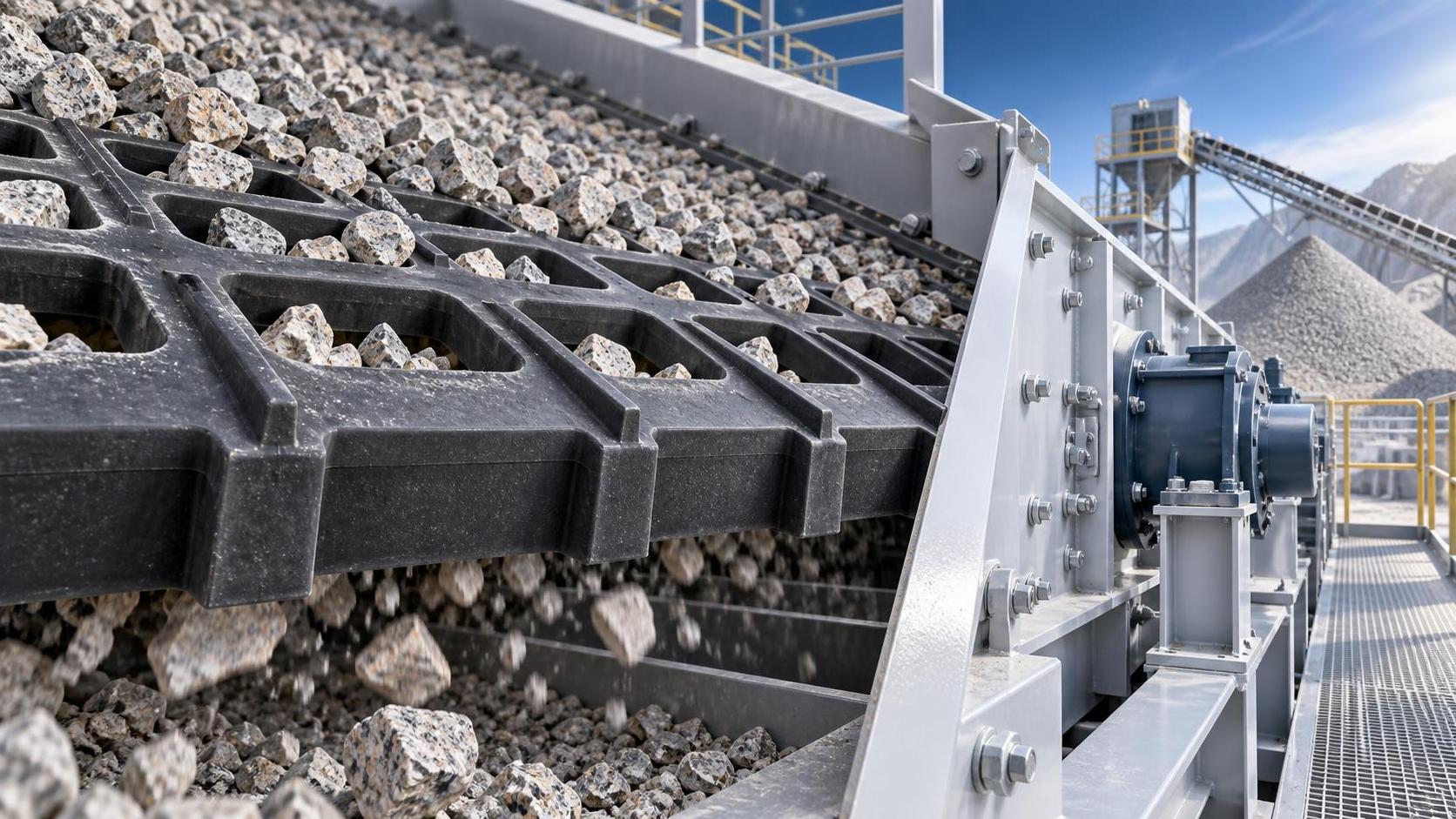
For quality control and safety teams, rubber screen mesh capacity is not determined by aperture size alone. Panel thickness directly affects open area, material flow, screening efficiency, wear resistance, and the risk of blockage or overload. A panel that appears suitable on a drawing may behave very differently once wet, abrasive, angular, or clay-bearing material reaches the vibrating screen.
This matters because screening is often treated as a downstream process, while its instability can affect the whole aggregate line. Poor separation may send oversize material into the finished stockpile, increase recirculating load, cause crusher choking, or create excessive fines in a graded product. Rubber screen mesh selection should therefore be reviewed as part of production control, equipment protection, and maintenance planning—not simply as a consumable purchase.
Aperture Is the Starting Point, Not the Full Capacity Calculation
Aperture size determines the nominal separation point: particles small enough to pass through an opening are classified as undersize, while larger particles remain on the deck. Yet nominal aperture does not guarantee that every particle of the same size will pass. Particle shape, feed depth, moisture, vibration conditions, and the available open area all influence the real result.
Larger apertures generally provide more passage area and can handle a higher volume of material, assuming the screen receives a reasonably distributed feed. They are common on scalping and coarse-sizing decks where the main purpose is to protect downstream equipment or remove large fractions. Smaller apertures naturally have a lower tolerance for high bed depth, especially when material contains near-size particles. These particles may repeatedly contact the opening without finding a passing orientation, reducing effective capacity even when the nominal aperture seems adequate.
Quality teams should distinguish between aperture dimension and open area. Two panels can use the same nominal opening but offer different total passage area because their bar width, rib geometry, or support structure differs. A supplier quotation that only states “20 mm aperture” does not provide enough information for a reliable comparison. The panel layout, usable screening surface, hole pattern, and retained support sections should also be checked.
Why Panel Thickness Changes Flow and Screening Behavior
Panel thickness is often selected for wear life and structural strength. In abrasive quarry material, a thicker rubber panel may resist impact and abrasion better than a thinner alternative. However, thickness also creates a longer passage path through each aperture. A particle must travel through the depth of the opening, not simply cross a flat surface. This can reduce the probability of passage, particularly for elongated, flaky, damp, or near-size particles.
The effect is most noticeable on fine and intermediate cuts. A thick panel with a relatively small opening may behave less freely than expected because particles can bridge, wedge, or carry moisture into the aperture. With coarse apertures and dry, cubical stone, the restriction may be less critical. There is no universal “thin is better” rule: thin panels can increase opening efficiency but may wear through early, deflect excessively, or fail under heavy impact at the feed end.
A practical selection question is whether thickness is being used to solve an impact problem, an abrasion problem, or a structural support problem. If high impact is concentrated at the feed zone, it may be more effective to use reinforced or thicker media in that zone while retaining a more open, flow-friendly panel arrangement farther down the deck. This is often preferable to applying one heavy panel specification across the entire screening surface.
The Trade-Off Between Open Area and Service Life
Rubber screen mesh is valued for impact absorption, reduced noise, and wear performance in many aggregate and mining applications. Its flexibility can also help release particles that would otherwise remain lodged in rigid media. But capacity depends on how the rubber formulation, aperture geometry, panel thickness, and support frame work together.
The right balance should be based on the actual feed. Material from weathered rock, river gravel, manufactured sand, and hard granite can impose very different screening demands. Wet fines and clay change the problem again. In these conditions, a high nominal open area may not translate into stable capacity if apertures blind or the feed forms a dense layer across the deck.
What to Inspect Before Blaming the Screen Panel
A capacity reduction is not automatically a mesh failure. Before changing aperture or thickness, the inspection team should review the full operating condition. Uneven feed distribution can overload one side of the screen and leave the other side underused. Excessive feed rate can create a deep material bed, preventing undersize particles from reaching the media. Worn feed chutes, damaged spray systems, loose panel fixings, and incorrect screen motion may produce symptoms that look like an aperture problem.
A useful field check is to compare the planned product cut with samples taken from both the oversize and undersize streams. If oversize material contains too much passing fraction, capacity may be restricted or blinding may be occurring. If undersize contains excessive oversize particles, the issue may involve aperture wear, panel damage, excessive vibration amplitude, or an unsuitable feed rate. Sampling should follow the site’s established quality procedure rather than relying on a visual judgment alone.
Safety review is equally important. A blocked deck can raise retained load and contribute to abnormal vibration. Damaged panels may allow large particles to bypass intended separation or create loose components around moving equipment. Lockout and isolation procedures should always be followed before inspecting screen media, support rails, or fastening systems.
Screening Media Must Match the Upstream Crushing Circuit
The size distribution arriving at the screen has a direct effect on mesh capacity. A crusher set too coarsely may send excessive oversize to the screen, increasing recirculation and impact on the top deck. A crushing circuit producing a high proportion of near-size material can also make separation more difficult. For granite applications, the operating relationship between a primary unit such as the FEIFAN PE800×1060 Jaw Crusher 136-230tph for Granite Crushing with Stable Operation ISO Certified Crusher and the downstream screen should be assessed through feed gradation, not nameplate capacity alone.
This system view is especially useful when recurring panel changes do not resolve poor performance. The mesh may be correctly manufactured but mismatched to the particle shape, impact energy, or feed volume created upstream. Adjusting crusher settings, feeder rate, chute design, or deck arrangement can sometimes provide a more durable solution than simply installing a thicker panel.
A More Defensible Specification for Rubber Screen Mesh
For procurement, quality acceptance, and maintenance records, a screen-media specification should identify more than aperture size. It should state the aperture shape and dimensions, panel thickness, external panel dimensions, fastening method, expected installation position, material characteristics, and any critical tolerance required by the project. Where product grading is controlled by contract or local standards, the screen specification should be linked to the required test and sampling process.
At Feifan’s Binzhou manufacturing base, the wire-mesh operation sits alongside equipment manufacturing for crushers, vibrating screens, feeders, conveyors, and complete aggregate lines. That combination is useful because mesh selection can be examined against deck structure, feed behavior, and circuit design rather than treated in isolation. With a 66,000-square-meter factory, 156 workshop employees, and a technical R&D team that includes 13 senior engineers, the group supports both standard media and project-specific screening arrangements.
The final decision should be based on the material’s real behavior over time: its size distribution, moisture, abrasiveness, shape, feed rate, and tendency to blind. Aperture determines the cut; thickness determines much of the durability and passage resistance. Evaluating both together gives quality and safety teams a clearer basis for controlling product consistency, avoiding avoidable overload, and scheduling replacement before a worn panel becomes a process risk.
Leave A Message
If you are interested in our products and want to know more details, please leave a message here, we will reply you as soon as we can.