How a Vibrating Screen Separates Material by Size, Motion, and Deck Design
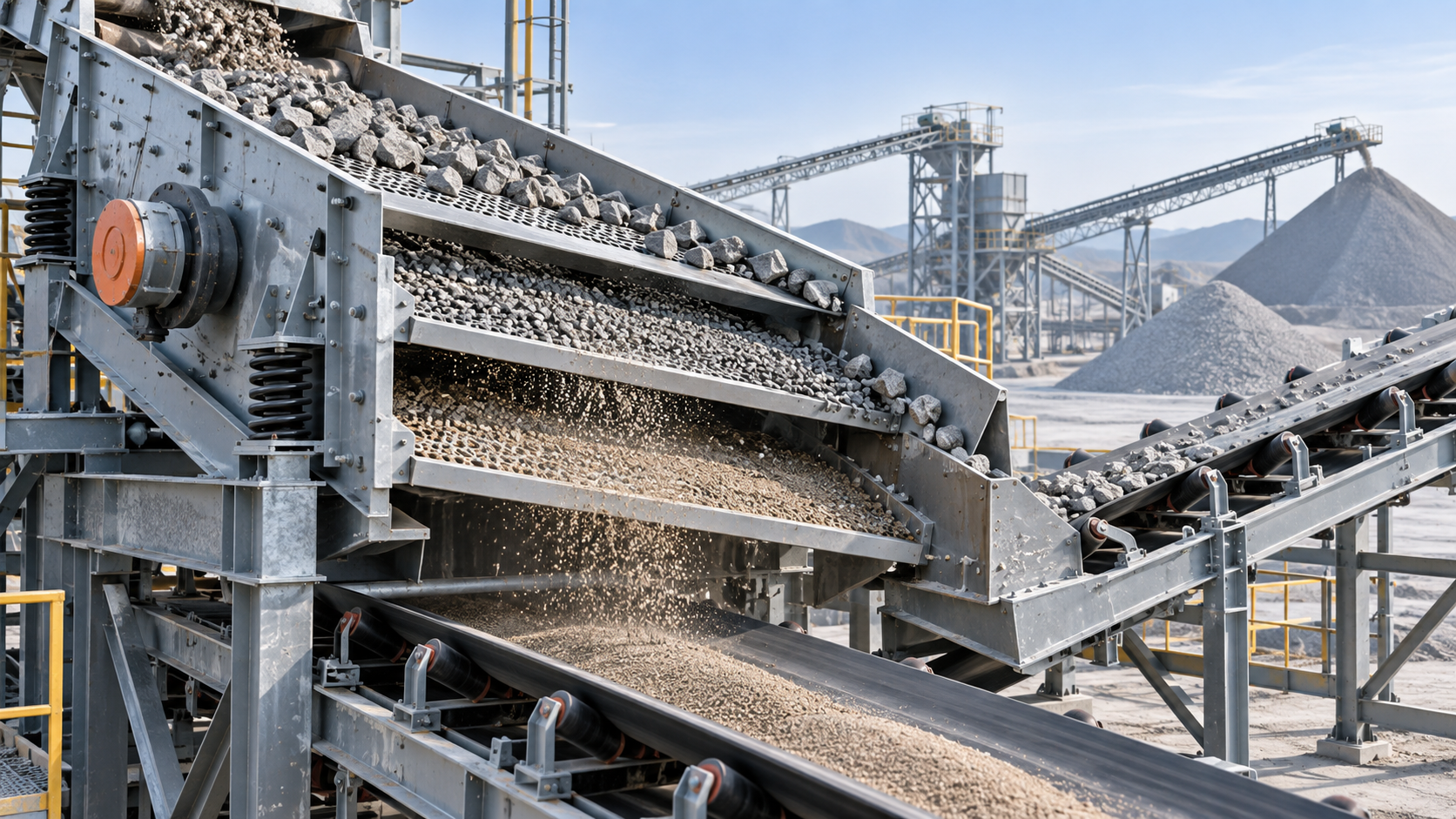
A Vibrating Screen separates material because vibration repeatedly lifts, stratifies, and advances a mixed feed across openings of a defined size. Smaller particles find the apertures and pass through; larger particles remain on the deck and discharge at the end. That simple principle is affected by three practical variables: the screen’s motion, the condition and size of the openings, and the number and arrangement of decks.
For aggregate, crushed stone, sand, ore, and recycled material, screening is not just a final sorting step. It determines whether downstream crushers receive the correct feed, whether finished products meet grading requirements, and whether the plant can maintain a stable flow without excessive recirculation.
Size Separation Depends on the Opportunity to Reach an Opening
A screen does not measure every stone individually. It gives particles repeated chances to contact an opening. A particle smaller than the aperture can only pass when it reaches the screen surface in a favorable position. Flat, elongated, wet, sticky, or near-size particles may take longer to pass than a compact particle of the same nominal size.
This is why screen aperture alone does not define final product quality. The material layer on the deck also matters. If the feed layer is too deep, fine particles stay buried beneath larger pieces and have fewer chances to reach the mesh. If the layer is too thin, the screen may be underused and plant capacity is lost.
Near-size material is usually the most demanding condition. For example, particles only slightly smaller than an opening may need repeated contact and movement before passing. A screen that performs well with a clear size difference can become less efficient when a large share of the feed is close to the required cut point.
Motion Creates Stratification and Transport
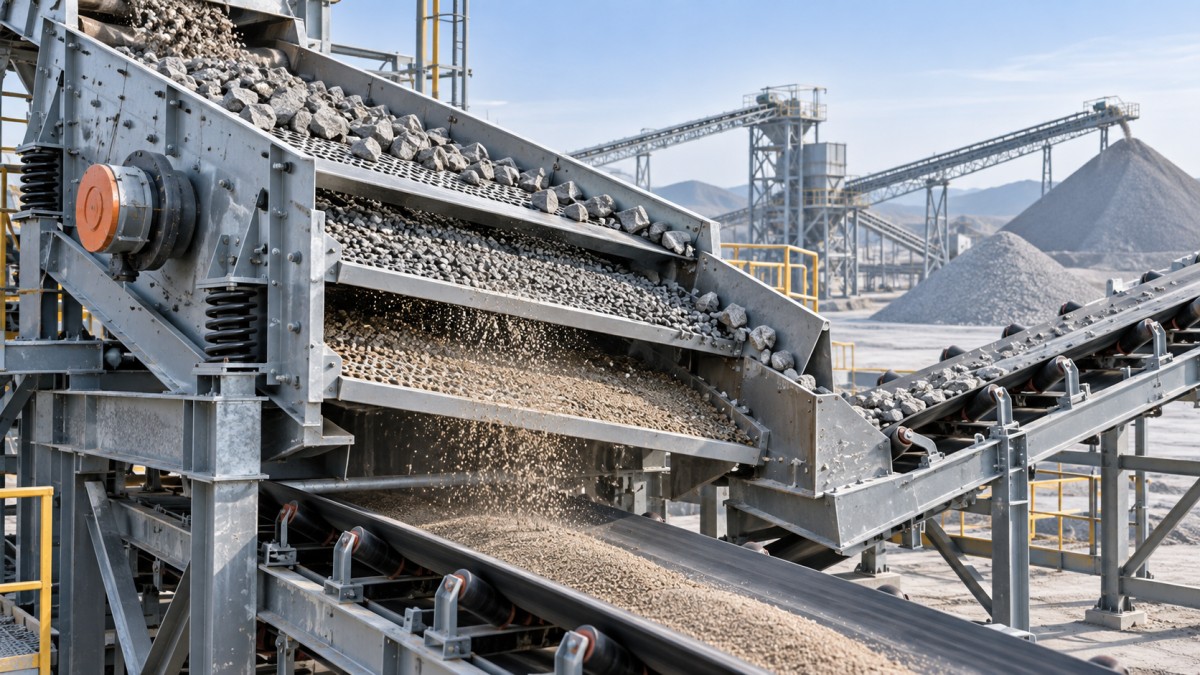
The vibrating mechanism provides more than shaking. Its motion separates the material bed into layers while moving material toward discharge. Larger particles tend to remain closer to the top of the bed, while smaller particles work downward toward the screen surface. This layering process is called stratification, and it is essential for efficient screening.
Different screen motions are suited to different jobs. Circular or elliptical motion is commonly used for general aggregate screening because it combines material throw with forward travel. Linear motion can provide more direct conveying action and is often useful where dewatering, fine screening, or controlled movement is needed. The appropriate choice depends on feed size, moisture, tonnage, and the required separation.
Amplitude, frequency, and screen angle work together. Stronger throw can help break up a compact material layer and improve movement across the deck, but excessive vibration may cause material to travel too quickly. When residence time becomes too short, smaller particles may leave with the oversize fraction before they have a reasonable chance to pass through.
Conversely, slow travel is not automatically better. It can create unnecessary bed depth, reduce throughput, and increase wear in one area of the deck. The useful setting is the one that keeps material spreading evenly, stratifying effectively, and discharging without buildup.
Deck Design Determines How Many Separations Happen
A single-deck screen creates one separation: undersize passes through and oversize remains on top. Multi-deck vibrating screens make several cuts in one machine. The top deck usually removes the largest material first, protecting lower decks from overload. Material that passes through then reaches the next deck, where a smaller size fraction is removed.
In a typical aggregate arrangement, the largest opening is installed on the upper deck and progressively smaller openings are used below. Each deck produces a different product stream or prepares material for a later stage. The design is useful when the plant needs several gradations but has limited installation space.
More decks are not always the better answer. Each lower deck receives material that has already passed through the deck above, and poor feed distribution can overload one side while leaving another side underused. A simpler arrangement may be preferable when only one or two clean cuts are needed.
Screen Media Is Part of the Separation System
Wire mesh, polyurethane panels, and other screen media do not behave identically. Woven wire often provides high open area and is useful where screening capacity is a priority. Polyurethane media can be suitable for abrasive material and certain wet or difficult screening conditions, particularly where wear life and reduced blinding are important. The right choice depends on the feed, rather than on a universal preference for one material.
Open area deserves attention. Two media panels may have the same nominal aperture but different wire diameter, panel structure, or support arrangement. A lower open area reduces the available space through which particles can pass, which can reduce capacity. On the other hand, a more robust panel may be justified where impact and abrasion are severe.
Blocked openings are a common cause of poor separation. Moist clay, wet fines, fibrous contaminants, and flaky particles can blind or peg the mesh. Increasing vibration alone rarely solves this permanently. The better response may involve changing media type, adjusting feed preparation, reducing moisture where practical, or selecting an aperture shape better suited to the material.
What Operators Often Misread
One common mistake is treating screen capacity as a fixed machine rating. Actual throughput changes with feed gradation, moisture, bulk density, shape, fines content, and how evenly the feed enters the screen. A machine can appear oversized on paper yet struggle if a concentrated feed stream lands on a small section of the top deck.
Another mistake is blaming the screen when the problem starts upstream. A crusher operating with an unsuitable closed-side setting can produce too much near-size material. An inconsistent feeder can surge the deck. Excessive carryover from washing or poor drainage can bring wet fines to dry screening equipment. Screening performance should be evaluated as part of the complete material flow.
Conveying layout also affects screen loading. Where elevation changes or limited space make conventional transfer arrangements difficult, equipment such as a Side Barrier Belt Conveyor | Conveying Machinery for Bulk Ore, Stone Crushing Plant can be considered as part of the material-handling layout. The goal is not simply to move material upward, but to deliver it to the screen in a controlled and evenly distributed stream.
Questions to Answer Before Selecting a Screen
- What is the maximum feed size, and how much oversize is present?
- Which final size fractions must be produced, and which cut sizes are most critical?
- Is the material dry, wet, sticky, abrasive, flaky, or rich in fines?
- How much near-size material is expected at each separation point?
- Will the screen feed be steady, or will it receive intermittent crusher surges?
- Does the layout require multiple decks in one machine, or can screening be divided across stages?
These answers provide a more reliable basis for selection than choosing a screen only by width, deck count, or nominal capacity. A properly matched machine creates cleaner fractions with less unnecessary recirculation. An improperly matched one may still vibrate normally while producing poor separation, uneven wear, and unstable plant output.
Understanding size, motion, and deck design makes it easier to see why a vibrating screen is a process-control machine rather than a simple sieve. The best configuration is the one that gives the actual feed enough opportunity to stratify and pass at the required cut sizes while maintaining stable movement through the entire production line.
Leave A Message
If you are interested in our products and want to know more details, please leave a message here, we will reply you as soon as we can.