Design Checks for Inclined Conveyors in Dusty and High-Impact Aggregate Plants
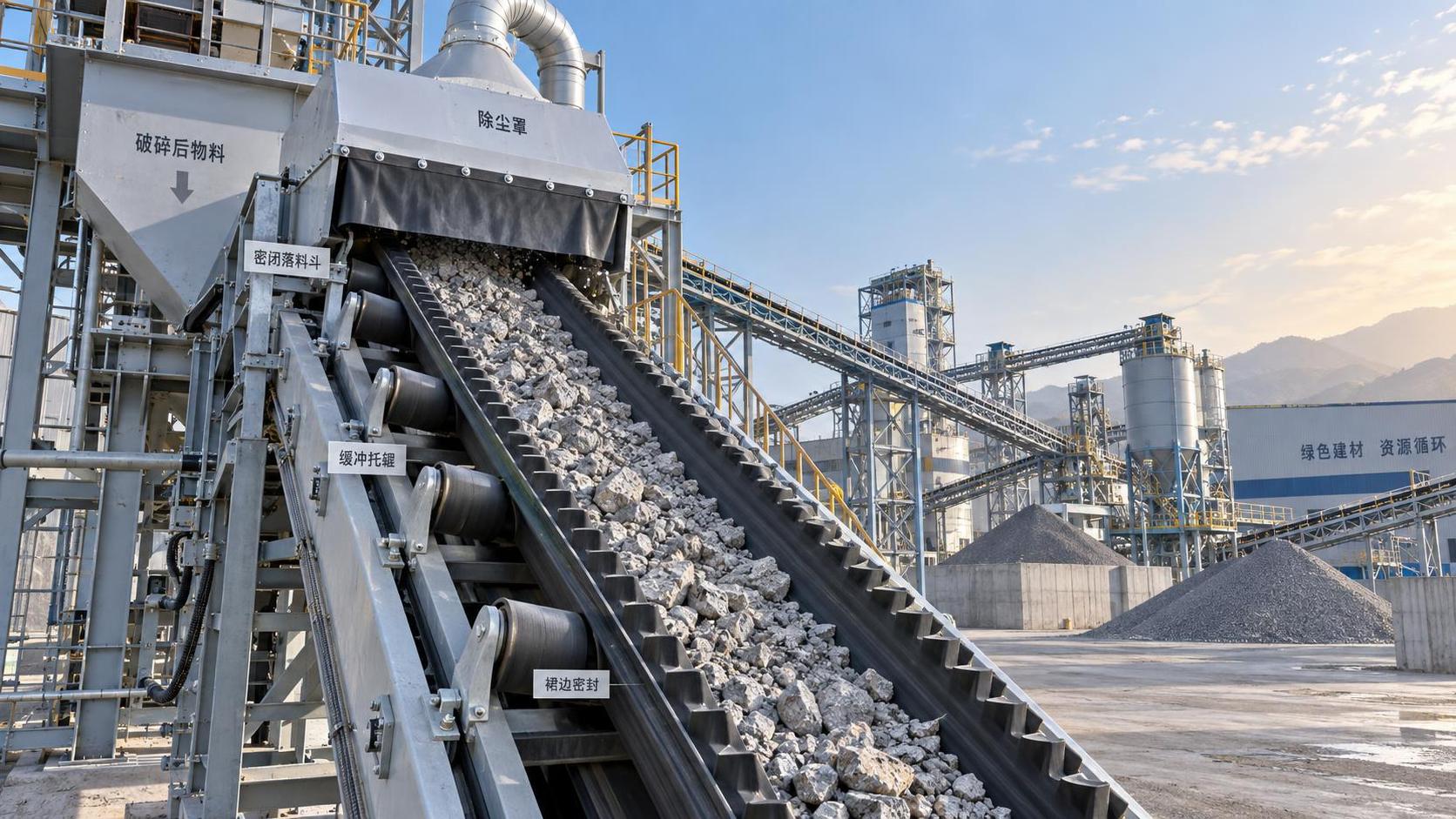
An inclined conveyor in an aggregate plant is often treated as a simple elevation change between two machines. In dusty, high-impact duty, that assumption creates expensive problems. A conveyor can meet its rated tonnage on paper and still suffer from belt slip, carryback, skirt leakage, rapid idler failure, or chronic spillage once it receives wet fines, irregular rock, and fluctuating feed from a crusher or screen.
For project managers, the first design question is whether the proposed incline can transport the full material range at stable loading conditions, not merely whether the selected belt can climb. The answer depends on the combined effect of conveyor angle, particle shape, moisture, belt surface, loading method, and the operating variation expected across the plant. An inclined belt conveyor for aggregate plant duty should therefore be reviewed as part of the transfer system, including the upstream discharge and downstream receiving point.
Start With the Material and the Actual Conveyor Duty
Design capacity is only one input. The conveyor should be checked against the largest rock, maximum feed surge, fines content, moisture range, and likely presence of sticky material. A belt moving dry, well-graded crushed stone behaves very differently from one handling clay-contaminated feed after rain. Fine wet material can build up on rollers and pulleys, while larger angular stone increases impact energy and can damage a belt at the loading zone.
The required incline should be assessed together with the material's tendency to roll or slide backward. As the angle increases, conventional smooth belts become more sensitive to loading depth and material condition. A shallow incline may operate reliably with a standard belt, while a steeper layout may require a chevron or cleated belt, revised loading geometry, or an alternative arrangement using multiple conveyors. Raising the belt angle simply to reduce civil work or plant footprint can shift cost into wear parts, power demand, cleaning equipment, and unplanned maintenance.
Project teams should request that the duty calculation reflects normal throughput as well as surge conditions. Crusher discharge is rarely perfectly uniform. If the feed system permits short periods above nominal capacity, the belt width, speed, skirtboard volume, and drive arrangement must accommodate those periods without allowing material to ride too high on the belt or spill at transitions.
Check the Loading Zone Before Specifying Belt Strength
High-impact loading is usually the part of the conveyor that determines its service life. Belt tensile rating matters, but it does not protect against a poorly designed receiving chute. When rock lands off-center, at excessive drop height, or with a velocity direction that conflicts with belt travel, the result is localized belt damage, mistracking, broken idlers, and leakage along the skirtboards.
A practical loading-zone review should cover four conditions:
- Drop height and rock size: Larger lump material and longer drops require an impact bed, closely spaced impact idlers, or both. The support arrangement must prevent the belt from deflecting excessively under impact.
- Material trajectory: The chute should guide material in the same direction and near the speed of the receiving belt. Material striking against belt travel creates turbulence and accelerates wear.
- Centered loading: The load stream needs to be centered across the belt. A conveyor that is repeatedly loaded to one side will not be corrected permanently by training idlers.
- Containment length: Skirtboards must be long enough to stabilize the material stream before it exits the sealing area. Short skirts allow fines to escape before the burden has settled.
Skirt sealing deserves close attention in dry aggregate plants because a small gap can become a continuous dust source. However, seals should not be tightened until they create excessive drag or damage the belt cover. Good sealing comes from stable belt support, correct loading, suitable skirtboard geometry, and properly adjusted flexible seals. It is rarely solved by adding more rubber against an unstable belt.
Dust Control Is a Conveyor Design Issue
Dust collection systems are often assigned to a separate package, but conveyor design determines whether that package can work. Open transfer points, high material fall, turbulent chutes, and poorly enclosed return paths create dust faster than a hood or collector can reasonably contain it.
For an inclined conveyor, the loading and discharge zones should be enclosed where practical, with enough access for inspection and cleaning. The enclosure must not interfere with belt tracking, maintenance, or emergency access. Its volume and openings should also be considered alongside the plant's dust extraction design. A fully enclosed chute with uncontrolled air entry can still release dust through gaps at inspection doors and skirtboards.
Carryback is another dust issue. Material adhering to the return side of the belt drops along the structure, contaminates walkways, and accumulates around rotating components. The design should provide for a primary cleaner at the head pulley and, where material conditions justify it, a secondary cleaner. The cleaning system needs a collection path for removed material. Otherwise, scraped fines simply collect below the head end and become a housekeeping and safety burden.
Wet suppression can reduce airborne dust, but it should be evaluated against material quality requirements and local water management. Adding water at a transfer point may increase carryback, make fines adhere to chutes, or complicate screening efficiency downstream. The conveyor layout should remain maintainable even when dust suppression is unavailable or reduced.
Drive Power and Take-Up Must Be Evaluated at the Worst Condition
Inclined conveyors require additional power to lift material, and the elevation component can become dominant on long or steep runs. The drive selection should account for starting torque, full-belt restart conditions, belt acceleration, friction losses, and the range of bulk density expected in operation. A drive sized only for steady-state running may struggle when a loaded belt must restart after a trip.
High-impact aggregate service also calls for a review of pulley lagging, belt wrap, and traction margin. Dust or moisture on the drive pulley reduces grip. Slippage generates heat and damages lagging and belt covers, so the response should not be limited to increasing motor power. The whole traction arrangement, including drive-pulley diameter, lagging type, wrap angle, and take-up tension, needs to work as a system.
The take-up should maintain adequate belt tension during loading changes and temperature variation without overstressing the belt or splices. Its travel must be accessible for inspection, and the structure should allow safe adjustment. On longer conveyors, the selected take-up method and control philosophy may materially affect starting behavior and belt life.
Wear Protection Should Follow the Material Path
Wear liners are valuable where material changes direction or strikes chute walls, yet arbitrary thickening is not a design strategy. The liner material, panel arrangement, fixing method, and replacement access should match the abrasion and impact at each location. A chute handling coarse crusher discharge may need impact-resistant protection at the entry, while a downstream fines transfer may benefit more from low-friction liners that discourage buildup.
The same principle applies to idlers and rollers. Closely spaced impact idlers are appropriate beneath the loading zone, while sealed, robust rollers are important throughout dusty outdoor duty. Roller selection should consider the consequence of failure as well as nominal load. A failed roller below a heavily loaded inclined section can rapidly damage the belt because the belt tension and material weight make local abrasion more severe.
Where the conveyor receives classified material from a high-capacity screen, the screen and conveyor need compatible surge capacity and transfer geometry. For example, an OEM Heavy Duty Banana Type Vibrating Screen with High Throughput for Large Scale Sand and Gravel Plants Machine can create a substantial, segmented material stream. The receiving conveyor should be checked for simultaneous discharge from multiple decks or outlets where the layout combines flows, rather than being sized from an average fraction alone.
Maintenance Access Is Part of the Equipment Scope
A mechanically sound conveyor becomes difficult to operate when workers cannot safely inspect idlers, clean transfer areas, change scrapers, or reach pull-cord switches. Inclined structures need walkways, guardrails, access platforms, and safe routes to head, tail, drive, take-up, and loading-zone components. The layout should also leave practical space for replacing a pulley, lifting a drive assembly, or handling belt-cleaner components.
Inspection access matters especially around enclosed dust-control points. Doors should be positioned where blockages, liner wear, and buildup can actually be seen. A small access hatch located away from the material stream may satisfy a drawing review while providing little operational value.
Electrical and mechanical protection should be selected for the expected failure modes: belt misalignment, belt speed loss, chute blockage, emergency pull-cord activation, and overload. Their mounting positions must reflect the conveyor arrangement. A belt-sway switch located outside the zone where tracking problems develop will provide limited protection.
A More Useful Review Before Release
Before approving fabrication, project managers should ask for a single operating review that connects the process duty with the mechanical arrangement. It should show the maximum material envelope, conveyor angle, loading trajectory, chute configuration, belt specification, drive and take-up basis, cleaner arrangement, dust enclosure, and access provisions. Reviewing these items separately often hides the interfaces where most operating problems begin.
The most reliable inclined conveying layouts are usually those that accept the limits imposed by the material and site geometry early in the project. A modest change in belt angle, transfer-point elevation, chute direction, or maintenance platform can prevent years of cleanup, downtime, and premature component replacement after commissioning.
Leave A Message
If you are interested in our products and want to know more details, please leave a message here, we will reply you as soon as we can.