Complete Crushing Plant Layouts for Hard Rock, Limestone, and Recycling Projects
A Complete Crushing Plant is more than a sequence of machines placed on a quarry floor. For a project manager, it is a production system that must keep material moving predictably from the quarry face, demolition yard, or stockpile to a saleable aggregate product. When the layout is right, operators spend less time dealing with bottlenecks, recirculating loads, and unplanned stops—and more time meeting delivery schedules.
That challenge looks different for every site. Hard granite may demand strong primary reduction and carefully managed wear. Limestone can often be processed with a simpler flow, but moisture, clay content, and product grading still influence the design. Recycling projects introduce another layer of uncertainty: rebar, wood, soil, asphalt, and inconsistent feed size can quickly disrupt a line designed only for clean stone.
The best plant layouts begin with the material and the commercial target, not with a preferred crusher model. Capacity matters, but stable throughput, product quality, maintenance access, power availability, transport conditions, and future expansion matter just as much.
Start the Layout with the Feed, Not the Finished Product
Many aggregate projects are planned around the desired output: base course, railway ballast, concrete aggregate, manufactured sand, or recycled sub-base. That is necessary, but it should not be the first technical question. Before selecting equipment, the project team should establish what will actually enter the hopper throughout the operating day.
- Hardness and abrasiveness: Granite, basalt, quartz-rich rock, and certain river stones create high wear conditions. These materials often call for jaw crushing at the primary stage and cone crushing for secondary or tertiary reduction.
- Maximum feed size: Blast fragmentation or incoming demolition blocks determine hopper dimensions, grizzly spacing, and primary crusher opening.
- Moisture and fines: Sticky clay and wet fines can blind screens, clog transfer points, and reduce effective plant capacity.
- Contamination: Recycling feed may include steel, timber, plastic, or asphalt. The layout needs pre-sorting and metal separation rather than relying on the crusher to solve every problem.
- Variation over time: A plant should be designed for realistic feed fluctuations, not only for ideal test samples.
For project leaders, this early assessment protects the schedule later. A crusher may have an impressive rated capacity, yet the full line will underperform if the feeder cannot regulate surges or if screening becomes the limiting step. In practical terms, plant capacity is governed by the narrowest point in the process.
Three Material Types, Three Layout Priorities
Hard rock: control wear and shape through staged reduction
Hard rock projects usually benefit from a robust, staged arrangement. A vibrating feeder with a grizzly section removes undersize material before it reaches the primary jaw crusher. This reduces unnecessary crushing work and helps protect the jaw from fines that do not need reduction.
After primary crushing, material commonly passes to a secondary cone crusher, followed by vibrating screens. Oversize fractions return through a closed circuit for further reduction. Where cubical aggregate or manufactured sand is required, a vertical shaft impact crusher may be added after the cone stage. The goal is not simply to make smaller stone; it is to produce controlled gradation and particle shape without creating excessive dust or needless recirculation.
Wear management should influence the physical layout. Crushers need clear lifting space for liner changes, safe access platforms, and room for service vehicles. A compact arrangement may save land initially, but cramped maintenance zones often cost more in lost production over the plant’s life.
Limestone: simplify the flow without overlooking fines
Limestone is generally easier to crush than hard igneous rock, so impact crushers are often suitable for primary or secondary duties. Their reduction ratio can support a relatively straightforward plant arrangement, especially where the feed is clean and consistent. A typical flow may include a feeder, scalping screen, primary impact crusher, screening station, and conveyors to finished-product stockpiles.
However, “soft rock” does not mean “simple project.” Some limestone deposits contain clay seams or weathered zones that alter screen performance. If natural fines are high, a washing section, dewatering screen, hydrocyclone system, or dry dust-control solution may be needed depending on local water availability and market specifications.
It is also worth planning stockpiles carefully. Segregation during stacking can affect final product consistency, particularly when several sizes are shipped daily. Separate discharge conveyors, radial stackers, or correctly designed bins can make loadout more reliable during peak dispatch periods.
Recycling: build tolerance into the system
A recycling crushing plant has to accommodate materials that rarely behave like quarry rock. Concrete may contain reinforcing steel; mixed construction waste may include soil, brick, wood, and lightweight debris. The layout should therefore prioritize separation before, during, and after crushing.
A receiving area with manual or mechanical pre-sorting prevents oversized non-crushable items from reaching the chamber. A magnetic separator positioned after the primary crusher is commonly used to recover ferrous metal. Wind separation or picking stations may be appropriate where light contaminants are common. Screens should be selected with the expected contamination in mind, because a high-capacity screen is of little value if its deck repeatedly blinds or suffers impact damage.
For these duties, screen media is a working component rather than a minor spare part. A properly matched FEIFAN OEM Stainless Steel Wire Mesh Screen Frame for Mining Vibrating Screen Replacement mesh can be considered where the screening process requires a durable replacement mesh frame and accurate material classification. Mesh opening, wire diameter, screen angle, and the condition of the incoming material should all be reviewed together.
The Flow Diagram Must Include What Happens Between Machines
Crushers get most of the attention, but transfer points often decide whether a plant feels orderly or constantly troublesome. Every conveyor transition should be reviewed for material trajectory, drop height, dust generation, belt tracking, and access for cleaning. Large drops can break already-sized aggregate, increase dust, and accelerate liner wear. Poorly designed chutes may create buildup that forces operators into unsafe manual intervention.
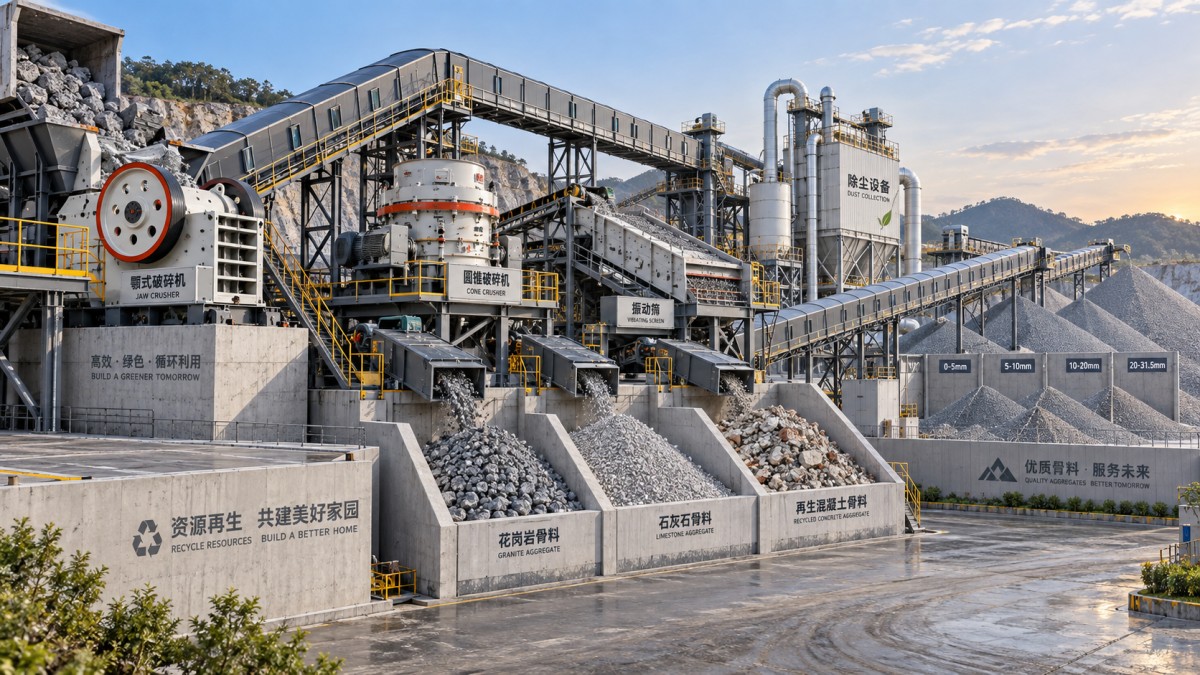
A well-considered Complete Crushing Plant generally includes:
- Receiving hopper and controlled feeding equipment;
- Scalping or pre-screening to bypass natural fines;
- Primary, secondary, and, where needed, tertiary crushing stages;
- Vibrating screens configured for the required product sizes;
- Conveyors with suitable transfer chutes and maintenance walkways;
- Dust suppression or collection points around crushing and screening areas;
- Metal removal and sorting equipment for recycling applications;
- Stockpiling, loading, and plant-control systems.
Not every project needs every item. The principle is to make each component serve a defined process purpose. Adding equipment without revisiting the material balance can create a line that is expensive but still unstable.
Use Material Balance to Test the Design Before Fabrication
Before fabrication begins, the engineering team should map the anticipated tonnes per hour through every stage and size fraction. This material balance should include recirculating loads, bypass material, moisture effects, and expected screen efficiency. It provides a more realistic basis for selecting belt widths, screen areas, crusher chamber settings, and stockpile capacities.
Project managers should ask a few direct questions during design reviews: What happens if the feed contains more fines than expected? Which machine limits output at the most demanding product mix? Can the line run a different specification without major mechanical changes? Is there a bypass route when one downstream unit is under maintenance?
These questions are particularly important when future capacity expansion is possible. Leaving space for an additional screen deck, tertiary crusher, or washing module is often easier than rebuilding foundations and conveyor routes after commissioning.
Maintenance Access Is Part of Production Capacity
Downtime is rarely caused by a single major failure alone. More often, it grows from small delays: a screen panel that is difficult to replace, no room to remove a crusher mantle, blocked chutes that are hard to inspect, or conveyors without safe access to rollers and scrapers.
A practical layout gives maintenance teams safe routes, lifting provisions, adequate platform width, and access doors at likely buildup points. It also considers spare-part planning from the beginning. Crushers, screens, feeders, and conveyors should be selected with wear parts and service support in mind, especially for remote overseas projects where replacement lead times can influence operating risk.
As a source factory serving aggregate EPC requirements, Feifan integrates crushing, screening, conveying, sand processing, and custom screen media into whole-line planning. The group’s production resources in Binzhou, Shandong include dedicated manufacturing for crushers, vibrating screens, belt conveyors, and screen meshes, allowing technical details at the interfaces between these systems to be reviewed as part of one project rather than as isolated purchases.
A Layout Should Make Operations Easier on Day One—and Year Five
The most useful crushing plant layout is not necessarily the one with the most equipment or the smallest footprint. It is the one that fits the material, meets the product plan, respects the site, and gives operators a clear, maintainable flow of work.
For hard rock, that often means durable staged crushing and strong wear planning. For limestone, it means using an efficient reduction path while managing fines and moisture. For recycling, it means accepting feed variability and designing separation into the process from the start. When these choices are made early, a Complete Crushing Plant becomes a dependable production asset rather than a collection of machines waiting for constant adjustment.
Leave A Message
If you are interested in our products and want to know more details, please leave a message here, we will reply you as soon as we can.