Common Belt Conveyor Problems in Wet Conditions and How to Spot Them Early
Common Belt Conveyor Problems in Wet Conditions and How to Spot Them Early
Wet conveyors usually do not fail all at once. The trouble starts in small, easy-to-ignore ways: a drive pulley that needs more take-up than usual after rain, fine material sticking to return idlers, a belt edge beginning to polish on one side, or a transfer point that suddenly throws more spillage than it did in dry weather. When operators ask, “What are common problems with belt conveyors in wet conditions,” the useful answer is not a generic list. It depends on where the water is coming from, what the material does when saturated, and whether the line is running aggregate, washed sand, crushed stone, or muddy feed coming straight from excavation.
In sand and gravel plants, moisture changes the behavior of the whole conveying section. A belt conveyor that runs quietly with dry 0-5 mm material can become unstable once the fines turn sticky. At that point, the problem is no longer only transport capacity. It becomes a combined issue of traction, belt tracking, housekeeping, wear rate, and maintenance timing.
Slippage rarely begins as a dramatic stop
In wet conditions, belt slippage is often the first symptom people notice, but it is usually not the first problem that actually develops. Water on the belt surface, reduced friction at the drive pulley, and sticky fines packed around the pulley lagging all push the system in the same direction. If the belt starts slower than normal under load, or if operators hear a brief squeal during startup after a shutdown in rain, that is already an early warning.
This shows up more often on conveyors handling washed material or feeding out of dewatering stages, where the surface moisture is not just from weather but from process water. In those lines, the belt may still appear “serviceable,” yet the real issue is the loss of consistent grip. A site team that only keeps tightening the take-up can mask the symptom for a while and create a different problem later, including added stress on splices and faster wear on the belt carcass.
The practical check is simple: watch startup behavior under a normal load, inspect pulley lagging condition, and compare required take-up adjustment before and after wet periods. If the conveyor needs repeated adjustment only when moisture is high, that pattern matters.
Mistracking in rain is often a material problem before it looks like a mechanical one
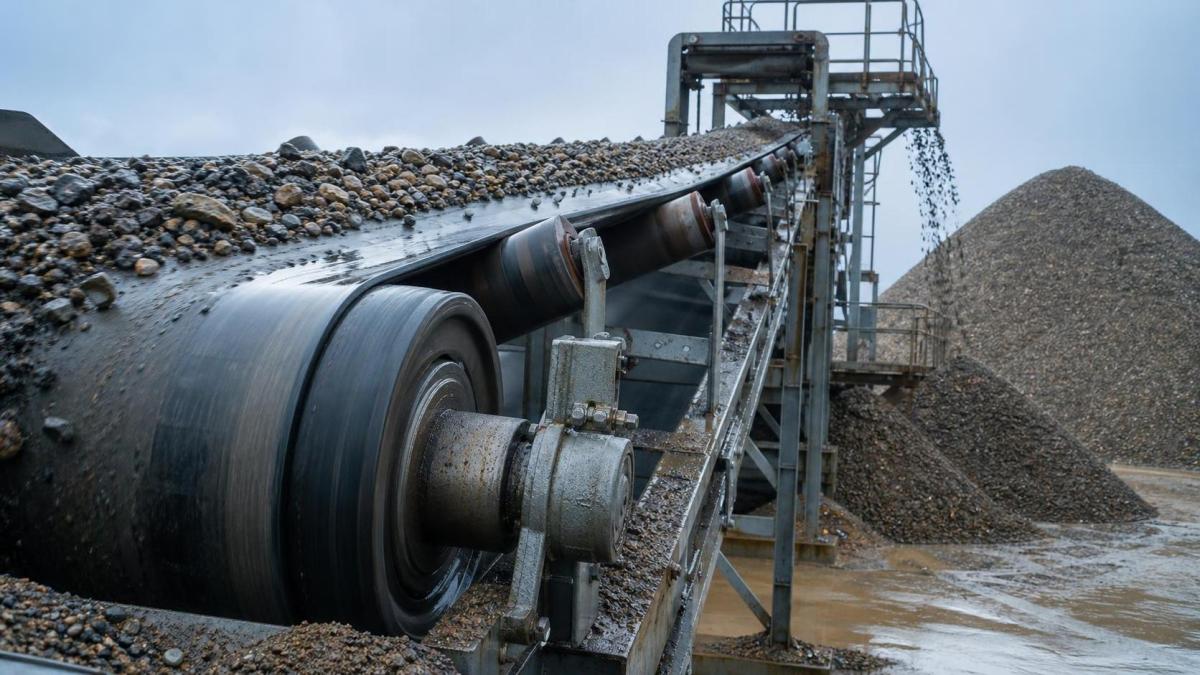
A wet belt that runs off-center is not always caused by a bad idler or poor installation, although those are possible. In aggregate plants, one frequent trigger is uneven loading caused by wet fines building up inside chutes, skirts, or loading boxes. Material then lands off-center, and the belt starts chasing the load. Another common situation is carryback accumulating unevenly on return rollers, which gradually steers the belt sideways.
This is where field judgment matters. If mistracking appears only after several hours of wet operation, the root cause is often buildup. If it appears immediately after startup, inspection should begin with loading alignment, pulley condition, and frame geometry. On long conveyors in quarry or mining service, even a small lateral drift in wet weather should not be ignored, because edge wear and skirt damage tend to accelerate quickly once water and abrasive fines are both present.
Carryback is the issue that keeps creating other issues
Sticky carryback is one of the most expensive “minor” conveyor problems in wet conditions. It drops onto return idlers, builds up on pulleys, throws off tracking, increases power demand, and makes walkways and service zones harder to keep safe. In plants handling clay-contaminated sand, weathered overburden, or wet manufactured sand fines, carryback tends to be persistent rather than occasional.
Operators sometimes focus only on scraper pressure, but that is not enough. The actual question is whether the belt surface, cleaning arrangement, discharge trajectory, and material moisture are compatible with one another. In a full wet-processing line, dewatering and washing equipment upstream can materially change the burden on downstream conveyors. For example, when a sand plant is feeding from washing equipment such as OEM Heavy Duty Spiral Sand Washer for Feldspar Mineral Washing with Low Wear Blades and Oil Lubrication Machine , the conveyor after the wash stage may see cleaner material, but also higher surface moisture and a stronger tendency toward sticky residue if fines are not fully controlled.
The earliest sign is often not visible spillage at the head pulley. It is residue on the return side, especially near the first few return idlers. Once those idlers begin to cake over, the line is already moving toward repeated tracking corrections and faster roller replacement.
Corrosion and abnormal wear do not develop at the same pace
Wet service ages different conveyor components in different ways. Structural steel, fasteners, guards, and pulley shells may show corrosion over time, while scraper blades, chute liners, idlers, and belt covers can wear much faster if water is carrying sharp fines into every contact point. In that sense, wet operation is not just “rust risk.” It is also a lubrication and abrasion management problem.
This is especially relevant in mines and aggregate plants with long maintenance intervals or exposed installations. A conveyor can look structurally sound while its rotating parts are already deteriorating. Seized or partially resistant idlers become more common when slurry-like contamination reaches the seals. The early clue is usually heat, drag, or a change in sound profile, not a dramatic visible defect. Good crews catch this during route inspections by listening for rough-running rolls and checking for localized belt cover polishing.
What site teams should watch during daily checks
A short inspection routine is more useful than a long checklist nobody completes. In wet weather or in washed-material service, these points usually give the clearest early signals:
- Startup hesitation, unusual pulley noise, or repeated take-up adjustment
- Belt drift that appears after buildup starts, not at cold startup
- Residue on return idlers within the first return section
- Material sticking inside transfer chutes or skirted zones
- Uneven edge wear, polished belt edges, or fresh rubber dust near contact points
- Idlers that feel hotter or harder to rotate than neighboring rolls
- Standing water around pulleys, loading zones, or maintenance access paths
None of these signs proves one single root cause by itself. Together, they usually show whether the line is dealing with traction loss, loading asymmetry, carryback, or component deterioration.
Wet conditions also change equipment selection upstream and downstream
On complete sand and gravel lines, conveyors should not be judged in isolation. Moisture introduced by washing, classification, or water recovery stages affects every downstream transfer. Companies that build both conveying equipment and wet-processing systems usually see this more clearly at project level: belt design, chute design, and process moisture need to be considered together. Where the plant includes crushers, screens, washers, feeders, and conveyors from one engineering chain, it is generally easier to correct flow path problems early because the interactions are already understood during layout and commissioning.
That is also why recurring conveyor trouble in wet service should prompt a process review, not only a maintenance response. If the feed gradation changed, if the wash stage is leaving more surface water than before, or if transfer points were modified during production expansion, the belt may simply be exposing a problem that started elsewhere.
The right question on site is less about whether moisture is present and more about how it is acting: free water, sticky fines, slurry contamination, or intermittent rain exposure. Once that is clear, the common problems with belt conveyors in wet conditions become much easier to identify early and much cheaper to correct before they turn into shutdowns.
Leave A Message
If you are interested in our products and want to know more details, please leave a message here, we will reply you as soon as we can.