Choosing Mining Screen Mesh for Abrasive Ore, High Moisture, and Fine Cuts
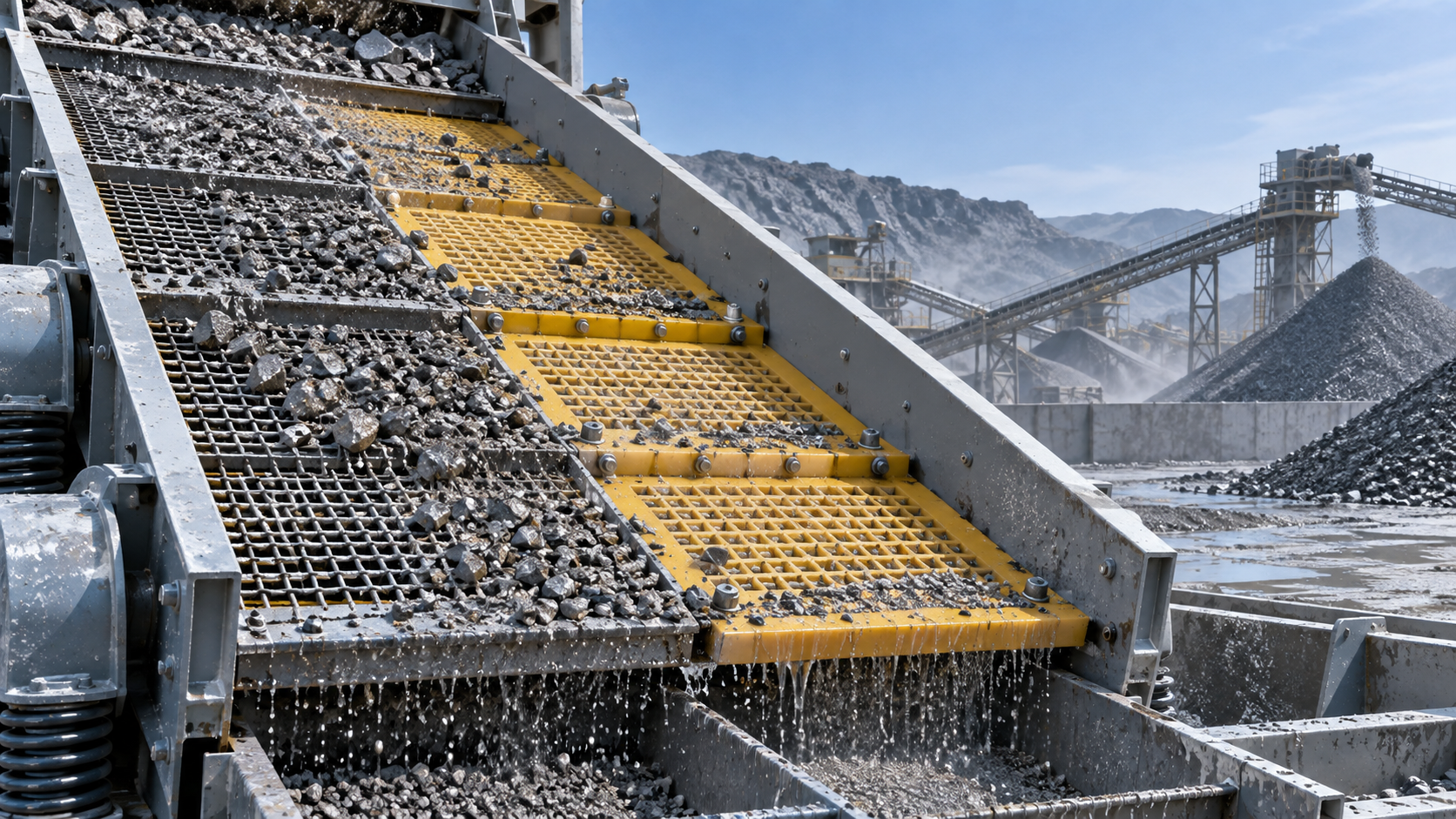
Choosing the right Mining Screen Mesh becomes far more complicated when the feed combines sharp, abrasive ore, sticky moisture, and a tight final cut size. A screen panel that looks acceptable on paper may wear out too quickly, blind over with wet fines, or allow too much near-size material to pass. For procurement teams, those issues do not stay at the screen deck: they affect crusher loading, product quality, labor requirements, spare-part consumption, and unplanned shutdowns.
The most dependable purchase decision starts with the material being screened rather than the mesh price alone. Abrasiveness, moisture level, particle shape, feed rate, required aperture, and the available vibrating screen configuration should all be considered together. The objective is not simply to buy the hardest panel or the finest opening. It is to select a screening surface that maintains usable open area and stable separation performance throughout its service life.
Start with the three conditions that drive mesh failure
In difficult applications, abrasive ore, high moisture, and fine cuts often appear together. Each condition creates a different failure mode, and the wrong response to one problem can make another worse.
- Abrasive ore accelerates wire wear, especially where angular particles repeatedly strike the impact zone. Quartz-rich aggregates, hard rock, iron ore, and crushed stone can polish and thin conventional wire long before the frame itself is damaged.
- High moisture causes fines to cling to one another and lodge inside apertures. This is commonly described as blinding or plugging. Once open area falls, capacity drops even if the feed rate remains unchanged.
- Fine cut requirements place greater demands on aperture accuracy. A small variation in opening size can influence product gradation, while excessively thin wire may sacrifice service life in pursuit of more open area.
Procurement decisions should therefore avoid treating “wear resistance” as the only specification. A heavy steel screen may survive abrasive feed but perform poorly with damp clay-bearing fines. Conversely, a flexible polyurethane panel can resist blinding very well but may not be the preferred choice for a large, high-impact primary screening zone.
Match Mining Screen Mesh material to the screening duty
Steel wire mesh remains an important choice in many quarry and mining operations because it provides high open area, accurate apertures, and strong capacity for dry or moderately moist crushed material. High-carbon steel and wear-resistant steel wire are often selected where sharp stone and repeated impact are expected. For fine screening, wire diameter needs careful review: thinner wire increases open area, but it also leaves less material to absorb abrasion.
Polyurethane screen mesh is frequently better suited to wet, sticky, or difficult-to-classify material. Its elastic surface can flex during vibration, helping release particles that would otherwise bridge an aperture. Polyurethane also offers good wear resistance in many abrasive applications and can reduce noise compared with steel screening media. The trade-off is that molded polyurethane panels usually have lower open area than woven wire, so deck design and required throughput must be evaluated before substitution.
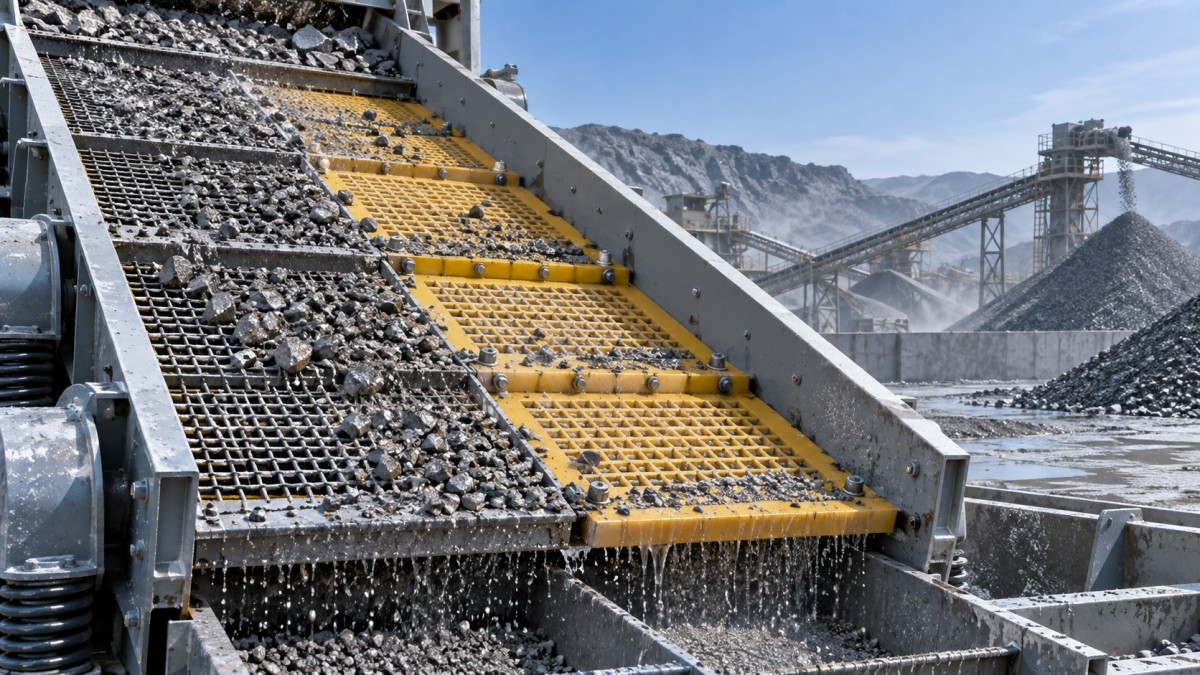
A mixed-deck approach is often more practical than committing the entire machine to one material. Steel meshes can be used in the high-volume or coarse separation zone, while polyurethane panels are installed where moisture, blinding, and fine classification become the main concern. This arrangement gives purchasing teams more control over cost without forcing one screen medium to solve every process problem.
Aperture shape matters as much as aperture size
When buyers specify a 5 mm, 10 mm, or 20 mm opening, the conversation should not end there. Opening geometry changes both separation behavior and wear pattern. Square openings are common when a relatively precise product size is required. Slotted openings may improve throughput and reduce pegging for elongated material, but their orientation must match the material flow and the desired grading result.
For wet fines, anti-blinding designs deserve close attention. Self-cleaning wire screens, with crimped or independently moving wires, can create enough movement to dislodge particles. Polyurethane media may use tapered openings that are wider beneath the top surface, reducing the chance that particles become wedged. These designs do not eliminate the need for correct screen vibration and washing conditions, but they can substantially reduce the operational burden where clay or sticky fines are present.
One common purchasing mistake is requesting the smallest possible aperture to protect product quality. If the opening is too fine for the moisture level and feed characteristics, blinding may reduce effective capacity so severely that the actual separation becomes less consistent. The required cut should be based on the process specification, with a realistic allowance for particle shape, moisture, and screening efficiency.
Ask for operating information before comparing quotations
A meaningful Mining Screen Mesh quotation should be built around operating data, not just length, width, and aperture. Before asking suppliers to recommend a panel, prepare a short application sheet covering the following points:
- Material type, hardness, abrasiveness, and the presence of clay or organic contamination
- Feed moisture range, including seasonal changes and water added during washing
- Maximum feed size and the percentage of near-size particles
- Required separation size, target product gradation, and acceptable oversize carryover
- Screen model, deck angle, vibration amplitude, frequency, and installation system
- Current mesh life, common failure location, and whether the main complaint is wear, breakage, pegging, or low capacity
This information makes it possible to compare alternatives on an equal basis. For example, a supplier may recommend a thicker wire only in the first impact area, while retaining a lighter wire in the downstream section to preserve open area. In another application, a polyurethane modular panel with reinforced support bars may be selected only for the wet fine deck. Such targeted choices are usually more economical than replacing every panel with the most expensive option.
Look beyond panel life: calculate the cost of usable screening time
Long service life is valuable, but it is not the sole measure of value. A mesh that lasts longer while losing capacity through blinding may cost more per tonne than a panel replaced more often. Procurement teams should assess cost through usable screening time: how long does the mesh maintain the needed open area, cut accuracy, and production rate before intervention is required?
Include labor for panel change-out, shutdown duration, discarded material caused by poor separation, and the availability of compatible spare panels. Standardizing fastening systems and panel dimensions across similar screens can simplify inventory, but only if the standardized mesh still fits the actual duty. Convenience should not override performance at a critical screening stage.
It is also worth inspecting how the panel interacts with the rest of the line. If conveyor transfer points deliver material unevenly onto one side of the screen, localized wear may occur regardless of mesh quality. A properly selected feeder, chute liner, or transfer conveyor can improve feed distribution and protect the screening deck. For hard-rock quarry lines where material movement is part of the reliability discussion, equipment such as a High Tension Roller Belt Conveyor | Heavy Duty Mining for Hard Rock Quarry Line can be considered as part of the broader material-handling assessment rather than as an isolated purchase.
Check construction details that are easy to overlook
Two meshes with the same nominal aperture can behave very differently in service. Buyers should examine wire crimping quality, edge reinforcement, hook or tensioned-end construction, panel flatness, and the compatibility of the mounting system with the existing screen deck. Loose installation can cause premature breakage, while excessive tension may damage wire at the hooks.
For polyurethane products, confirm the panel thickness, reinforcement structure, aperture taper, locking arrangement, and support-bar spacing. A panel must be supported correctly; otherwise, excessive flexing can shorten its life or compromise the cut size. Where large panels are used, handling weight and replacement access should also be considered. Maintenance crews will notice these details long before they appear in a procurement comparison table.
A practical selection path for demanding ore
If the material is dry, highly abrasive, and requires high throughput, begin by evaluating wear-resistant steel wire mesh with an appropriate wire diameter and reinforced impact zones. If fines are wet and prone to plugging, test polyurethane or self-cleaning media in the affected deck area. When a fine cut is essential, verify actual aperture tolerance and assess performance with representative feed, not only clean test material.
For operations facing all three conditions at once, a trial installation on the highest-risk section is often the most sensible route. Monitor throughput, blinding frequency, product gradation, wear location, and change-out time. The results will provide a more reliable basis for larger procurement than a comparison based solely on unit price.
As a source manufacturer of polyurethane screen meshes, steel screens, vibrating equipment, and complete aggregate processing systems, Feifan can support this evaluation with mesh selection matched to the screen machine and the wider production line. The best Mining Screen Mesh is rarely the cheapest panel at delivery. It is the one that fits the ore, the moisture condition, the required cut, and the maintenance reality of the site—so the screening stage remains predictable when the material is not.
Leave A Message
If you are interested in our products and want to know more details, please leave a message here, we will reply you as soon as we can.