Can a banana screen handle material with high moisture?
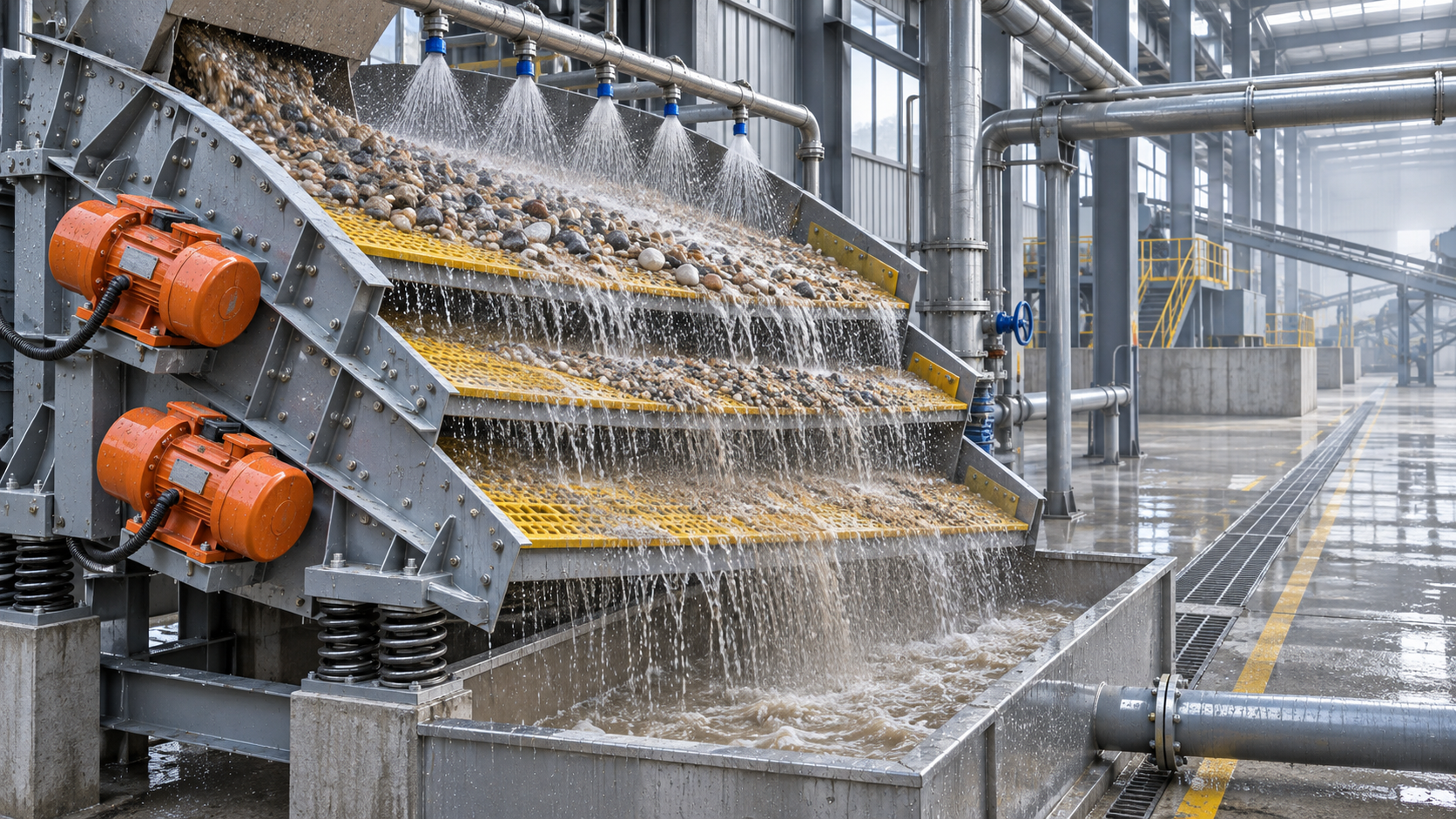
Yes, a banana screen can handle high-moisture material, but moisture percentage alone cannot determine whether it will screen effectively. A wet, free-draining aggregate may pass over the deck with manageable blinding, while a feed containing sticky clay and near-size particles can block the openings even at a lower moisture level.
The selection question is whether the required separation and throughput can be maintained with the available feed conditions, screen media and water supply. A banana screen, also called an Equal Thickness Screen, can move a large feed load across its steep inlet section, but its deck shape cannot prevent sticky material from coating or lodging in the apertures.
How moisture changes screening performance
On a multi-slope banana screen, the steep feed section encourages material to travel quickly and spread into a thinner bed. The shallower sections downstream give particles more opportunity to pass through the openings. This arrangement can be useful when the feed contains a large proportion of undersize material and the machine must process a substantial volume.
Water changes how particles behave on that deck. Fine particles can adhere to larger ones, form agglomerates or build up on the screen surface. Near-size particles may lodge in openings, while clay can smear across the media and progressively reduce its open area. As blinding develops, undersize material is more likely to report to the oversize discharge, and throughput may fall.
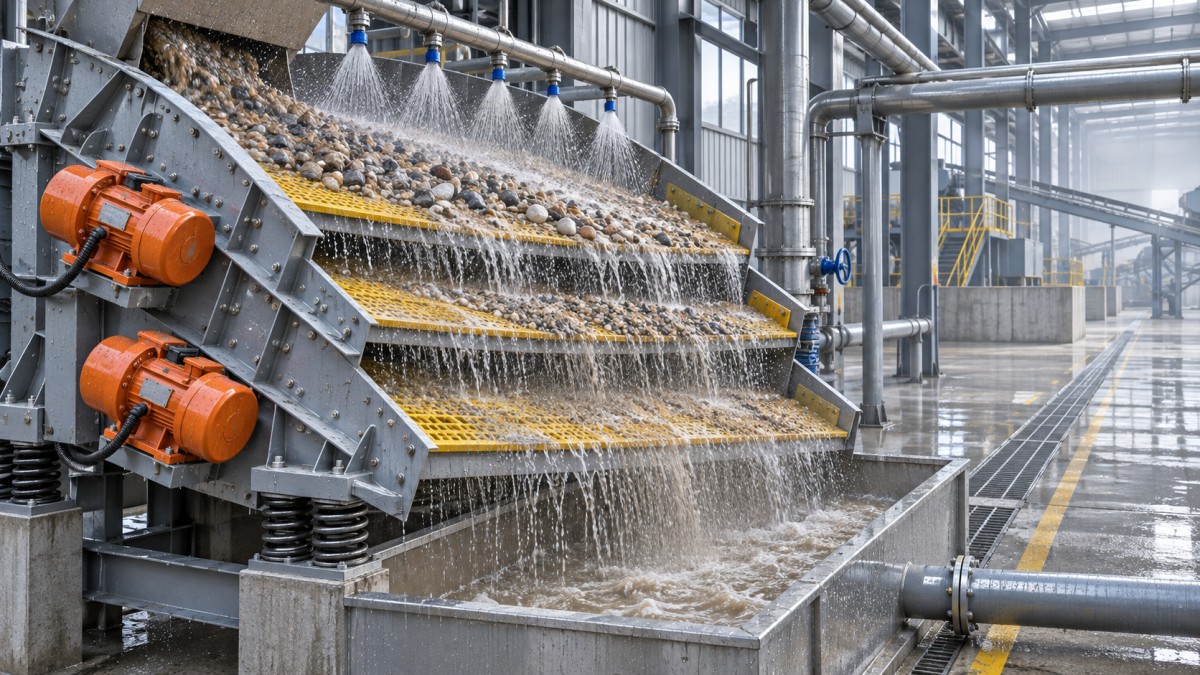
More water does not always make screening more difficult. With enough properly distributed wash water, some fines can be separated and carried through the deck as slurry. Between a free-flowing dry condition and an adequately washed condition, however, damp, sticky feed can be particularly troublesome. Whether washing helps depends on how readily the material breaks apart and whether the rest of the plant can handle the resulting slurry.
Look beyond the moisture figure
Before selecting a machine, define the feed at the screen inlet and the separation the plant needs to achieve. At a minimum, the evaluation should cover:
- Particle size distribution: The amount of material close to the aperture size affects the likelihood of pegging and the time needed for separation.
- Clay and fines: Their quantity matters, but so does their behaviour when wet. Plastic or sticky fines can bind particles together and blind the deck.
- Feed variability: Rain, changes in the source material and upstream washing can alter both moisture and consistency. A design based only on an average sample may struggle during difficult operating periods.
- Required separation: A coarse scalping duty may tolerate conditions that are unsuitable for a finer separation, where blocked openings have a greater effect on product quality.
- Feed rate and distribution: An uneven feed or an excessive bed depth can overload part of the deck and leave insufficient opportunity for undersize to pass.
Consider moisture together with the proportion of fines and the required cut size. A high moisture reading in coarse, clean stone does not present the same screening problem as moisture held in a clay-rich sand. Equally, a screen that produces acceptable results at a reduced feed rate may not meet the plant’s production requirement.
Dry screening, washing and media selection
If the feed remains sufficiently free-flowing, screening without added water may be practical. The assessment should focus on how quickly the media blinds, how much undersize remains in the oversize product and how often cleaning interrupts production. Weather-related changes should also be considered where material is stored or conveyed outdoors.
Wet screening is an option when wash water can disperse or remove the troublesome fines. Spray placement and distribution need to suit the deck and material: water must reach the bed and help transport fines through the openings. The downstream process must also be able to collect, classify or dewater the slurry. Washing should therefore be evaluated as a plant decision, with water supply and handling included in the assessment.
Screen media affects both separation and maintenance. Polyurethane panels can be considered for wet and abrasive duties, while wire media may offer a different balance of open area and wear life. Aperture shape and size, panel arrangement and the material’s tendency to peg or adhere all affect the choice. More open area may improve passage, but it must be weighed against wear, panel strength and the required product specification.
Self-cleaning media may reduce certain forms of pegging or blinding, but it should not be assumed to solve heavy clay smearing. Check compatibility with the screen’s motion and operating conditions, and allow for access to inspect and replace panels. If clay arrives as durable lumps, washing on the screen alone may not provide enough breakdown; upstream scrubbing or another preparation step may be needed.
When to compare another screen arrangement
A banana screen deserves consideration where high feed capacity and effective load distribution are important, provided the material can be kept moving and the apertures remain sufficiently open. Its capacity advantage should be assessed at the required separation efficiency, with the difficult feed condition included in the evaluation.
Where the duty is less demanding or a different deck arrangement better suits the plant, a circular vibrating screen may also be worth assessing. The Mining Grade Circular Vibrating Screening Machine for Stone and Sand Processing is an example of that equipment category. Its suitability for a wet, sticky feed still depends on the deck configuration, media and operating conditions; the machine type alone does not establish its capacity or resistance to blinding.
For a consequential selection, provide a representative feed sample and operating envelope for screening trials. Include the wetter or more clay-rich conditions the plant must handle, and assess both product quality and sustained throughput. Observe aperture blockage, oversize contamination, water demand and cleaning intervals. Those results give the equipment supplier and plant engineer a firmer basis for sizing the screen and deciding whether washing or feed preparation is required.
Leave A Message
If you are interested in our products and want to know more details, please leave a message here, we will reply you as soon as we can.