Buying Mining Equipment: Questions to Ask About Parts, Service, and Uptime
Buying Mining Equipment: Questions to Ask About Parts, Service, and Uptime
Buying Mining Equipment is a long-term investment that directly affects production capacity, operating costs, and project profitability. For procurement professionals, comparing machine specifications is necessary, but it is not enough. A crusher, vibrating screen, conveyor, or complete aggregate line only creates value when it can keep processing material reliably. The practical purchasing question is not simply, “What does this machine cost?” It is, “What will it cost us when it stops?”
That distinction matters most in sand and gravel operations, where a single bottleneck can hold up the entire line. A worn screen panel can affect grading. A failed bearing can stop a feeder. A delayed crusher wear part can leave people, trucks, and downstream equipment waiting. Before placing an order, buyers should examine the supplier’s spare-parts capability, technical service process, and understanding of the full production flow—not just the machine being quoted.
Start with the real operating condition, not the catalog capacity
Rated capacity is often the first figure on a quotation, but it should be treated as a starting point. Actual throughput depends on feed size, moisture, clay content, abrasiveness, required aggregate gradation, recirculating load, and how steadily material reaches the equipment. A machine that appears generously sized on paper may perform very differently if the feed is intermittent or the material contains sticky fines.
Ask the supplier to explain the assumptions behind the proposed configuration. What material characteristics were used? Is the stated output based on a closed circuit or open circuit? What happens if the quarry face changes and the feed becomes harder or more abrasive? A serious supplier should ask these questions back. If the discussion never moves beyond a model number and a headline capacity, the risk is being transferred to the buyer.
For a complete line, look beyond the primary crusher. The feeder, transfer points, screening area, stockpile arrangement, dust-control provisions, electrical configuration, and access for routine maintenance all influence uptime. EPC experience can be useful here because equipment selection and plant layout need to work together. It is much easier to plan a lifting point, service platform, or spare-parts storage area before installation than after a line is already running.
Ask exactly which parts wear—and how quickly you can get them
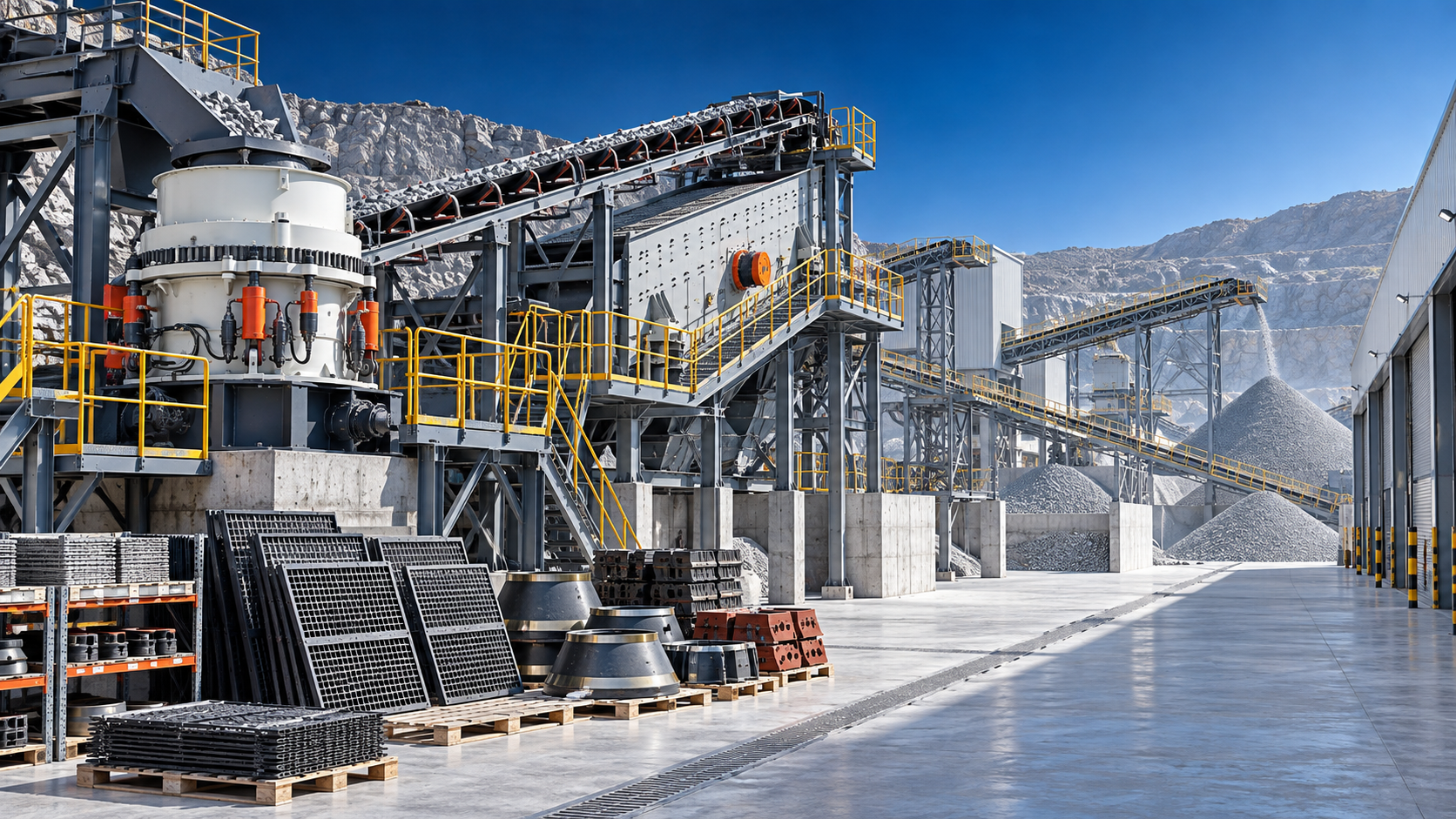
Every crushing and screening plant has consumables. The issue is not whether parts will wear; they will. The question is whether the buyer understands the likely wear points and has a sensible replenishment plan. For crushers, this may include liners, mantles, concaves, jaw plates, impact components, seals, bearings, and hydraulic-system items. For screens, media selection is just as important as the machine itself. Polyurethane screen meshes, steel screens, and other screen-media choices affect wear life, open area, blinding behavior, and the quality of final separation.
Request a recommended commissioning and operating spares list, separated into three categories: parts needed before startup, fast-moving wear parts, and critical components whose failure would shut down production. Do not accept a vague statement that “parts are available.” Ask where they are manufactured, whether drawings or part numbers are controlled, what lead time applies to routine versus critical items, and whether compatible parts can be supplied for the exact equipment configuration.
- Which components have the highest expected wear under our material conditions?
- Which parts should be stocked on site before the plant begins commercial operation?
- Can the supplier provide an itemized parts list with material descriptions and replacement guidance?
- Are screen meshes, crusher wear parts, and conveyor components produced or sourced within a controlled supply chain?
- What information will the supplier need to identify an urgent replacement correctly?
This is where a manufacturer with both equipment and screen-media capability may offer a practical advantage: the crusher and screen should not be specified in isolation. If the screen deck is poorly matched to the expected particle distribution, the crusher may carry unnecessary recirculating load. A lower initial price on one item can become expensive if the line has to work around a mismatch.
Service response is more than a promise of after-sales support
“After-sales service” is easy to put in a brochure. Procurement teams should turn it into operational questions. Who will handle installation guidance? Is remote troubleshooting available? What documents will be supplied with the equipment? Can the supplier support commissioning when a complete production line is involved? If site service is required, what is the escalation route and what costs are included or excluded?
For international projects, clarify language, time-zone coverage, shipping responsibility, customs documentation, and the availability of electrical or control-system support. A mechanical issue may be straightforward, but an unlabelled cable, a missing wiring diagram, or an incorrect sensor setting can delay startup just as effectively as a broken part. Service documentation should include maintenance intervals, lubrication requirements, installation drawings, operating instructions, and a clear serial-number or identification system.
It is also reasonable to ask how the supplier organizes its engineering and manufacturing resources. A group that combines mining machinery production, screen-mesh manufacturing, export coordination, and whole-line project support may reduce handoffs between separate vendors. That does not remove the need for due diligence, but it can make responsibility clearer when a problem spans crushing, screening, conveying, and spares logistics.
Evaluate uptime through maintenance access
Downtime is often caused by maintenance taking longer than expected, not by the failure itself. During technical review, ask to see where operators will access grease points, inspect belts, change screen media, remove crusher liners, and clean material buildup. A machine can be mechanically sound yet difficult to maintain safely in a confined layout.
Look at the equipment as the maintenance crew will see it on a wet day, not as it appears in a clean factory photo. Is there enough room to open inspection doors? Are platforms and handrails included where they are needed? Can lifting equipment reach heavy wear components? Will conveyors allow belt tracking and idler replacement without dismantling surrounding structures? These are modest design details, but they can decide whether a scheduled job takes hours or turns into an extended stoppage.
For cone crushing applications, buyers should also ask whether the equipment is intended to support both reduction and shaping targets, and how the supplier recommends setting it up for the actual feed. A product such as OEM Multi Function Hydraulic Cone Crusher Realizing Crushing And Shaping For Stone Materials Machine should be assessed not only by its hydraulic features, but by liner selection, chamber suitability, access for maintenance, control compatibility, and the expected relationship with the downstream screen.
Compare total ownership cost, not only the delivered price
A lower purchase price can be justified if the equipment is simple, well-supported, and suitable for the duty. But it is not automatically the lower-cost option. Compare quotations using the same scope: main equipment, motors, drives, electrical controls, structural steel, screen media, commissioning support, spare parts, freight terms, packaging, and documentation. Missing scope often reappears later as a change order or an unplanned local purchase.
It is useful to build a short internal comparison sheet that records more than price. Include warranty boundaries, recommended spares, estimated delivery sequence, service contacts, exclusions, and the information still awaiting clarification. This forces technical and commercial teams to discuss the same assumptions before the purchase order is issued.
A supplier with established manufacturing capacity, engineering personnel, and export experience can be worth considering when the project requires coordinated equipment rather than a single replacement machine. Still, the buyer should verify the proposed scope, drawings, and service commitments for the specific order. Factory scale is reassuring; disciplined project communication is what protects the schedule.
The final question: what happens on the first bad day?
Before selecting Mining Equipment, imagine a blocked chute, an unexpectedly abrasive feed, a failed screen panel, or a crusher component that needs replacement during peak production. Who takes the call? Which part is already on site? What drawings and manuals are available? Can the plant continue at reduced capacity, or does one issue stop everything?
The best purchasing decision is rarely the one with the most impressive specification sheet. It is the one supported by a realistic parts plan, maintainable layout, clear service responsibility, and a supplier willing to discuss the inconvenient details before the equipment ships.
Leave A Message
If you are interested in our products and want to know more details, please leave a message here, we will reply you as soon as we can.