Belt Angle, Cleats, and Material Size in Inclined Aggregate Conveying
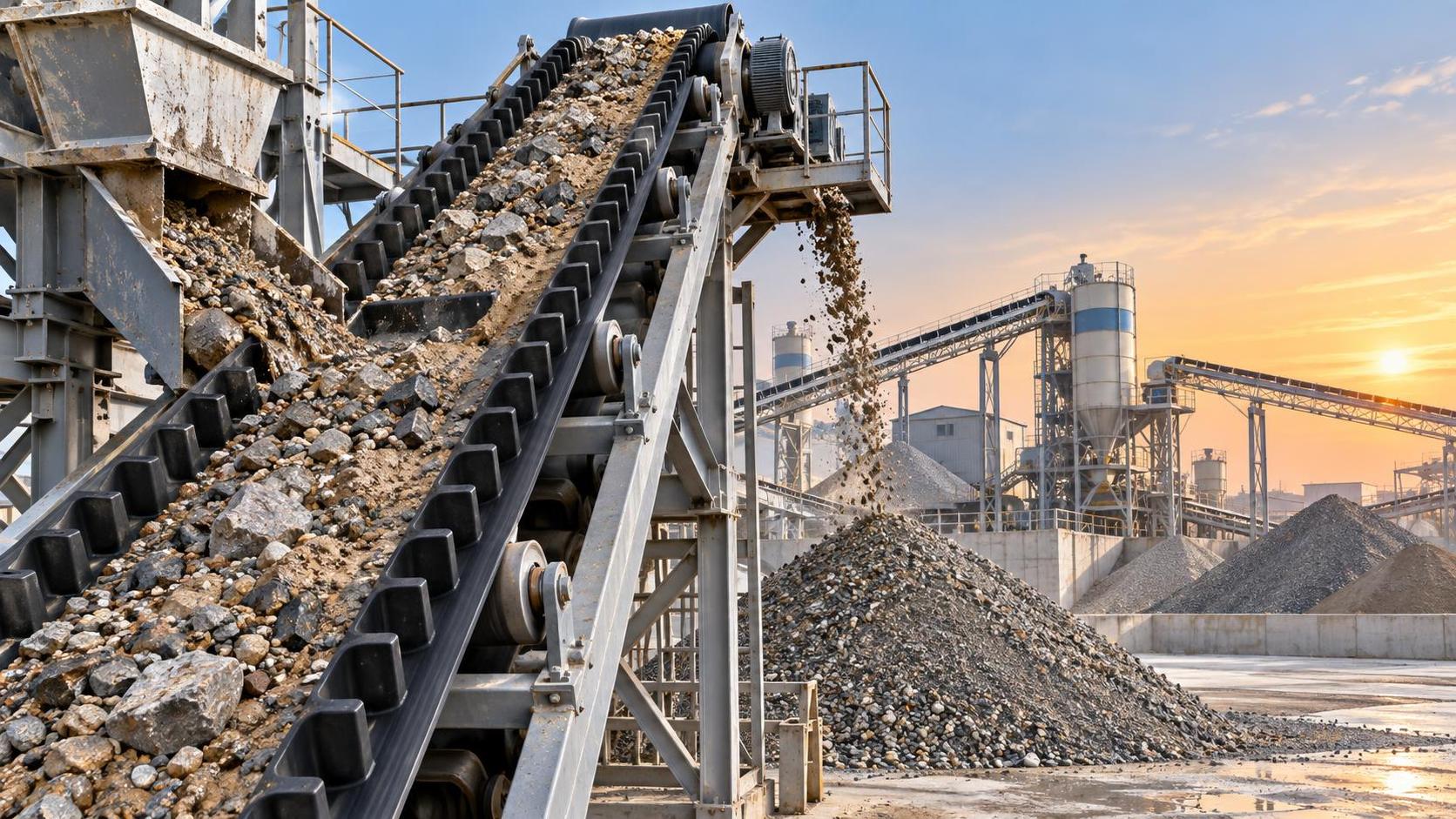
An inclined conveyor succeeds when the belt retains the load as a stable bed from the feed point to the discharge point. Belt angle, cleat geometry, and material size must be assessed together because a change in one often changes the acceptable range of the others. A belt that conveys dry, graded crushed stone smoothly at one angle can experience rollback, segregation, or side spillage after the feed becomes wetter, finer, or more irregular.
For an inclined belt conveyor for aggregate plant, the first practical question is not simply how steep the route must be. It is whether the material remains supported by belt friction throughout acceleration, travel, and discharge. The answer is shaped by particle shape, moisture, fines content, feed depth, belt surface, and the way material enters the conveyor.
Read Belt Angle as a Material-Retention Limit
A higher incline reduces the horizontal footprint of the conveyor, but it increases the downslope component of the load. At a mild incline, a conventional rough-top or patterned belt may retain well-graded aggregate without special cleats. As the angle rises, individual stones begin to slide relative to the belt, especially where rounded particles or damp fines create a low-friction layer beneath coarser material.
The belt angle also affects the material profile. A shallow conveying angle can carry a broad, low bed. A steeper angle tends to pull the load toward the tailing side of each cleat or toward the lower edge of the belt surface. If the feed chute deposits material unevenly, this profile becomes unstable and produces intermittent surges at discharge.
Do not judge the allowable incline from the largest stone alone. Large angular particles may appear secure while fine sand, wet screening by-product, or clay-contaminated fines migrate downhill between them. This movement reduces the effective friction of the whole burden. A conveyor can therefore show a clean belt surface near the edges while losing material internally through a gradual backward slip of the fine fraction.
Conditions That Shift the Decision
- Dry, angular crushed aggregate tends to interlock and resists sliding better than rounded gravel, although sharp oversize pieces can damage a belt cover or catch on cleat roots.
- Wet fines and sticky material alter the contact layer against the belt. The problem may appear as smearing, material carryback, or sudden rollback after a feed-rate increase.
- Wide size distribution creates voids and segregation. Small particles settle below larger stone, while larger particles may roll or bridge at the chute and discharge.
- Variable feed matters as much as average capacity. A belt that holds a thin, even burden can lose stability when a feeder releases a short, deep surge.
Steepening the belt without revisiting the loading zone is a common source of rework. A load centered at the conveyor inlet may shift toward one side after it settles into the troughed belt. Misalignment, skirt leakage, and uneven idler loading can then be mistaken for a tracking problem when the original cause is unstable loading on an incline.
Cleats Must Support the Burden Without Becoming Traps
Cleats divide the belt into carrying pockets. Their purpose is to resist downhill movement of the burden, not merely to make the belt look suitable for steep conveying. Cleat height, spacing, shape, flexibility, and attachment strength must correspond to the depth and character of the material layer.
Low cleats can control a shallow bed of small aggregate where belt friction is nearly adequate but occasional slip must be prevented. Higher cleats provide more retaining force, yet they also increase impact exposure at the loading zone and can create material buildup at their leading faces. For coarse, sharp aggregate, excessively tall or rigid cleats may be struck repeatedly by falling stone. This can loosen attachments, split rubber around the cleat base, or create local belt distortion.
Spacing is often misread as a simple capacity setting. Wider cleat spacing forms larger pockets, but the material can surge within those pockets when feeding is inconsistent. Very close spacing increases the number of cleats passing beneath the loading point and may reduce the effective open area for larger particles. The preferred spacing gives the burden room to settle without allowing large pieces to roll backward between cleats.
A cleat should not be selected independently from the belt profile. On a flat belt, the cleat retains nearly the full width of the load. On a troughed belt, material collects near the center, and the side portions of the cleat may carry little load. Sidewalls can be necessary when fine or rounded material migrates toward the belt edge, but they also require careful transition design. Sidewalls that are compressed, folded, or pulled sideways through an unsuitable transition can wear rapidly and cause scattered spillage.
Material Size Is About Shape, Range, and Feed Formation
Nominal top size is necessary for equipment selection, but it does not fully describe inclined conveying behavior. A flat slab-shaped stone and a nearly cubic stone of similar nominal size behave differently on a moving cleated belt. Elongated particles can orient across a cleat pocket and bridge. Rounded particles tend to roll. Fine material can compact below coarse fragments and hold water, creating a mobile layer during belt acceleration.
When oversize enters a conveyor designed around a narrower gradation, the immediate symptom may be a torn cleat, but the larger issue is often feed formation. An oversize piece arriving at high velocity can bounce rather than settle. It may strike multiple cleats, rotate toward a skirtboard, or sit proud of the material bed and fall at the discharge transition. A lower feed height, controlled feeder rate, and a chute that directs material in the belt travel direction reduce these effects more reliably than simply adding heavier cleats.
Fine material raises a different concern. With dry manufactured sand or clean screenings, the belt may carry a stable layer at an incline that would be unsuitable once water is introduced upstream. After washing, drainage time and dewatering performance influence the conveyor as directly as belt texture. Where a spiral washer feeds an inclined transfer belt, the retained moisture and fines load should be considered with the washer discharge condition rather than treated as a generic sand specification. Equipment such as OEM Heavy Duty Spiral Sand Washer for Feldspar Processing with Reinforced Blades Reducer Drive and Oil Lubrication System Machine illustrates why the downstream conveyor must be matched to the physical condition of the discharged material.
Feed and Discharge Often Decide Whether the Design Works
Even a suitable belt and cleat arrangement will struggle if material falls vertically onto a steep moving belt. The impact zone should allow the load to accelerate toward belt speed before it reaches the main incline. Material entering too slowly relative to belt speed is dragged upslope by the cleats; material entering too fast can bounce, spread sideways, and overload skirt seals. Both situations increase belt wear and produce a fluctuating burden.
At discharge, the head pulley and trajectory must release material cleanly. Fine wet aggregate may adhere to the belt behind the discharge point, while coarse material can rebound from chute liners if the receiving chute is too close or incorrectly positioned. Carryback is not always a scraper-setting issue. It may indicate packed material at cleats, excessive moisture, unsuitable belt cover texture, or insufficient discharge clearance.
Inspection should focus on recurring patterns rather than isolated spills. Material collecting below the lower return side suggests rollback or leakage from the loading zone. Repeated buildup behind each cleat points toward wet fines or insufficient cleaning. Damage concentrated on only a few cleats often indicates oversize impact or a feeder surge. These distinctions prevent a belt-tracking adjustment from being used to mask a material-handling problem.
The most reliable arrangement is the one that maintains a consistent burden under the actual feed range, keeps material contained through the transition sections, and releases it without persistent carryback. Belt angle establishes the gravity challenge; cleats provide retention; material size and condition determine how much of that retention is truly available.
Leave A Message
If you are interested in our products and want to know more details, please leave a message here, we will reply you as soon as we can.