What Is a Vertical Shaft Impact Crusher and Where Does It Perform Best?
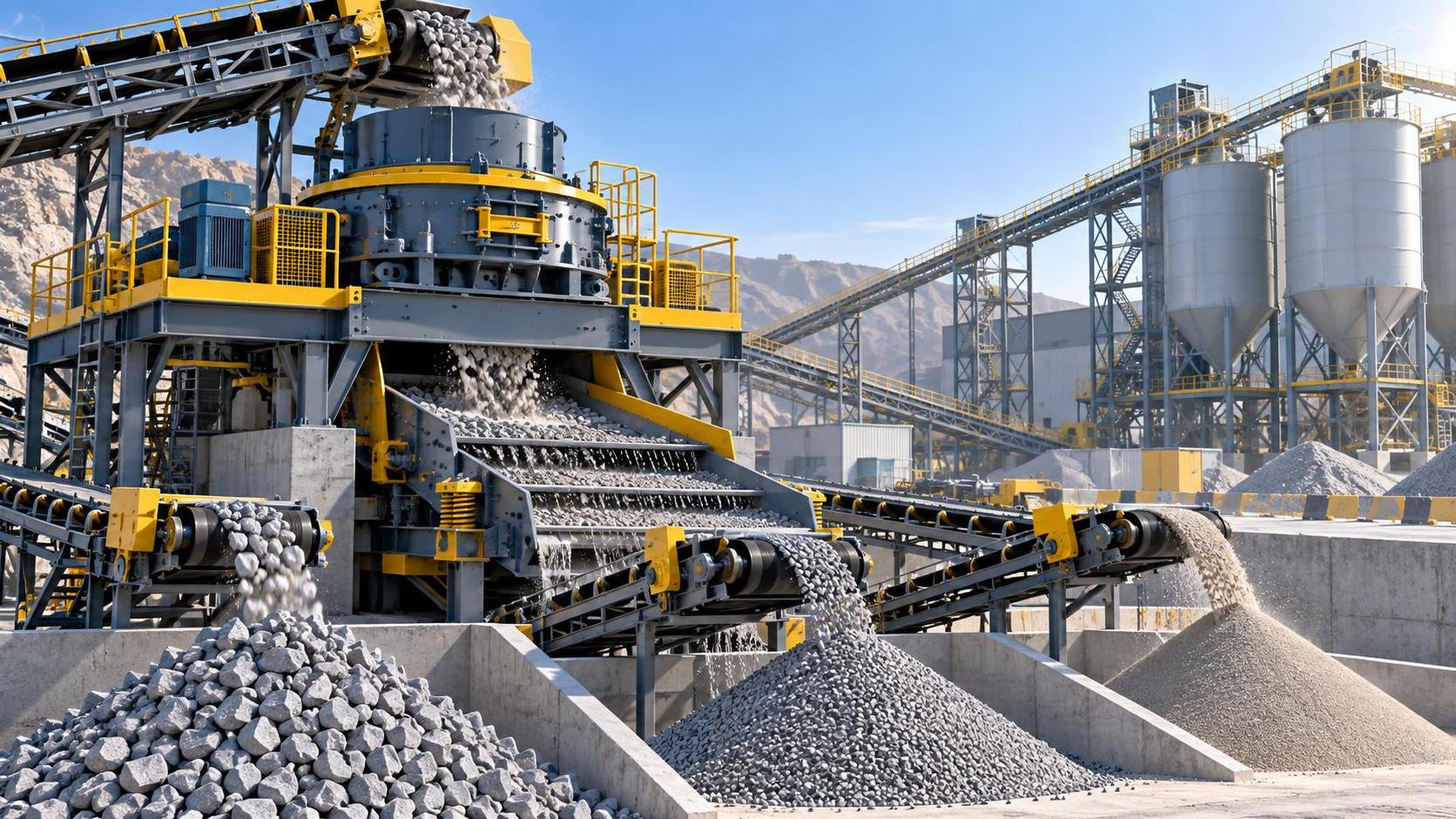
A Vertical Shaft Impact Crusher (VSI crusher) is a crushing machine that accelerates rock, gravel, or recycled aggregate inside a high-speed rotor and breaks it through impact. Its main value is not simply reducing particle size. It is producing material with a more cubical shape, controlled fines content, and a grading profile suitable for manufactured sand or premium aggregate applications.
That distinction matters in a crushing plant. A jaw crusher or cone crusher is usually selected for primary or secondary size reduction and throughput. A VSI crusher is most often placed at the final crushing stage, where the quality of the finished aggregate becomes more important than the reduction ratio alone. It performs best when a project needs well-shaped aggregate, consistent sand gradation, or improved particle geometry for concrete, asphalt, road base, and similar specifications.
How a VSI Crusher Breaks Material
The defining feature of a Vertical Shaft Impact Crusher is its vertically oriented rotor. Feed material enters the top of the machine and falls into the rotor, where it is accelerated at high speed. The rotor then discharges the particles outward into the crushing chamber.
Two crushing arrangements are common:
- Rock-on-rock crushing: Material thrown from the rotor strikes a bed of other material inside the chamber. This configuration is widely used for manufactured sand and shaping aggregate because it reduces direct contact between the feed and metal impact surfaces.
- Rock-on-anvil crushing: Accelerated material strikes fixed anvils or impact plates. This arrangement can provide stronger reduction for some materials, but wear on the anvils may be more significant, especially with abrasive feed.
In both cases, particles fracture along natural weaknesses. Rather than being mainly compressed between two surfaces, as in a cone crusher, the feed receives a high-energy impact. The result is generally a more angular but cubical particle shape, with fewer elongated or flaky pieces when the machine is correctly fed and operated.
The crushed material leaves the chamber through the lower section of the machine. In a complete plant, it is normally screened afterward. Oversize material can be returned to the VSI in a closed circuit, allowing the plant to tighten control over the final product size and limit unnecessary over-crushing.
Why Particle Shape Is the Central Advantage
Many aggregate projects encounter a problem that cannot be solved merely by installing a larger crusher: the material meets nominal size requirements but does not meet shape, gradation, or fines-quality requirements. Elongated particles can affect compaction, asphalt mix behavior, concrete workability, and the consistency of finished products. Natural sand shortages or restrictions on extraction can also create a need for manufactured sand with more predictable properties.
A VSI crusher addresses this quality stage. Its impact action can improve the shape of crushed stone coming from a cone crusher, particularly where the feed contains flaky particles. It can also produce fine aggregate from suitable rock feed, provided that the feed is properly graded and the moisture level is managed.
However, “better shape” should not be interpreted as a universal outcome. The final result depends on the feed material, rotor speed, chamber configuration, screen settings, recirculating load, and wear condition of the crushing components. A poorly balanced circuit can create excess fines, unstable gradation, or a product that varies significantly over a production shift.
Where It Performs Best
VSI crushers are strongest in applications where the required output is a quality-controlled final product rather than coarse crushed rock. Manufactured sand is the most recognized application. With competent rock feed and a properly designed screening circuit, a VSI can help generate sand with particle shape and size distribution more suitable for concrete production, mortar, precast products, and asphalt mixtures than material produced by compression crushing alone.
They are also commonly used for aggregate shaping. A plant producing 5–10 mm, 10–20 mm, or similar finished fractions may use a VSI after secondary or tertiary crushing to reduce flaky particles and refine the aggregate profile. This can be particularly important for road surfacing aggregate, high-specification concrete aggregate, and asphalt aggregate, where the relationship between shape, strength, cleanliness, and gradation affects downstream performance.
Another suitable application is recycling, although material preparation is critical. Clean recycled concrete aggregate, crushed asphalt, brick, or similar materials may be processed in an impact-based circuit when the objective is to create usable, consistently sized recycled aggregate. The feed must be screened and controlled before entering the rotor. Steel, wood, plastic, and other contaminants can damage equipment or cause unstable operation. A recycling line therefore depends as much on separation and feeding discipline as on the crusher itself.
For projects combining crushing, screening, and stockpile handling, downstream equipment has an equal influence on final quality. Conveyors should transfer material without excessive drop height or segregation, while screening equipment must match the expected feed rate and target cuts. In road-construction and aggregate-recycling systems, equipment such as an OEM Low Vibration Transmission Machine With Standard Configuration For Aggregate Recycling And Road Construction Material Supply Machine is relevant only when its conveying and transfer capacity are aligned with the crusher circuit. A high-quality VSI output can be lost if the material is mixed, segregated, or overloaded after crushing.
Feed Conditions That Determine VSI Results
The feed should already be within the machine’s allowable top-size range. A VSI is not normally the correct choice for handling large quarry-run rock directly from blasting. Oversize feed can cause severe rotor wear, blockages, vibration, and reduced throughput. Primary and secondary crushing stages must reduce the material before it reaches the VSI.
Feed consistency is equally important. Wide variation in feed size changes the impact conditions inside the chamber. Too much fine material entering the machine can reduce crushing efficiency and increase the proportion of dust or ultra-fines. Too much coarse material can lower capacity or overload the rotor. A controlled feed, normally supported by screening and a stable feeder, gives the VSI a far better chance of producing a consistent product.
Material properties also matter. Hardness, abrasiveness, moisture, clay content, and fracture characteristics all affect performance. Competent, clean rock is generally well suited to manufactured-sand production. Highly abrasive feed can still be processed, but wear-part consumption needs to be considered in operating cost calculations. Wet or clay-contaminated feed is more problematic because it can adhere to screens, restrict material flow, and make it difficult to control the final sand fraction.
For that reason, a VSI crusher should not be assessed by nameplate capacity alone. The useful question is how much saleable material the entire plant can produce at the required shape and gradation, with the expected feed condition and maintenance intervals. A machine that produces a high tonnage of unsuitable fines or poorly graded sand does not improve project economics.
Limits That Should Be Recognized Early
A VSI is often described as a sand-making machine, but it does not create quality sand from every source material. If the parent rock is weak, heavily weathered, contaminated, or rich in deleterious fines, impact crushing cannot correct those underlying material issues. Washing, classification, blending, or an alternative feed source may be required.
Wear is another operational consideration. Rotor tips, anvils, liners, feed tubes, and related components are exposed to high-velocity impact. Their service life varies according to feed abrasiveness, rotor speed, machine configuration, and operating discipline. Delayed replacement of worn components can reduce shaping performance, create imbalance, and increase the risk of unplanned stoppages.
Dust control must be integrated into the plant design. Fine crushing naturally generates airborne dust, especially with dry feed. Enclosures, extraction points, water-based suppression where appropriate, and suitable housekeeping arrangements are operational requirements rather than optional additions. Their design should also account for local environmental and worker-safety obligations.
A VSI is also sensitive to uneven feeding. Intermittent surges or one-sided feed distribution can affect rotor balance and product consistency. The feeder, conveyor arrangement, chute design, and automation logic should be treated as part of the crusher system, not as separate accessories.
Positioning the VSI in the Crushing Circuit
The most effective arrangement is usually a staged circuit. Large feed is reduced by primary crushing, often followed by cone crushing or another secondary stage. Screening removes material that is already within specification and directs only the required fraction to the VSI. The VSI then performs final reduction and shaping, followed by classification into finished aggregate or sand products.
Closed-circuit operation is particularly useful where tight gradation is required. Material that remains too large after the VSI returns through the screen to the crusher, while correctly sized material exits the circuit. This arrangement improves control, but it must be designed carefully: excessive recirculating load can consume power, accelerate wear, and reduce net plant output.
The decision to use a Vertical Shaft Impact Crusher is therefore justified when final-product quality is the constraint. It is a strong choice for manufactured sand, aggregate shaping, selected recycling applications, and projects where cubical particle form has practical value. It is less suitable as a replacement for primary crushing or as a cure for poor feed quality. The best results come from matching the VSI to a stable, pre-sized feed and designing the screening, conveying, dust-control, and maintenance systems around the finished material specification.
Leave A Message
If you are interested in our products and want to know more details, please leave a message here, we will reply you as soon as we can.