Vibrating Screen Stroke, Frequency, and Incline: Their Effect on Throughput
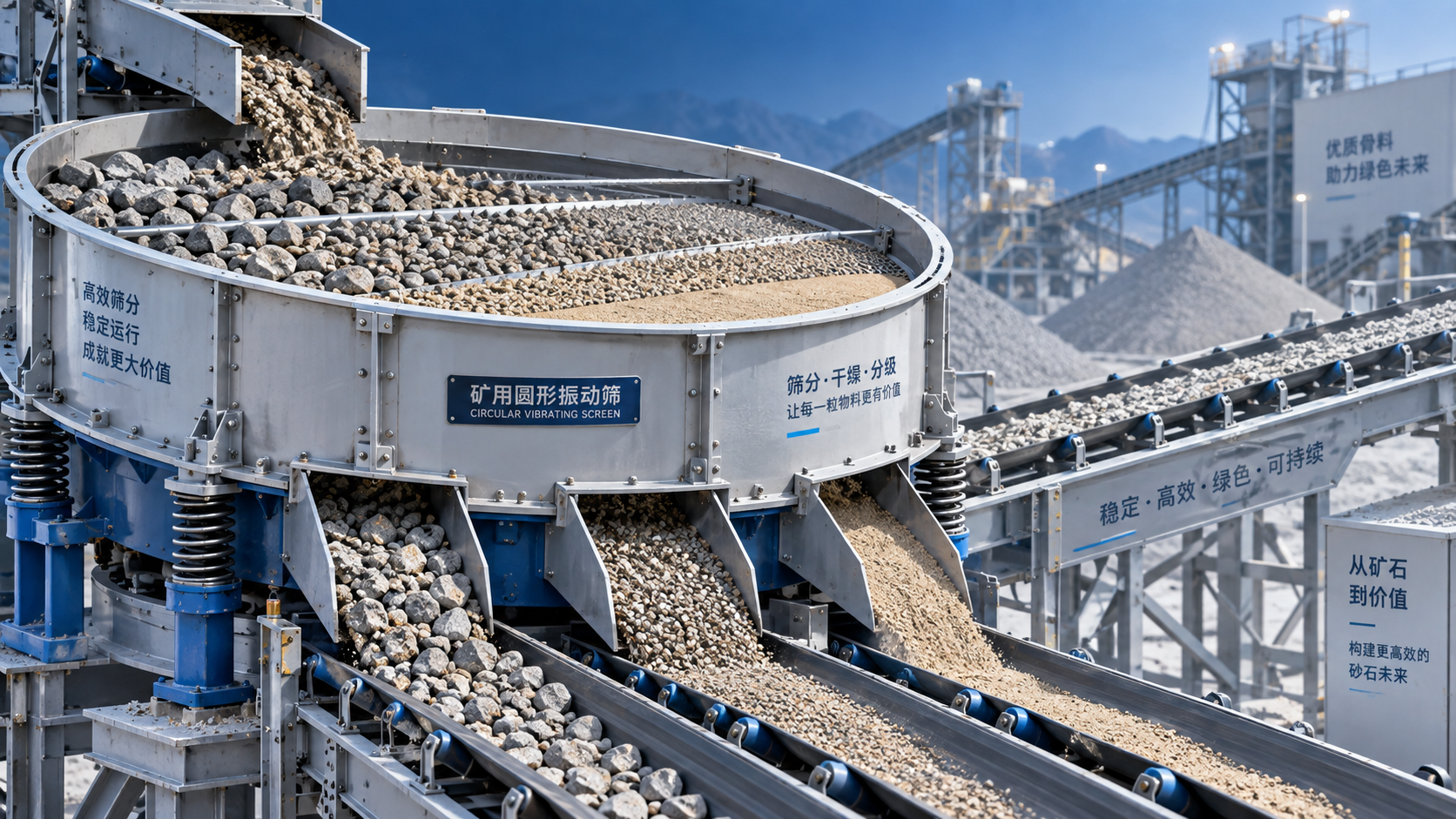
A screen can have the correct deck area and aperture yet still miss its production target because the material is not moving in the right way. In practice, the warning signs are familiar: a bed that piles up near the feed end, fines carried into the oversize stream, excessive material speed near discharge, or a machine that appears busy but delivers less usable throughput than expected.
The core judgment is that stroke, frequency, and incline must be set as a working combination rather than treated as independent capacity controls. Stroke determines the size of the vibrating movement, frequency determines how often that movement occurs, and incline helps define the material travel rate and residence time. A higher setting in one area does not automatically improve throughput; it can reduce separation quality if it moves material across the deck before stratification is complete.
How the three parameters shape material behavior
A Vibrating Screen separates material only when smaller particles gain repeated opportunities to reach the screen surface and pass through the apertures. This requires stratification: larger particles tend to rise, while fines move downward through the material bed. The vibration must also carry material forward at a controlled pace. Stroke, frequency, and deck angle govern both actions.
These settings should be judged by what happens on the deck, not by a single number. A coarse, dry crushed stone feed may need energetic transport and sufficient throw to prevent bridging. A fine sand fraction near the cut size may require a calmer travel rate, longer retention, and a bed that remains thin enough for particles to contact the mesh.
Stroke: more movement is not always more capacity
Stroke is the peak-to-peak displacement created by the screen’s vibrating mechanism. A larger stroke generally produces a stronger throwing action. This can be helpful when the feed contains larger stone, angular particles, sticky fines, or a deep material bed that resists separation. It helps open the bed and can improve the movement of near-size particles that otherwise remain trapped among larger pieces.
However, an oversized stroke may turn orderly conveyance into excessive particle bounce. Instead of settling and finding openings, particles can spend too much time airborne. Fine material may be carried forward with the oversize, particularly on the lower deck where the aperture is small and separation requires repeated screen contact. Large stroke can also increase impact loading on screen media, fastening systems, and the structure.
Short stroke has the opposite limitation. The material may creep rather than stratify, especially when the feed is damp or the bed is thick. The visible symptom is often a dense layer that moves as a mass. Openings may be available, but fines do not reach them efficiently. Before increasing stroke, check whether the feed rate is creating an overloaded deck; an excessively deep bed cannot be corrected solely by more vibration.
When a stroke change is justified
- Increase or consider a stronger stroke when coarse feed does not spread, material bridges over openings, or wet and angular particles remain tightly packed.
- Reduce stroke when fines visibly bounce across the deck, screen media show unnecessary impact wear, or product contamination rises after a previous increase.
- Review the drive configuration and manufacturer limits before any mechanical adjustment. Counterweight changes affect dynamic forces, not just material movement.
Frequency: acceleration and contact opportunities
Frequency is commonly described as vibration cycles per minute. At a given stroke, increasing frequency raises the number of acceleration events applied to the material. This can improve bed loosening and help particles encounter apertures more often. Yet frequency cannot be evaluated separately from stroke. A short, rapid motion behaves differently from a long, slower throw even when both settings appear energetic.
Fine screening often benefits from enough frequency to keep the upper layer active and prevent surface blinding from becoming persistent. But the goal is controlled stratification, not maximum vibration. When frequency is excessive for the material and deck angle, the feed can travel too quickly or become overly fluidized. In that condition, undersize particles may not remain on the deck long enough to pass, and near-size material is more likely to report to the wrong stream.
A useful evaluation method is to observe the material along the full deck length. At the feed end, the bed should spread and begin to loosen. Through the central area, the fines should be actively working downward. Near discharge, the remaining oversize should be relatively clean rather than carrying a visibly high fine fraction. If most separation appears to happen only at the first section of deck, or if fines are still present at the discharge end, the operating balance requires review.
Incline controls residence time more directly than many operators expect
Deck incline adds gravitational transport to the conveying action created by vibration. A steeper angle generally moves material toward discharge faster. This can raise apparent capacity because the deck clears quickly, but it may reduce screening efficiency when the retained material has insufficient time to stratify and pass through the aperture.
A flatter angle usually extends residence time. This can help when processing fine aggregates, near-size fractions, or material requiring careful separation. The trade-off is that a flat deck can hold material too long, creating a deeper bed and increasing the chance of localized buildup. At the extreme, capacity falls because the screen no longer evacuates material efficiently.
Incline should therefore be selected from the required cut and feed characteristics, then confirmed through operating observations. Coarser scalping duties commonly tolerate faster travel. Final sizing decks, especially those working with fine sand or narrow aggregate gradations, often need more controlled residence time. Moisture, clay contamination, screen-media open area, and feed distribution can shift that balance significantly.
Diagnosing throughput loss without chasing the wrong setting
When throughput drops, changing all three parameters at once makes the result impossible to interpret. Start with the deck condition and feed presentation. A screen receiving material mainly on one side or in one concentrated zone loses effective area regardless of its vibration settings. Uneven feed also causes one section to overload while another section is underused.
- Confirm the duty: compare actual feed size distribution, moisture condition, and desired cut size with the intended operating duty. A change in quarry face, crusher setting, or recycled-material content can alter screen behavior.
- Inspect the screen media: look for blinding, pegging, worn apertures, loose tension, damaged panels, or reduced open area. These conditions often resemble a vibration-parameter problem.
- Observe travel and bed depth: watch the material at feed, middle, and discharge. Note whether the bed is compacted, airborne, uneven, or moving too rapidly.
- Make one controlled adjustment: change the parameter most closely linked to the observed symptom, then allow stable operating conditions before judging the result.
- Verify both capacity and product split: more tonnage is not an improvement if the undersize and oversize streams no longer meet the required gradation.
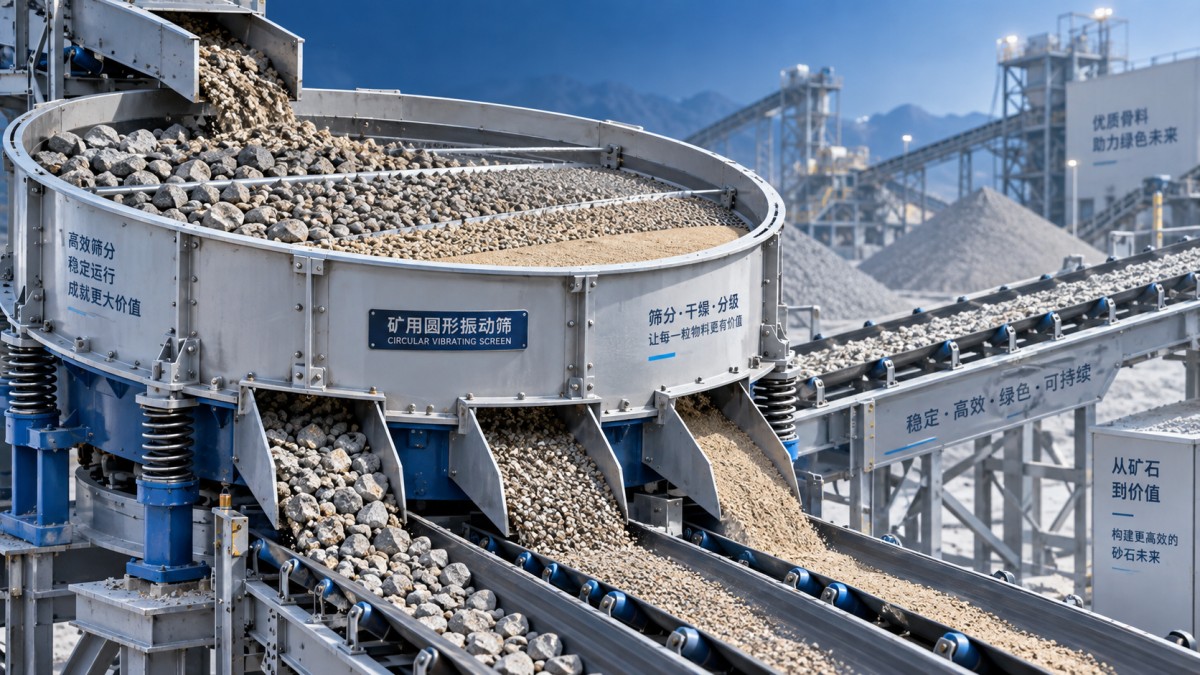
For new installations or replacement planning, the machine should be evaluated together with screen media, feed box design, deck arrangement, and conveyor capacity. A circular unit such as the Mining Grade Circular Vibrating Screening Machine for Stone and Sand Processing may be considered where stone and sand duties require a screening machine matched to the broader process layout. Its final configuration should still be based on feed analysis, required product sizes, and the intended operating range rather than nominal capacity alone.
Matching parameter priorities to material conditions
Dry coarse stone usually places priority on transport, bed opening, and resistance to impact. Stroke may have a strong influence because larger particles need enough movement to spread over the deck and avoid building up around the feed area. Fine dry aggregate places more emphasis on contact time and stable stratification. A rapid travel rate can look productive while allowing fine material to bypass the screening opportunity.
Damp material requires a different diagnosis. Moisture can cause particles to adhere to each other or blind apertures, reducing effective open area. Increasing frequency or stroke may improve movement in some cases, but it will not solve severe media blinding caused by unsuitable aperture shape, excessive moisture, or clay-rich feed. Cleaning systems, appropriate polyurethane or wire media selection, and controlled feed loading may be more relevant than a major mechanical setting change.
Near-size material deserves particular caution. These particles are close to the aperture dimension and require repeated, well-oriented contact with the screen surface. They are the first fraction to be lost when incline is too steep, the bed is too deep, or vibration becomes excessively turbulent. Technical evaluation should focus on the proportion of near-size particles, because this fraction often determines whether a screen needs more area, a different media design, or revised operating parameters.
The best throughput setting is therefore not the one that produces the fastest material travel. It is the setting that keeps the deck adequately loaded, maintains stratification, clears the oversize efficiently, and delivers the required separation at a stable rate. Monitoring product quality alongside feed rate, deck condition, and visible material motion provides a more reliable basis for adjustment than changing stroke, frequency, or incline in isolation.
Leave A Message
If you are interested in our products and want to know more details, please leave a message here, we will reply you as soon as we can.