Key VSI Crusher Parameters That Affect Sand Gradation and Particle Shape
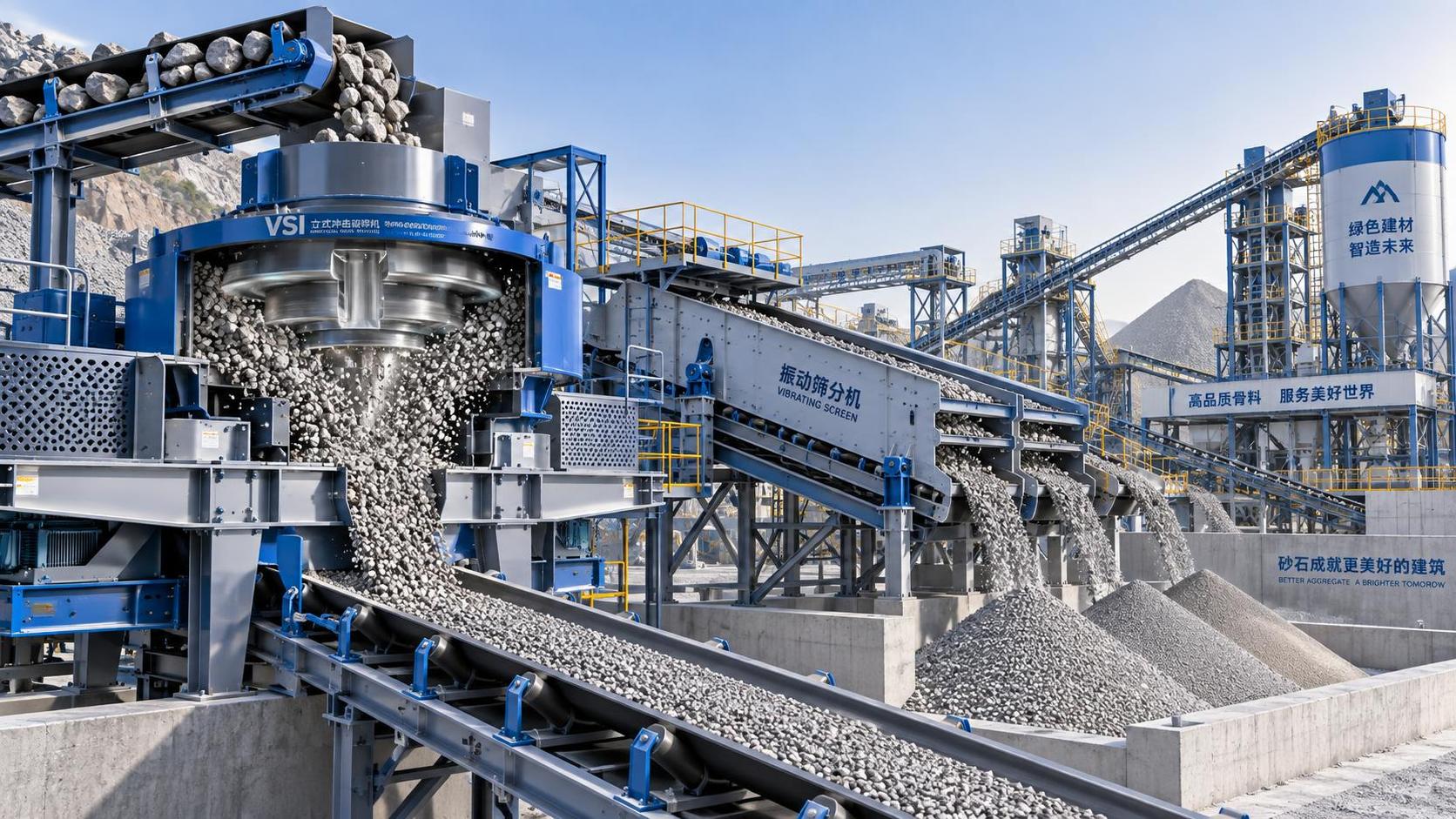
A Vertical Shaft Impact Crusher does not produce a fixed sand quality simply because it is operating within its rated capacity. Sand gradation and particle shape are the combined result of rotor energy, feed characteristics, crushing-path configuration, and the condition of the parts that receive impact. A machine can maintain high throughput while drifting outside the required particle-size envelope, generating excessive fines, flat particles, or unstable day-to-day results.
The most useful control principle is to treat the VSI as a shaping and grading stage within a complete process, not as an isolated machine. Quality control should compare crusher operating conditions with measured product gradation, particle-shape results, screen efficiency, and recirculating load. Safety control should treat abnormal vibration, changes in power draw, material buildup, and wear-pattern shifts as process warnings rather than merely maintenance issues.
Rotor speed sets impact energy, but not product quality by itself
Rotor tip speed is usually the most sensitive adjustable parameter in a Vertical Shaft Impact Crusher. Higher tip speed raises the kinetic energy transferred to feed particles. This generally increases breakage intensity, improves the removal of sharp edges, and can create a more cubical manufactured-sand particle. It can also increase the proportion of fine material and dust, especially when the feed already contains weak, flaky, weathered, or highly abrasive particles.
Operating at a higher speed is therefore not automatically a remedy for poor shape. If the sand becomes too fine while the coarse fraction remains poorly shaped, the underlying issue may be oversized feed, uneven feed distribution, inappropriate chamber configuration, or worn rotor components. Raising speed in that condition can increase wear and energy consumption without correcting the root cause.
Low rotor speed has its own quality risk. Insufficient impact energy leaves more elongated particles intact and may allow a wider, less controlled product gradation. The machine may appear stable, but the retained coarse particles can reduce the consistency of concrete sand or asphalt aggregate blends. Where shape specifications are demanding, rotor speed should be validated through controlled product sampling rather than judged by motor current alone.
A sound adjustment method is to change one speed setting at a time, stabilize the circuit, and compare samples taken under the same feed conditions. Gradation results should be assessed together with shape indicators used by the relevant project specification. Changes in speed also require inspection of vibration, bearing temperatures, lubrication condition, and rotor wear, because mechanical limits must override any attempt to improve sand quality through higher energy.
Feed size determines whether the rotor is shaping particles or absorbing overloads
The crusher’s maximum feed size is a mechanical limit, not a preferred routine feed condition. When a large proportion of material approaches that limit, the VSI spends more energy on primary breakage. Its shaping function becomes less predictable, and the result can be a broad gradation with intermittent coarse particles. Oversized pieces also increase the likelihood of impact concentrations, accelerated wear at the rotor and feed tube, and unstable vibration.
For consistent manufactured sand, the feed should be narrow enough that particles receive comparable impact energy. A poorly controlled upstream crushing stage is often visible in the VSI product as sudden shifts in coarse-to-fine balance, even where rotor speed has not changed. The correct response is not always to adjust the VSI. Check the upstream crusher closed-side setting, screen cut sizes, bypass streams, and the possibility that screen blinding or damaged media is allowing oversize material into the sand-making stage.
Feed moisture requires separate attention. Damp fines can adhere to larger particles, form deposits in the feed chute, and alter the effective feed distribution into the rotor. Sticky material may also build up in the crushing chamber, reducing free discharge and creating imbalance. The quality consequence is often erratic gradation rather than a consistent shift toward one size fraction. The safety consequence is more serious: accumulated material can produce abnormal vibration, unexpected blockages, and hazardous conditions during cleaning or inspection.
Uniform feed distribution protects both shape consistency and rotor balance
A VSI requires material to enter centrally and distribute evenly across the rotor passages. A centered feed does more than protect components. It helps ensure that particles receive similar acceleration and strike the intended impact surfaces under repeatable conditions. When the feed stream is offset, one section of the rotor may carry more material than another. This creates uneven wear, fluctuating load, and a product in which particle shape varies over time.
Distribution problems are frequently caused outside the crusher: feeder misalignment, segregated material on a belt, an incorrectly positioned chute, restricted feed-tube flow, or buildup at the inlet. Material segregation is particularly important when feed contains a wide range of sizes. Larger particles may roll to one side of the conveyor while fine fractions concentrate elsewhere, creating an unbalanced feed even if the average tonnage remains constant.
Routine inspection should include the feed tube, distributor plate or cone, chute liners, and visible rotor wear patterns. Uneven wear is not merely a parts-life issue; it is evidence that the impact path has changed. Continued operation after a pronounced imbalance can increase vibration and create a risk of rotor damage. Any inspection requiring access to the chamber must follow the site’s isolation, lockout, and stored-energy procedures. A stopped rotor is not sufficient evidence that all hazardous energy has been controlled.
Chamber configuration changes the balance between reduction and shaping
Most VSI machines can operate with rock-on-rock, rock-on-anvil, or a related hybrid arrangement. The selected configuration affects particle breakage mechanisms, wear rate, and the practical range of feed materials.
In rock-on-rock operation, particles accelerated by the rotor strike a material bed within the chamber. This configuration is generally associated with improved shaping because breakage occurs through repeated particle-to-particle collisions. It depends on maintaining a stable material bed. If feed rate falls too low, or chamber buildup is not maintained as intended, particles may strike hard surfaces more directly, changing both wear behavior and product gradation.
Rock-on-anvil operation directs material toward metallic impact surfaces. It can deliver strong reduction, particularly where harder or more competent feed requires additional breakage. However, it can also increase wear-part consumption and may create a different fine-content profile than rock-on-rock operation. The correct choice depends on the feed rock, the target gradation, available recirculating load, and the permitted wear cost—not on a universal preference for one configuration.
A common control error is to evaluate chamber configuration only by tonnes per hour. A configuration that improves instantaneous throughput but raises the proportion of unusable fines, increases particle elongation, or produces unstable screen loading may reduce overall plant yield. The useful measure is conforming sand output after screening, classification, and any required washing, not crusher discharge alone.
Wear parts gradually alter the crushing process before they fail visibly
Rotor tips, anvils, cavity liners, feed tubes, and distributor components define the material path. Their wear changes impact angles, exit trajectories, and the way a material bed forms in the chamber. As a result, gradation drift can occur even when speed, feed rate, and nominal feed size appear unchanged.
Wear should be monitored against the manufacturer’s documented limits and inspection intervals. Waiting for a part to break or wear through introduces more than a maintenance issue: it can permit hard metal fragments to enter the product stream, damage downstream screens or conveyors, and trigger sudden imbalance. A worn rotor set should also be assessed for symmetry. Replacing only one heavily worn component without considering the condition of matching components can disturb rotor balance.
Trend records are more useful than isolated inspections. Recording power draw, vibration readings where available, bearing temperature, throughput, rotor speed, and product sieve results allows gradual process drift to be identified before quality failure occurs. A sharp change in any of these values warrants investigation, especially if it coincides with a new feed source, liner change, screen-media replacement, or moisture change.
Screening performance can disguise a VSI setting problem—or create one
Final sand gradation is determined by the crusher and the classification circuit together. If screen apertures are blocked, worn, torn, or loaded beyond their effective capacity, the measured final product may suggest that the VSI is producing too much coarse material or too many fines when the real failure lies in separation. Similarly, excessive recirculation can force material through the VSI repeatedly, increasing fine content and unnecessary wear.
High-moisture sand and gravel streams are especially vulnerable to carryover and screen blinding. Where flexible polyurethane media is selected for such duty, its performance should be evaluated as part of the entire control loop: aperture accuracy, panel tension, open area, cleaning action, deck load, and the gradation of material returned to the crusher all affect the VSI feed. Equipment such as the FEIFAN OEM Self Cleaning Flexible Panel for High Moisture Sand and Gravel Polyurethane Vibrating Screen Panel is relevant only when the screening condition is contributing to unstable classification; it does not replace verification of crusher settings or feed control.
Quality limits should be tied to operating envelopes
The strongest operating practice is to establish a validated envelope rather than rely on one “correct” setting. That envelope links acceptable feed-size distribution, moisture condition, rotor speed range, feed-rate range, chamber arrangement, and wear-part condition to the required final sand specification. When one variable moves outside its accepted range, product testing should increase until conformity is confirmed.
This approach prevents a frequent mistake: correcting a gradation deviation with a single parameter change while the process has changed in several ways at once. If the product becomes finer after a speed increase, for example, the response should also examine whether the feed has become smaller, the screen cut has shifted, recirculation has risen, or worn components have altered the impact path. Reliable sand quality comes from controlling these interactions, while reliable operation depends on recognizing that the same interactions can signal developing mechanical and safety risk.
Leave A Message
If you are interested in our products and want to know more details, please leave a message here, we will reply you as soon as we can.