Which cone crusher cavity suits your feed size distribution?
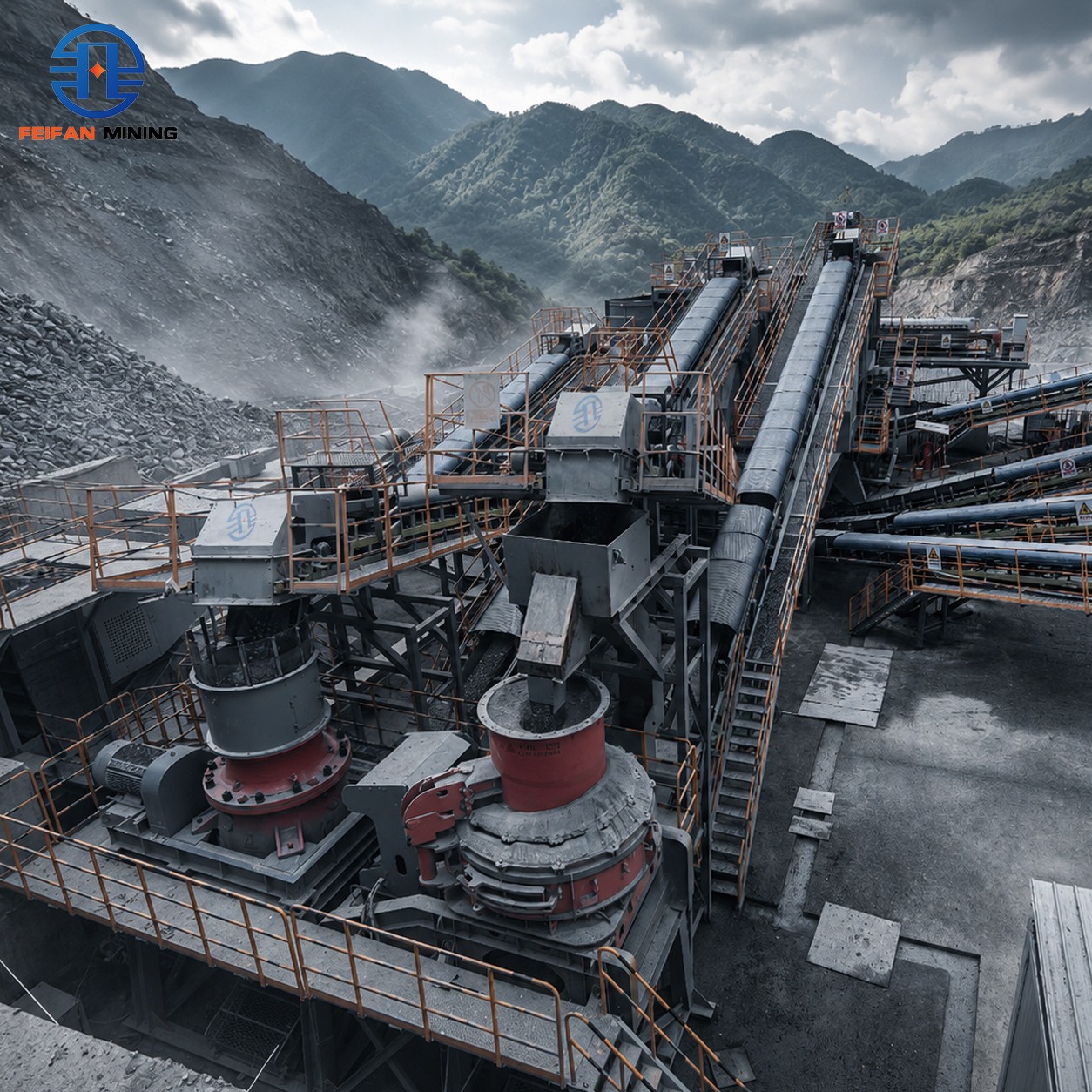
Choosing the right cone crusher cavity starts with your feed size distribution—not simply the largest rock entering the chamber. Two feed streams can share the same maximum size yet behave very differently: one may contain mostly large, consistent particles, while the other carries a substantial proportion of fines. Specifying the same chamber for both can lead to disappointing throughput, uneven liner wear, or unnecessary recirculation.
For procurement teams, the practical question is not “Which cavity is best?” It is “Which cavity will handle our actual feed and deliver the required product within the crusher’s operating limits?” Coarse, medium, and fine cavities provide a starting point, but the final selection must connect feed gradation, crusher model, discharge setting, and circuit design.
Read the feed curve before comparing cavity names
A maximum feed size tells you whether the largest particles may enter the chamber. It does not describe how the remaining material will fill and move through the crushing zone. A useful selection therefore begins with a representative sieve analysis taken at the proposed cone crusher inlet.
Ask your process team or supplier to establish:
- Maximum feed size: include occasional oversize, not just normal production.
- F80: the particle size through which 80% of the feed passes by mass.
- The complete grading curve: particularly the proportions of coarse particles, intermediate sizes, and fines.
- Material characteristics: rock type, hardness, abrasiveness, moisture, clay content, and bulk density.
- Operating variation: changes caused by quarry benches, upstream crusher settings, screen wear, or changing production requirements.
Sample across representative operating periods rather than relying on one convenient belt sample. In a closed circuit, the cone crusher receives fresh feed plus screen oversize returning for further crushing. The combined feed distribution is the relevant one; fresh-feed data alone can give a misleading picture.
Coarse, medium, or fine: what the labels actually mean
Cavity names describe relative chamber geometry within a manufacturer’s product range. They are not standardized across brands—or necessarily across models from the same supplier. A “medium” cavity on one crusher should not be treated as equivalent to a “medium” cavity on another.
A larger opening does not automatically make a coarse cavity the safest purchase. If the feed is predominantly too small for the selected chamber, crushing may become concentrated in a limited area rather than using the liner profile effectively. Conversely, feeding large particles into a fine cavity can restrict entry and increase the risk of bridging or unstable operation.
Request the manufacturer’s chamber drawing, feed-size guidance, and operating limits for the exact model and liner combination. Avoid selecting from a generic coarse/medium/fine chart alone.
Match the cavity and discharge setting together
The closed-side setting, or CSS, is the minimum discharge gap between the crushing surfaces during the crushing cycle. It influences product grading, capacity, and load, but it cannot compensate for an unsuitable chamber.
Tightening the CSS to obtain a smaller product can increase crushing duty and circulating load. It may also encounter power or mechanical limits before the desired production rate is reached. Opening the setting may relieve some restrictions, but can send more oversize back from the screen.
For every proposed cone crusher cavity, ask the supplier to state:
- The permitted CSS range for that chamber and material duty.
- Expected throughput and product grading at the proposed operating point.
- Assumptions about feed distribution, material properties, and feed arrangement.
- Expected motor loading and the operating limits used in the assessment.
Distinguish the crusher’s total discharge from the plant’s saleable output. In a closed circuit, a high crusher throughput may include substantial recirculating material. Procurement comparisons should focus on the required finished products, not an isolated capacity figure.
Three feed situations that change the decision
Mostly coarse material, with occasional larger pieces
A coarse cavity may be appropriate, but occasional oversize still needs a defined control method. Do not assume hydraulic protection makes oversized feed acceptable. Check whether the upstream crusher, scalping arrangement, or operating procedure can keep feed within the specified limits.
If a few large pieces are driving the purchase toward a larger crusher or chamber, compare that investment with correcting the upstream oversize problem.
A broad distribution containing substantial fines
Some smaller particles can contribute to a well-filled crushing chamber, but excessive fines may consume capacity without requiring useful additional reduction. Moisture and clay can make this situation more difficult by encouraging packing.
Assess whether screening out material already meeting the product requirement would improve the circuit. This is not an automatic recommendation to remove every fine particle: the decision depends on product requirements, screen performance, and the crusher manufacturer’s feed guidance.
Small, relatively uniform feed for final-stage crushing
A fine cavity is a logical candidate when the feed is suitably controlled. However, verify that upstream screening prevents oversize excursions and that the chamber can maintain the required throughput at the intended CSS.
If a quotation promises a small product at high capacity, ask for the underlying feed assumptions. A result based on dry, consistently graded stone may not represent a wet, variable quarry feed.
Check the feeding arrangement before blaming the liners
Even a suitable cavity can perform poorly when feed enters unevenly. Segregation at a conveyor discharge may send coarse particles to one side and fines to the other. Off-center feeding can create uneven chamber loading and uneven wear.
Review the feed hopper, distributor, transfer points, level control, and ability to maintain a stable chamber level within the manufacturer’s recommendations. Choke feeding is commonly desirable for cone crushing, but it means controlled chamber loading—not uncontrolled surging or an overflowing hopper.
Where premature liner wear is already a problem, inspect the worn profile and operating history before simply ordering a different cavity. Uneven feeding, unsuitable CSS, abrasive material, and incorrect liner selection can produce overlapping symptoms.
Turn the quotation into a comparable technical offer
A useful request for quotation includes the sieve analysis, normal and peak feed rates, material properties, required product fractions, operating hours, and circuit flow sheet. Ask each bidder to identify the proposed crusher model, cavity designation, mantle and concave combination, liner material, and recommended operating setting.
Then compare lifecycle consequences: liner cost per tonne of saleable product, replacement downtime, spare-parts availability, and the practicality of changing chambers if production requirements change. Treat wear-life estimates as conditional on the stated material and operating assumptions.
For integrated projects, the cavity should be assessed alongside upstream crushing, vibrating screens, conveyors, and recirculation. Shandong Feifan Mining Machinery Co., Ltd., part of the Binzhou-based group founded in 2009, manufactures this equipment and provides aggregate EPC solutions. Its group’s screen-manufacturing capability also allows screening requirements to be considered alongside crusher selection rather than as a separate purchase.
The right cone crusher cavity is the one supported by your feed curve and a credible circuit assessment. Before placing an order, require a clear explanation of feed acceptance, expected output, operating limits, and the response to feed variation. That gives procurement a more dependable basis for selection than either the smallest advertised product size or the largest quoted capacity.
Leave A Message
If you are interested in our products and want to know more details, please leave a message here, we will reply you as soon as we can.