Tracked or wheeled mobile crushing station for frequent relocation?
Frequent relocation can turn the wrong Mobile Crushing Station into a source of transport delays, repeated setup costs, and lost production. For project managers, the choice between tracked and wheeled equipment starts with one practical distinction: moving within a jobsite is not the same as transferring between separate projects.
Tracked units generally offer greater on-site mobility, while wheeled configurations may simplify transfers between prepared locations where towing arrangements and road regulations permit. Neither is automatically the better choice for a busy relocation schedule. The right answer depends on where the plant moves, how it gets there, and how quickly the complete production line can restart.
What does “frequent relocation” mean on your project?
A crusher following an advancing quarry face faces a different mobility problem from a contractor moving between highway construction sites. Both relocate frequently, but their transport requirements are almost opposite.
Before comparing equipment quotations, separate your expected movements into three categories:
- Short movements within one site: repositioning near a new excavation area, stockpile, or demolition zone.
- Transfers between nearby work areas: movement along private access roads or across a large construction corridor.
- Transfers between independent projects: road transport involving permits, transport vehicles, loading arrangements, and scheduled deliveries.
Record the likely frequency, distance, ground conditions, and available access for each category. A plant that moves several times within a quarry may benefit more from tracks than one transported much farther between projects every month.
Tracked versus wheeled: compare the relocation process
The distinction is not simply “tracks for difficult ground, wheels for roads.” Transport dimensions, machine weight, route restrictions, and site preparation can overturn an otherwise straightforward choice.
When tracked equipment earns its place
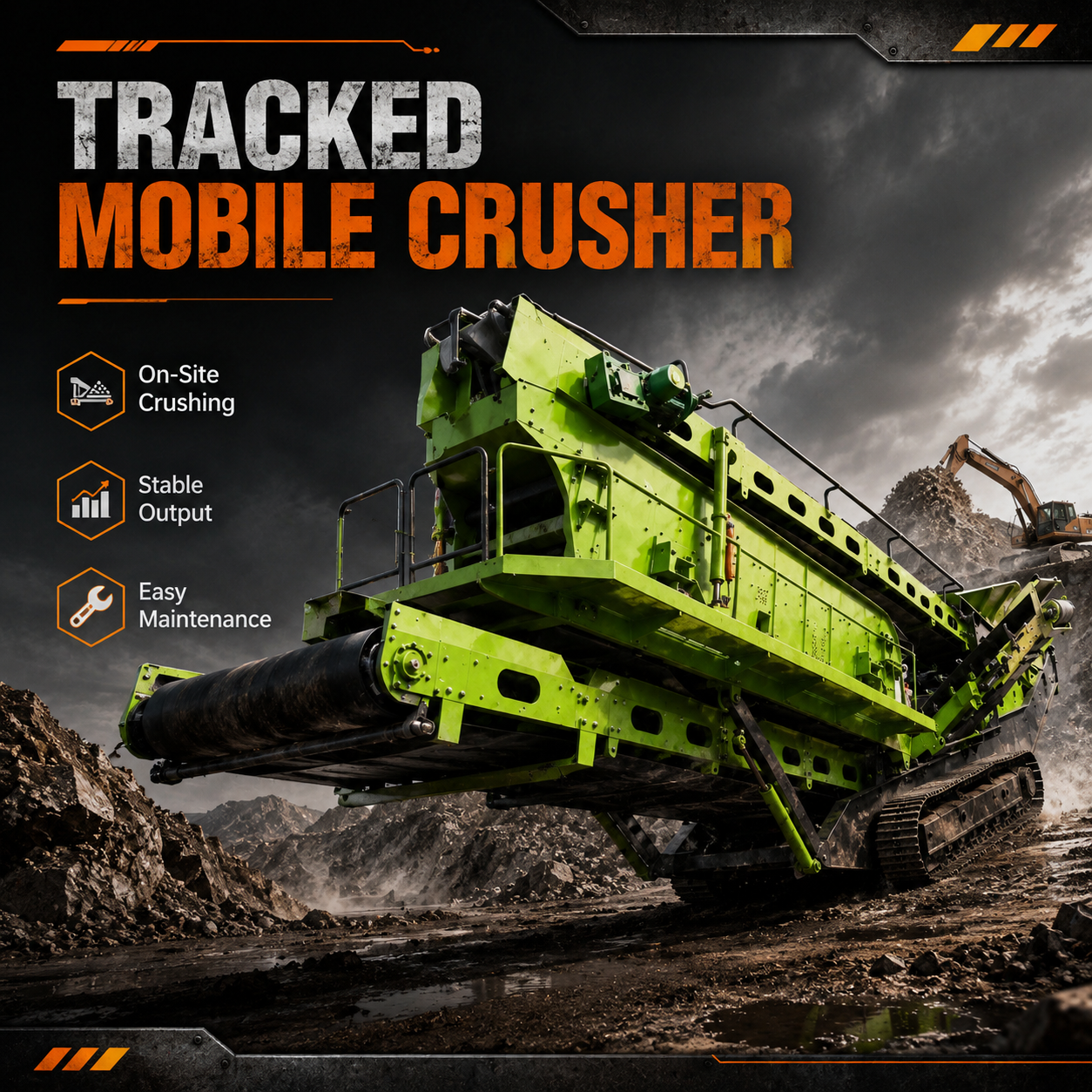
A tracked mobile crusher is often the stronger candidate when the feed location changes regularly. Keeping the crusher closer to the excavation or demolition area can reduce loader travel and avoid repeatedly hauling raw material to a distant processing point.
This matters when the cost of moving material exceeds the cost of repositioning the plant. On a large site, loader availability and haul distance can influence daily output as much as the crusher’s nominal capacity.
However, tracks do not make unsuitable ground safe. Soft fill, buried voids, steep gradients, and unstable edges still require assessment. Confirm permitted travel gradients, operating slopes, ground-bearing requirements, and travel procedures with the equipment supplier. A machine’s ability to travel across a surface does not mean it can safely crush there.
Also distinguish self-propelled travel from crushing operation. Do not assume a tracked crusher can process material while moving. Follow the manufacturer’s instructions for shutdown, conveyor stowage, travel, and restart.
When a wheeled configuration makes more sense
Wheeled equipment deserves close consideration when projects provide prepared working pads, reliable access roads, and longer production periods between moves. It can also suit contractors with compatible towing resources and predictable transport routes.
The potential advantage lies in the transfer arrangement—not in an assumption that every wheeled plant can be connected to a truck and immediately driven away.
Before choosing a wheeled Mobile Crushing Station, verify:
- Whether the proposed configuration is approved for public-road towing in the destination country.
- Its transport height, width, total mass, and axle loads.
- Required braking, lighting, coupling, and documentation arrangements.
- Whether conveyors, hoppers, or other components must be removed before transport.
- Whether the receiving site has enough turning space and firm ground for positioning.
Some wheeled units still require specialized transport. If that applies, compare their actual loading and setup requirements with those of tracked alternatives rather than relying on the chassis label.
Measure downtime from the last tonne to the next saleable tonne
A quick machine movement is useful, but it is not the same as a quick production restart. For scheduling purposes, relocation begins when saleable production stops and ends when the line consistently produces material within specification.
That interval can include clearing retained material, folding conveyors, disconnecting utilities, loading, transport, unloading, leveling, reconnecting, inspection, and trial production. Permit delays or unavailable transport vehicles can extend it further.
A practical comparison is:
Total relocation cost = transport and permit costs + handling and setup labor + support equipment + production downtime cost.
Use realistic lost contribution when valuing downtime, rather than treating all unproduced revenue as lost profit. Where stockpiles protect deliveries, the immediate commercial impact may be lower; where supply commitments depend on continuous production, schedule exposure may be much greater.
Ask suppliers for a relocation sequence covering the exact proposed configuration. “Fast setup” is only meaningful when it identifies the crew, lifting equipment, site preparation, and utility connections required.
Select the crushing circuit before deciding the chassis
Mobility cannot compensate for an unsuitable crushing process. Feed size, rock strength, abrasiveness, moisture, clay content, and required product grading should determine the crusher and screening arrangement.
A compact unit may be easy to relocate yet fail to deliver the required aggregate specification. Conversely, adding secondary crushing, screening, and recirculation may improve product control while increasing transport loads and setup tasks.
Evaluate the whole line: feeder, primary crusher, secondary stage where required, vibrating screen, return conveyors, stockpiling equipment, and dust-control arrangements. A tracked crusher paired with difficult-to-move ancillary equipment may offer less practical mobility than expected.
Power deserves the same attention. Diesel-hydraulic, diesel-electric, and externally powered configurations have different fuel, connection, maintenance, and operating implications. These are separate choices from tracks versus wheels; confirm the actual drive system instead of assuming it from the undercarriage.
Turn the site brief into a defensible purchase decision
For projects dominated by short, repeated moves over uneven working areas, start the evaluation with tracked equipment. For transfers between accessible, prepared sites, give wheeled equipment serious consideration, subject to verified transport compliance. Mixed projects need a full-cycle cost comparison rather than a universal rule.
Provide prospective suppliers with material test information, required throughput and grading, site layouts, relocation frequency, route constraints, and available towing or lifting resources. Request production and transport layouts together so that operating performance is not assessed separately from logistics.
Feifan’s group combines crusher, vibrating screen, conveyor, and screen-media manufacturing with aggregate EPC services. For a relocation-focused project, these capabilities are relevant to evaluating the complete processing arrangement—not simply choosing an undercarriage. Confirm the proposed equipment scope, interfaces, transport provisions, and service requirements during technical review.
The better Mobile Crushing Station is the one that reaches the next working position safely, restarts predictably, and produces the required aggregate with the least overall disruption. Choose around that complete cycle, not around mobility claims alone.
Leave A Message
If you are interested in our products and want to know more details, please leave a message here, we will reply you as soon as we can.